In short: in Honduras, the most reliable eSIM for coverage and operators is Tigo or Claro, with good 4G signal in Tegucigalpa, San Pedro Sula, and Roatán, and real gaps in La Mosquitia and rural mountain areas. Activate the eSIM before flying and only activate it upon landing: you arrive connected without roaming or physical SIM queues.
Coverage and operators in Honduras: what's really available
Honduras has three mobile operators with their own networks: Tigo Honduras, Claro Honduras, and Hondutel. The first two cover the vast majority of the country with 4G in cities and main road arteries; Hondutel is the state operator, with a more limited network and a focus on areas where the other two do not reach with the same strength. For a data eSIM, what matters is not which one "wins" on paper, but to which network the profile you purchase connects you, and whether that network covers the areas you will be traveling through.
PuraSIM's eSIM for Honduras relies on local operators with the best data coverage, so in practice, your experience will be similar to that of a Honduran with a Tigo or Claro line, not an emergency roaming with low priority.
| Operator | Main strength | Where it fails most | Network type |
|---|---|---|---|
| Tigo Honduras | More extended urban coverage, good presence on highways | Interior of La Mosquitia, some mountain areas | 4G, with 5G in punctual deployment in large cities |
| Claro Honduras | Good coverage in San Pedro Sula, northern zone and Sula Valley | Smaller Bay Islands, isolated rural sections | 4G |
| Hondutel | Presence in areas where the state operator invested in infrastructure | Generally more irregular data coverage | 3G/4G limited by area |
Where you'll have good signal and where you'll be out of luck
Coverage in Honduras is not uniform, and it's wise to plan with that in mind, not with a tourist map in your head.
Tegucigalpa and San Pedro Sula
In the two major cities, the 4G signal is stable in the city center, commercial areas, and most residential neighborhoods. In Tegucigalpa, the mountainous terrain of the capital does create occasional shadow zones in some hillside neighborhoods, so if you are staying in an elevated colonia and the signal fluctuates, it's not an eSIM fault: it's the topography.
Roatán, Utila, and the Bay Islands
Roatán has reasonable coverage in West Bay, West End, and Coxen Hole, which is where diving tourism is concentrated. In Utila, coverage is more discreet outside the town. If you are going diving or on excursions to smaller cays, assume you will be without data for a good while: download maps, reservations, and any documents you need offline beforehand.
Copán Ruinas and the archaeological zone
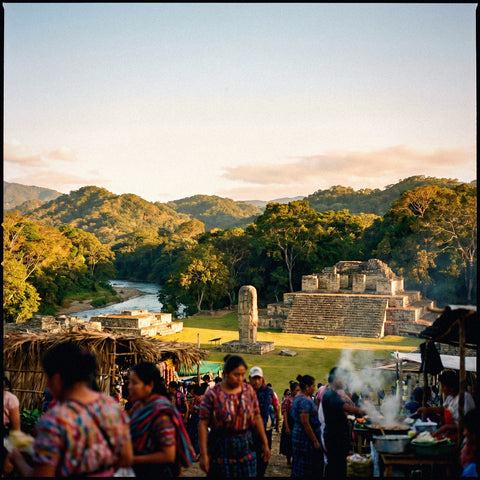
The town of Copán Ruinas has decent coverage for managing reservations, translating, or ordering a tuk-tuk. Inside the archaeological park itself, the signal degrades amidst the dense vegetation; this is not an operator problem, it's the jungle acting as a Faraday cage.
La Mosquitia and rural inland areas
Here's where we need to be honest: La Mosquitia is one of the regions with the least telecommunications infrastructure in Central America. If your trip includes sections through this area, expect long stretches with no coverage from any operator, yours or local. No eSIM on the market can fix this, because it's not a data profile problem but a lack of existing antennas.
What network your eSIM uses and why that matters more than "GB included"
When you buy data for travel, the number of gigabytes sounds important, but what truly determines your experience is which local network the profile connects you to. An eSIM that prioritizes Tigo in Tegucigalpa and Claro in San Pedro Sula will give you a better real-world experience than one that connects "to the available network" without preference, because in areas with mixed coverage, your phone can get stuck on the weakest operator in the area. If you notice that your speed consistently drops in a place where you should have a good signal, try turning airplane mode on and off: it forces a new network search and sometimes jumps to the correct operator.
How much data you need for Honduras
It depends on the type of trip; there's no magic number. If you're going to use GPS, messaging, and social media normally on a one or two-week trip through Tegucigalpa, Copán, and the islands, a mid-range plan will cover you comfortably. If your plan is to work remotely, make video calls, or constantly upload videos, upgrade to a larger plan or review your usage profile: our guide to tricks for saving data while traveling has specific adjustments (disabling automatic app updates, lowering streaming quality, limiting background backups) that stretch any plan much further than people realize.
How to activate your eSIM in Honduras without hassle
The process is the same as for any destination, but it's best to do it in the correct order to avoid burning through data from your Spanish plan prematurely:
- Purchase the eSIM before traveling and save the QR or installation code, preferably with screenshots rather than just in your email (in case you don't have Wi-Fi upon arrival).
- Install the profile using Wi-Fi, at home or at your departure airport. Installing is not the same as activating: the profile remains "dormant" until you activate it.
- Upon landing at Toncontín, Ramón Villeda Morales, or Roatán airport, activate the data line and disable roaming on your physical SIM to avoid duplicate charges.
- Check that the APN has been configured automatically (on most phones, it's automatic) and that the mobile data icon shows the new line active.
If this is your first time with an eSIM or your phone is a bit old, review our step-by-step guide on how to install an eSIM beforehand: it covers compatible models and typical installation failures (incompatible profile, incorrectly configured dual SIM) before they become a problem at the airport.
eSIM vs roaming vs physical SIM in Honduras
| Option | Management | When it makes sense |
|---|---|---|
| Roaming from your Spanish operator | Zero management, but cost skyrockets outside the EU | Only if you need to keep your number active for a specific emergency |
| Local physical SIM | Must find a point of sale, register, and sometimes wait in line | Long stays where the initial process is worthwhile |
| PuraSIM eSIM | Purchased and installed before flying, activated upon landing | Trips from days to a few weeks, without wanting to waste time at the airport |
If you're still unclear about the real difference between these options beyond price, our comparison of eSIM vs roaming and international chip vs eSIM go into the technical details of each.
Myths and what almost no one tells you about coverage in Honduras
"If I have 4G in Tegucigalpa, I'll have it throughout the country"
No. Honduras is a country with very distinct topography and dispersed population centers. Coverage follows main roads and cities; as soon as you leave these main arteries, especially towards the east and La Mosquitia, the signal easily disappears.
"Roatán is a small island, it must have coverage everywhere"
Coverage in Roatán is concentrated in the area where tourism and population are located: West End, West Bay, Coxen Hole, and French Harbour. The interior of the island, jungle areas, and some more isolated beaches to the east have intermittent or no signal.
"With plenty of data, I don't need to download anything offline"
Having GB is useless if you're in an area without antennas. The habit that truly saves your trip is downloading an offline Google Maps map of the Copán, Roatán, or La Mosquitia area before moving, and saving your accommodation addresses in text, not just in chat.
"Hotel Wi-Fi is more reliable than mobile data"
In many accommodations in rural areas and on the islands, Wi-Fi works worse than the mobile network, with shared and saturated connections during peak hours. In practice, mobile data with a good signal usually provides a more consistent experience than a small hotel's Wi-Fi.
"A portable charger has nothing to do with coverage"
It has more to do with it than it seems: in areas with weak signal, your phone searches for a network more aggressively and drains battery much faster. If you're going to be on the road for hours between Tegucigalpa and Copán, bring an external battery; you'll run out of coverage due to a dead battery before a lack of antennas.
When NOT to buy an eSIM for Honduras
It must be said with the same clarity: if your trip is a short layover of a few hours at San Pedro Sula or Tegucigalpa airport on your way to another destination, airport Wi-Fi is probably enough, and there's no need to buy anything. And if you already have a regional eSIM that covers Central America for a route that includes several countries (for example, if you are then going to Colombia, which is common on backpacking routes in the region, where you can consult our guide on eSIM for Colombia), first check if that eSIM already includes Honduras before buying a country-specific one: buying two profiles may not give you anything extra.
A note on privacy on public Wi-Fi networks
With decent mobile coverage in cities and Roatán, many travelers still end up using hotel or cafe Wi-Fi to save data. If you do, keep in mind that shared public networks are a common weak point for credential theft on open networks. Our guide on eSIM, VPN, and privacy when traveling explains how to combine both without complicating your life.
Frequently asked questions about eSIM in Honduras
Which operator provides the best coverage in Honduras, Tigo or Claro?
Both have a good presence in cities and main arteries. Tigo usually stands out a bit more in general urban coverage and presence on highways; Claro has particular strength in San Pedro Sula and the Sula Valley. In practice, the eSIM connects to the operator with the best available signal depending on the area, so you don't have to choose manually.
Does eSIM work in Roatán and the Bay Islands?
Yes, it works in the tourist centers of Roatán (West End, West Bay, Coxen Hole) and in Utila town. Outside these areas, on more isolated beaches or cays, coverage can be intermittent or nonexistent, so it's advisable to plan for this if you take excursions to small islands.
Is there data coverage at the Copán Ruins?
In Copán Ruinas town, coverage is reasonable. Within the archaeological site, amidst the vegetation, the signal weakens: this is a normal effect of tree density, not a line failure.
Can I use eSIM in La Mosquitia?
La Mosquitia is the region with the least telecommunications infrastructure in the country. If your route passes through there, prepare for long stretches without coverage from any local operator, whether yours or another. This is not something an eSIM can solve because there are not enough antennas in the area.
Do I need to manually change the APN in Honduras?
On most modern phones, the data profile automatically configures the APN upon activation. If you don't have data after activating, check in the eSIM line settings that the APN is selected; usually, restarting the phone once is enough.
Is eSIM or physical SIM better for a one-week trip to Honduras?
For a week, eSIM usually pays off compared to finding a physical SIM sales point, registering, and waiting in line right after landing. A physical SIM might be worthwhile for longer stays or if you need a local number for administrative procedures.
What do I do if my eSIM has no data upon landing?
First, check that you have activated the profile (not just installed it) and that data roaming is turned on within the settings of that line. If it still doesn't work, restart your phone and toggle airplane mode on/off: this forces a new network search and usually resolves the problem in seconds.