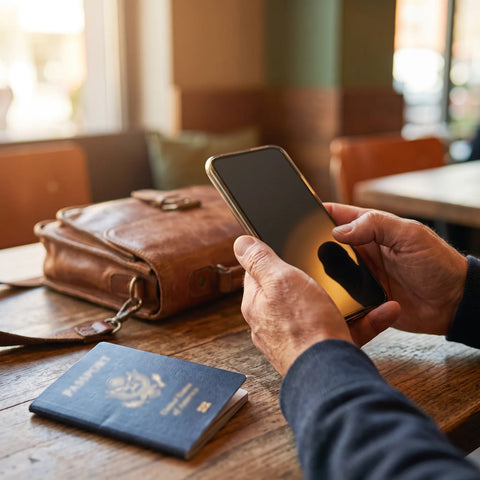
In short: the eSIM for the Dominican Republic gives you mobile data as soon as you land in Punta Cana, Santo Domingo, or Puerto Plata, without having to search for a local SIM card counter or activate roaming with your Spanish carrier. Claro, Altice, and Viva's 4G coverage is good in tourist areas and major cities; on rural roads and some isolated coastal stretches, the signal is weaker, so it's good to know before planning a road trip around the island.
Coverage in the Dominican Republic: what to expect by area
The Dominican Republic is not a small and uniform country as it is sometimes portrayed in guidebooks: there is a real difference between moving around the National District and getting lost on secondary roads in the interior. Before deciding how many GB to buy, it's worth understanding the coverage map by area.
In Punta Cana and Bávaro, the quintessential tourist area, 4G coverage is solid both at the airport and along the hotel strip. It is the best-connected part of the country, logical given the volume of visitors. Even so, within some very extensive resorts (there are some with hundreds of meters of gardens and several swimming pools) the signal can weaken in areas further away from the reception; there, the hotel's Wi-Fi usually saves you, and the eSIM comes into play as soon as you go out onto the street.
Santo Domingo, the capital, has consistent coverage throughout the National District, the Colonial Zone, and the main avenues. This is where the three operators perform best. If your trip combines a couple of nights in the capital before heading to the coast, you won't notice any significant interruptions.
In Santiago de los Caballeros, the country's second-largest city, urban coverage is good, although when heading towards the towns in the Central Mountain Range (Jarabacoa, Constanza) the signal starts to depend heavily on the topography: in closed valleys between mountains, you might lose 4G and be stuck on a slower network for stretches of the journey.
Puerto Plata and the north coast (Sosúa, Cabarete) maintain good coverage in the urban core and on beaches frequented by surfers and kitesurfers, who depend on the internet to check wind forecasts. Outside these strips, on roads that border the coast inland, it is common to find stretches with intermittent coverage.
Samaná deserves a special mention because it is where travelers ask the most questions: the city of Samaná and Las Terrenas have reasonable coverage, but if you are going to take the excursion to El Limón Waterfall or venture into the less accessible beaches of the peninsula (Playa Frontón, for example, which can only be reached by boat or on foot), assume that you will be without a good signal for much of the journey. This is not a failure of your eSIM: it is the topography of the peninsula.
If your route includes La Romana or Bayahíbe, coverage near the port and hotel areas is stable; if you go to the East National Park or take an excursion to Saona Island, keep in mind that on the water and on the island itself the signal almost completely disappears for most of the trip.
Mobile Operators in the Dominican Republic
The country has three main operators, and PuraSIM's eSIM automatically connects to the network with the best available signal at all times, without you having to manually select or worry about which one "works best" in each city.
| Operator | Presence | Technology | Strengths |
|---|---|---|---|
| Claro RD | National, most widespread | 4G / 4G+ | Best coverage in rural and inland areas |
| Altice (Orange) | Strong in cities and coast | 4G / 4G+ | Good performance in Santo Domingo and tourist hubs |
| Viva | Urban, less rural coverage | 4G | Additional option in urban centers |
The practical difference for you as a traveler is minimal because you don't manage the connection to a specific network yourself: the eSIM profile selects the best available. What does matter is understanding that if you move outside tourist areas (mountainous interior, undeveloped coasts), even Claro, which is the operator with the widest rural deployment, can have blind spots.
How much data do you need for your trip?
There's no magic number here: it depends on whether you'll be working remotely from the hotel, if you only need Google Maps and WhatsApp, or if you'll be constantly uploading videos to social media. As a usage guide, not a price guide:
- Short trip (one week, resort or city): with maps, messaging, social media in moderation, and some video calls, consumption is usually light-to-medium. If you also use the hotel's Wi-Fi for heavier tasks (uploading photos, streaming in the room), less data will be more than enough.
- Tour of several areas (Punta Cana + Santo Domingo + Samaná, for example): you will depend more on the eSIM because you are constantly changing Wi-Fi networks and using GPS navigation intensively on the road, so consumption will increase.
- Long stay or remote work: in this case, it is advisable to have plenty of GB, especially if you are going to make work video calls outside the accommodation's Wi-Fi.
Always check the data plan for the Dominican Republic on purasim.com to see the available day and GB options at any given time, with updated pricing.
How to activate your eSIM before flying (and what you might forget)
The process is simple, but there are a couple of details that people overlook and that later cause stress at the airport:
- Purchase in advance, not at your departure airport. Do it a few days before flying, with calm Wi-Fi at home, not last minute with the saturated Wi-Fi in the boarding lounge.
- Install the eSIM profile with Wi-Fi; never wait until you're mid-flight or already on Dominican soil without a connection to scan the QR.
- Do not activate the plan until you are ready to use it. Most data eSIMs start counting days from the first network connection, not from purchase, so installing the profile in advance doesn't burn through your plan days; what does consume the counter is activating it and connecting to the Dominican network.
- Check that your mobile is eSIM compatible before buying: most iPhones from XS and recent high-end Android phones are, but there are exceptions, especially in models purchased unlocked outside Europe.
- Leave your Spanish carrier's data roaming disabled and only activate the eSIM profile's mobile data, to prevent your phone from trying to use both networks at once and surprising you with a bill.
If this is your first time using an eSIM, it's a good idea to review the step-by-step guide on how to install an eSIM before leaving home: it's five minutes that will save you nerves at passport control.
eSIM vs roaming vs physical SIM in the Dominican Republic
There isn't a single right answer for everyone; it depends on how much you'll use your phone and your tolerance for handling procedures at your destination.
| Option | Cost | On-site management | When it makes sense |
|---|---|---|---|
| Roaming with your Spanish operator | Cost skyrockets outside the EU; check current rates with your operator | None, it just works | Short trips (a couple of days) where you prioritize zero friction and don't care about the price |
| Local physical SIM (Claro, Altice) | Usually cheap in physical stores | Find a store, queues, sometimes passport paperwork | Long stays where price matters more than convenience, and you don't mind losing your Spanish number while using your phone |
| PuraSIM eSIM | Check the current price on the plan details page | Digital installation, no queues or physical card | Most trips: you arrive with data ready and keep your Spanish number for WhatsApp and SMS |
If you want to delve deeper into the technical differences between these options, you'll find a more detailed explanation in eSIM vs roaming: what suits you according to your trip and in international chip vs eSIM.
What almost no one tells you before traveling with eSIM to DR
Beyond the obvious, there are details that are only learned by traveling or asking those who have already been there:
- The airport is not a good place to install anything. The Wi-Fi at Punta Cana (PUJ) and Las Americas (SDQ) is unreliable and often saturated upon the arrival of several international flights in a row. Install the eSIM profile at home, before leaving, and activate it once you have coverage from the Dominican operator.
- Many all-inclusive resorts block or limit certain apps on their Wi-Fi (video calls, streaming) to avoid saturating the bandwidth shared among hundreds of rooms. If you need to make a work video call with decent quality, it's sometimes better to use mobile data than the hotel's Wi-Fi.
- Speed decreases significantly on weekends and crowded days in the busiest tourist areas, because the network is shared among thousands of tourists at once. This is not a failure of your eSIM or the operator: it's simply cell saturation during peak hours.
- If you rent a car to travel around the island, download the Google Maps offline map for the Punta Cana–Santo Domingo and Santo Domingo–Samaná routes before leaving. There are stretches of road, especially when crossing mountainous inland areas, where real-time navigation can cut out just at the curve you need.
- Two active eSIMs at once can confuse your phone. If you also have an eSIM from a recent trip installed (for example, from the United States or Europe), check in settings that the default active data line is for the Dominican Republic, not the old one.
When it's NOT worth buying an eSIM for this trip
One must be honest: an eSIM is not the solution for everything. If you are going to spend five days enclosed in an all-inclusive resort without practically leaving the premises, and the hotel has decent Wi-Fi in the common areas, it is possible that you do not need mobile data at all beyond for the airport and some specific journey. In that case, consider whether a small plan just for arrival and departure is worth it, instead of contracting more GB than you will use. Honesty here is also part of the service: buying too much does not make you better connected, it just makes you pay for something you don't use.
Frequently asked questions about eSIM in the Dominican Republic
Does eSIM work well in Punta Cana and Bávaro?
Yes, it is the area with the best coverage in the country because it concentrates the largest tourist infrastructure. You will only notice some signal drop in very interior areas of large resorts, where the hotel's own Wi-Fi usually fills the gap.
How many GB do I need for a week in the Dominican Republic?
It depends on your usage: if you combine hotel Wi-Fi with GPS navigation and moderate social media, a medium plan is usually enough. If you are going to move around several cities or work remotely, it is advisable to have more leeway. Check the available options in the eSIM plan for the Dominican Republic and choose according to your real itinerary, not by default.
Does eSIM work inside all-inclusive resorts?
Yes, operator coverage reaches almost all hotel areas in Punta Cana, Bávaro, and Puerto Plata. Many resorts offer their own Wi-Fi, so the eSIM is more useful for leaving the complex, moving around the area, or when the hotel's Wi-Fi is slow during peak hours.
Is there coverage in Samaná and at El Limón Waterfall?
The city of Samaná and Las Terrenas have reasonable coverage. On the excursion to El Limón Waterfall and on hard-to-reach beaches of the peninsula, it is common to lose signal for stretches of the route due to the terrain's topography, so do not use it as a reference for real-time navigation.
Does the eSIM for the Dominican Republic also work in Haiti?
No. Although they share the island of Hispaniola, the Dominican Republic and Haiti have completely independent operator networks. If your trip involves crossing the border, you will need a different plan for the Haitian side.
Do I need to remove my physical Spanish SIM to use the eSIM in the DR?
No, you don't need to. You can keep your physical SIM with its voice and SMS line (with data roaming disabled to avoid charges) and use the eSIM only for data. This way, you keep your Spanish number for calls and WhatsApp without changing cards.
What if my phone doesn't support eSIM?
You can check this in your phone's settings before traveling; if it's not compatible, you'll have to rely on a local physical SIM or your operator's roaming. It's best to verify this in advance, not at the departure airport.
If, in addition to the Dominican Republic, you plan to combine your trip with another destination in the region, check out the guide to eSIM for Colombia, and if you want to make the most of the data you buy, these tips for saving data while traveling will be useful.