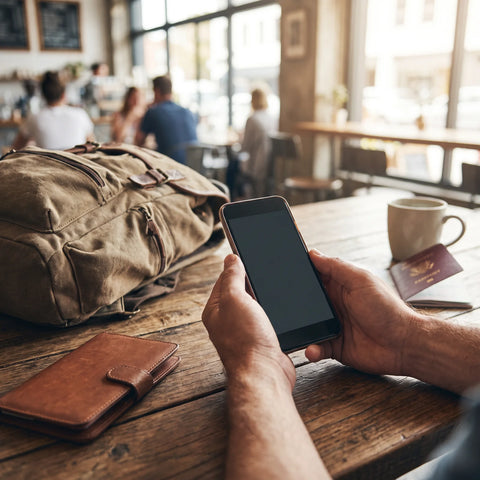
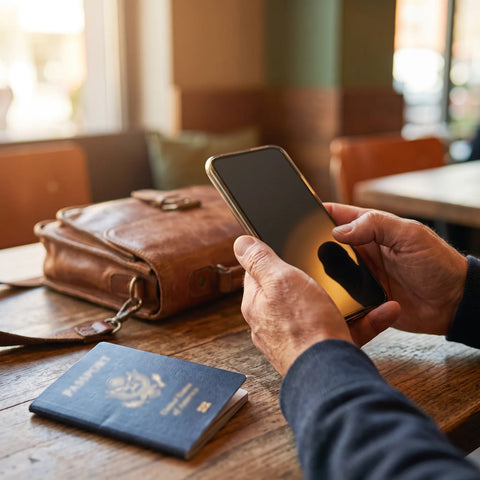
In short: PuraSim's Punta Cana eSIM gives you internet as soon as you land in the Dominican Republic, without roaming or queuing for airport WiFi. It's installed with a QR code before you leave home, works on Claro and Altice networks in Punta Cana, Bavaro, Santo Domingo, and Samaná, and plans start from $1.49.
Landing in Punta Cana with your phone connected from minute one changes your trip: no more looking for airport WiFi or paying extra when you get back. With an eSIM for the Dominican Republic, you have data as soon as you step into the Caribbean, without changing physical SIM cards and no surprises on your bill. Romi explains how to choose your plan, what coverage to expect, and how to activate it in a minute.
Why carry data in the Dominican Republic
The Dominican Republic is one of the most visited destinations in the Caribbean, and although many go to an all-inclusive resort, relying solely on hotel WiFi is a bad idea. The signal in rooms and on the beach is often slow or intermittent, and premium WiFi often costs extra. Carrying your own connection gives you the freedom to use Google Maps, call a taxi, or translate the menu without being tied to the reception desk.
Having an active eSIM upon landing is also a matter of practical security. If you book excursions to Saona Island, rent a buggy, or leave Punta Cana for Santo Domingo, you'll want navigation and messaging working all the time. With PuraSim, you have data in 218 destinations, the same app you use on other trips works here.
Coverage and networks: Claro and Altice
The Dominican mobile market is dominated by two major operators: Claro and Altice (formerly Orange/Tricom), with Viva as a smaller third player. Claro has the most extensive network in the country, with good presence in tourist and rural areas, while Altice offers very good speed in cities. A quality eSIM relies on these local networks, so the coverage you receive is the same as a Dominican would have with their line.
4G/LTE is widely available in Punta Cana, Bávaro, Santo Domingo, Santiago, and Puerto Plata, with 5G growing in urban areas. In the mountainous interior, on virgin beaches of Samaná, or on secondary roads, the signal may drop, so it is advisable to download offline maps. If you want to understand how a connection without a physical card works, read what is a virtual eSIM.
Romi's Tip: in a large resort, move out of the room to an open area if you notice a weak signal; the concrete walls of Caribbean hotels block LTE quite a bit.

How many GB you need depending on your trip
The amount of data depends on how much you use your mobile outside the hotel's WiFi. If you're only going to check maps, messages, and social media occasionally, a small plan is enough; if you make video calls, upload daily reels, or work remotely, you'll need significantly more. As a reference, a week of light-to-medium use usually ranges from 3 to 5 GB, and two active weeks can require 10 GB or more.
| Travel profile | Duration | Recommended data |
|---|---|---|
| Resort + WiFi, basic use | 7 days | 1-3 GB |
| Active tourism and maps | 7-10 days | 5 GB |
| Content creator / social media | 10-14 days | 10 GB |
| Remote work / digital nomad | 2-3 weeks | 15-20 GB or unlimited |
One advantage of PuraSim eSIMs is that you can top up without reinstalling anything if you run short, so there's no need to buy extra "just in case." For a more precise calculation, review how to save data on your travel eSIM, with tricks to stretch your GB without running out of connection halfway through your stay.
How to activate your eSIM with the QR
Activating your plan is a matter of a minute and is done before leaving home, with your usual WiFi. After purchase, you receive a QR code by email; you scan it with your phone's camera from the settings, and the profile is installed. Important: install the eSIM before the trip, but do not activate data until you arrive in the Dominican Republic to avoid using up the plan early.
- Check compatibility: almost all phones from iPhone XS, Pixel 3, and recent mid-to-high-end Samsung models support eSIM.
- Scan the QR: on iPhone, Settings > Cellular > Add eSIM; on Android, Settings > Connections > SIM > Add.
- Activate eSIM data roaming upon landing (it's internal to the plan, no extra charges).
- Select the eSIM as your data line and keep your home number for calls on WiFi.
If you've never done it, our step-by-step guide on how to install an eSIM shows you the process with screenshots. And remember: with PuraSim, you have 24/7 Spanish support if anything gets stuck at the moment.
Areas: Punta Cana, Santo Domingo, Samaná and more
Each area of the country has its own character and level of coverage. Punta Cana and Bávaro concentrate the large resorts in the east: here, 4G is solid on avenues and in shopping centers, although within all-inclusive resorts, WiFi is usually limited or paid, another reason to carry your own data. Santo Domingo, the capital, offers the best connectivity in the country, ideal for strolling through the Colonial Zone with guides on your mobile.
Samaná is the green jewel of the northeast, famous for whales and beaches like El Limón; the signal is good in the town but weaker in remote coves. Puerto Plata, on the north coast, combines a boardwalk, cable car, and beaches with decent urban coverage. La Romana and Bayahíbe, gateway to Saona Island, have reliable LTE in the hotel zone. In all cases, download offline maps for day trips.
At an all-inclusive resort, don't assume that free WiFi reaches the beach or your room. Many charge a several-dollar-a-day upgrade for a stable signal, so a low-GB eSIM is usually cheaper and offers more freedom.
Practical tips: tourist card, currency and resorts
Before your trip, it's a good idea to clarify a few procedures. The Dominican tourist card is usually included in the airline ticket for most airlines for years, but always check if this is your case; you will also have to fill out the electronic entry and exit form (E-Ticket) before traveling, and having data at the airport helps to do it without stress.
The local currency is the Dominican peso (DOP). In resorts and tourist areas, dollars and cards are accepted, but for markets, taxis, and tips, it's advisable to carry some cash in pesos and check the daily exchange rate with your connection.
- Tips: in restaurants, the 10% legal service charge plus an 18% tax is usually included; check the bill before adding extra.
- Plugs: Type A/B and 110V, same as the USA; bring an adapter if you're coming from Europe.
- All-inclusive resorts: confirm what the wristband covers and what activities or premium WiFi are paid separately.
- Excursions: book Saona or Samaná trips in advance and save the confirmations on your mobile.
If you have time to move outside the resort complex, also check out our general guide to internet in the Dominican Republic, with more details on coverage by province.

Prices: traditional roaming vs eSIM
Here's where the biggest difference in your wallet comes into play. Your operator's international charges in the Dominican Republic can skyrocket: outside the European Union, data is billed at very high rates per megabyte if you don't have a specific bundle, and it's easy to end up with charges of tens or hundreds of euros after a week of normal use. That's why so many travelers return with a nasty surprise on their bill.
| Option | Estimated cost | Advantages | Disadvantages |
|---|---|---|---|
| Your operator's rate | High, per MB or expensive bundle | No changes needed | Risk of unexpected bill |
| Local SIM at destination | Medium | Local rates | Queuing, passport, changing numbers |
| PuraSim eSIM | From $1.49 | Active on arrival, no roaming, hotspot included | Requires compatible mobile |
With an eSIM, you know exactly what you're paying before you leave. PuraSim plans start from $1.49, you connect without roaming, share via hotspot, and have Spanish support. To understand why traditional roaming is so expensive, read eSIM vs roaming, where we compare both options line by line. And if your next stop after the Caribbean is South America, check out the guide to eSIM for Colombia.
Myths and what almost no one tells you
There are beliefs about traveling connected to the Dominican Republic that should be debunked before packing your bags. Here are the ones that cause the most confusion.
- "Punta Cana Airport (PUJ) WiFi is enough while I wait for my eSIM": there is free network in common areas, but it's slow and gets saturated during peak arrivals of European charter flights, exactly when most people are trying to book transfers or notify family. If you activate your eSIM before getting off the plane, you save yourself that invisible queue.
- "The hotel card is more than enough": in Bávaro resorts, WiFi is shared among hundreds of rooms, and from 7-8 PM onwards, with everyone connected at the same time to upload dinner photos, the speed plummets. Your eSIM doesn't depend on how many people are in the complex.
- "During rainy season (June-November) there's nothing to do if the network fails": heavy downpours and occasional tropical storms can affect fiber or a specific antenna, but since it relies on two different networks (Claro and Altice depending on the chosen destination), the outage is usually local and brief, not a general blackout of the country.
- "Any unlocked phone supports eSIM": just because a phone is unlocked doesn't mean it has a physical eSIM chip inside; some models sold in Europe for specific operators have the feature factory-blocked. Check your settings before buying, not at the airport.
- "No need to change the time, Spain and Punta Cana are similar": the Dominican Republic is on GMT-4 all year round, with no daylight saving time change, so the difference with Spain varies between 5 and 6 hours depending on the season; with active data, your phone adjusts it automatically and you avoid confusion when coordinating airport transfers.
Frequently asked questions
Does the eSIM work as soon as I land in Punta Cana?
Yes. If you installed the profile before traveling, you just need to activate the eSIM data upon landing, and the local network (Claro or Altice) will give you a connection in a few seconds, without looking for WiFi at the airport.
Can I still receive WhatsApp with my Spanish number?
Yes. Your Spanish number remains associated with your physical SIM or your other eSIM; WhatsApp, Telegram, and other apps work with data regardless of which line you use for browsing. Keep the PuraSim eSIM only as your data line.
How many GB do I need for a week at a resort?
If you use the hotel WiFi a lot, 1-3 GB is usually enough for maps and messaging outside the resort. If you're doing active tourism or uploading content, estimate around 5 GB. You can always top up if you run short.
Is there good coverage at all-inclusive resorts?
4G usually reaches open areas and avenues well, but inside concrete rooms, the signal can falter. Resort WiFi is often limited or paid, so your eSIM is the perfect backup plan.
Do I need a document or passport to activate the eSIM?
No. Unlike a local SIM, the eSIM is purchased online and activated with a QR; there's no need to register your passport or queue in a store upon arrival.
Can I share the connection with my partner?
Yes. PuraSim eSIMs allow data sharing via hotspot, so a single plan can provide internet for two phones or a tablet during the trip.
What is the best eSIM for Punta Cana?
The one that best serves you is one that relies on Claro and Altice (the networks with the most coverage in the east of the country), allows sharing via hotspot, and lets you top up data without reinstalling anything if you run short halfway through your trip. The PuraSim Dominican Republic eSIM meets all three points and is activated before leaving home, so you arrive in Punta Cana already connected.
Conclusion
Traveling to the Dominican Republic with an eSIM means landing connected, forgetting about paid resort WiFi, and above all, not fearing the bill when you return. We've seen that coverage relies on solid networks like Claro and Altice, that a few GB cover a resort trip, and that activating the QR takes barely a minute. Whether you're going to Punta Cana, Santo Domingo's Colonial Zone, or whale watching in Samaná, having your own data gives you plenty of freedom.
With PuraSim, you have 218 destinations, plans from $1.49, QR activation in 1 minute, roaming-free connection, hotspot, and 24/7 Spanish support. Choose your eSIM and prepare your trip with everything ready. To plan excursions and procedures, also check the official tourism website of the Dominican Republic.