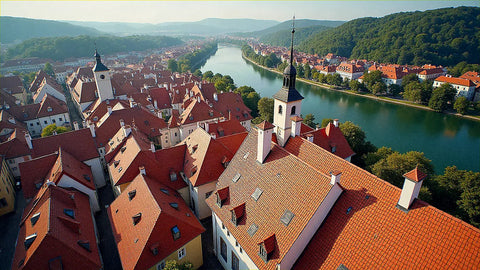
If you're planning a trip to Prague and its surroundings, you're probably wondering how to get internet in the Czech Republic without getting a shock on your bill or begging for Wi-Fi from cafe to cafe. I'll tell you clearly and without exaggeration: here I compare all the real options —your Spanish plan's roaming, hotel Wi-Fi, a local Czech SIM, and an eSIM— so you can choose the one that truly suits you based on how you travel and how much data you use.
Internet in the Czech Republic: your four options at a glance
In the Czech Republic, you have four ways to connect: roaming from your Spanish plan (included because it's an EU country), hotel and bar Wi-Fi, a local Czech SIM, or a travel eSIM. For most Europeans, roaming is enough; an eSIM is only truly beneficial in very specific cases.
First, a nuance that makes a difference compared to other destinations: the Czech Republic is a member of the European Union, so your home plan already provides coverage without extra charges for crossing the border. However, be careful, it does not use the euro: here you pay in Czech crowns (CZK), a detail that matters if you end up buying a SIM card in a physical store.
Even so, "included" is not always "enough." Each option has its moment, and choosing without surprises on your bill requires understanding what each one offers. Here they are summarized at a glance before going into detail:
| Option | Ideal for | Estimated cost | Main drawback |
|---|---|---|---|
| EU Roaming | EU travelers with plenty of data on their plan | Included | "Fair usage" cap on cheap plans |
| Hotel/cafe Wi-Fi | Checking your phone at night | Free | No connection on the street or in the car |
| Local Czech SIM | Long stays, non-EU travelers | From ~500 CZK (~€20) / 10 GB | Must go to a store and pay in crowns |
| Travel eSIM | Those who want data immediately, without paperwork | From about €5 / week | Requires a compatible phone |
Roaming with your Spanish plan: what it includes and the fine print
I'll start with the honest truth: if you have a typical Spanish plan, in the Czech Republic you'll browse using the gigabytes from your bundle at no extra cost. This is the "Roam Like At Home" principle, valid throughout the European Union. Calls, messages, and data are deducted from your usual plan at Spanish prices, with no extra charges for being in Prague instead of Madrid. For a long weekend or a week exploring Bohemia, you often won't need anything more.
If you have a normal Spanish plan and are traveling to Prague for a week, the most honest thing I can tell you is this: you probably don't need to buy anything extra. European roaming covers you. An eSIM only comes into play when your plan falls short or when you're coming from outside the EU.
Now for the fine print, which almost no one tells you about. There is a fair usage policy: if your plan has a very low price per gigabyte (think of those almost unlimited data plans at bargain prices), your operator might apply a data cap while you're abroad. In 2026, the European calculation starts from a wholesale cap of €1.10/GB (this will decrease to €1 in 2027), and your roaming limit is calculated by dividing the monthly price of your plan without VAT by that figure and multiplying by two. There's also a permanence rule: roaming is for travel, not for living abroad, and if you spend more than 4 months connected there, they might notify you.
In simpler terms: most contract plans provide plenty, but it's worth checking before you go. I break it down in my comparison eSIM vs roaming and in how much international roaming costs.

When an eSIM truly pays off in the Czech Republic
I'm not going to give you a hard sell: if you're from the EU and your plan has generous data, you probably won't need anything extra to get around Prague. That said, there are very clear situations where an eSIM saves you money or trouble. This is where it truly pays off:
- You're short on gigabytes in your plan. If you have limited data at home, using it all in Prague will leave you without internet halfway through your trip. An eSIM with its own data bundle frees up your phone for the entire itinerary.
- You have a cheap plan with a fair usage cap. If your operator cuts your roaming to a few gigabytes due to the low price of your plan, a separate data bundle is worthwhile and avoids rationing.
- You use an old plan or one without EU roaming included. Some legacy plans charge roaming as an extra; an eSIM saves you a silly surcharge in that case.
- You're traveling from outside the EU. If you're coming from Latin America, the UK, or the US, you don't have "Roam Like At Home," and your operator's roaming can be very expensive.
- You want total control over spending. With a fixed bundle, you know exactly how many gigabytes you have and how much you're paying, with no surprise bills upon return.
If your situation is on this list, my specific guide to eSIM for the Czech Republic saves you the trouble of comparing plans one by one.
Hotel and local Wi-Fi: useful, but don't rely solely on it
Free Wi-Fi is everywhere in the Czech Republic: hotels, apartments, cafes in Prague's Old Town, pubs, restaurants, and even many trams and stations have a connection. It's more than enough for uploading photos at night, making a video call from your apartment, or planning the next day's route, and it doesn't use up a single gigabyte of your data plan.
The problem is relying solely on it. Wi-Fi stays at the hotel, and you don't. As soon as you go out to find a pub, open a map to get to Prague Castle, or show your train ticket to Český Krumlov on your phone, you'll lose your connection precisely when you need it most. Furthermore, many open networks are slow at certain times and are not the most secure for entering passwords or banking details.
My advice: never rely solely on Wi-Fi. Use it for what it's good for—downloading offline maps, syncing the cloud, making backups—and always have mobile data as a backup. If you're debating between portable Wi-Fi and other options, I compare them in eSIM vs pocket Wi-Fi, where you'll see why a pocket router is usually the worst option for a short city trip.
Local Czech SIM: O2, T-Mobile, and Vodafone
The Czech Republic has three operators with their own networks and excellent coverage: O2, T-Mobile, and Vodafone. All three provide 4G in almost all populated areas and are actively deploying 5G. As of the end of 2024, Vodafone led the country's 5G coverage with nearly 94%, followed by T-Mobile (~90%) and O2 (~87%). In terms of speed, O2 stands out in Prague, and T-Mobile is the fastest on average nationwide.
A tourist SIM is a solid option for long stays or for those coming from outside the EU. You can buy them at operator stores, Václav Havel Airport (more expensive), supermarkets, kiosks, and chains like Alza or Datart. Estimated prices are around 500 CZK (~€20) for 10 GB with T-Mobile's Twist card, from 300 CZK for 5 GB on O2, or Vodafone data bundles from 120 CZK. At the airport, expect to pay 10-20% more than in the city center.
| Operator | 5G Coverage (2024) | Strong point | Estimated prepaid price |
|---|---|---|---|
| Vodafone | ~94% | Most widespread 5G; "Data SIM for visitors" designed for tourists | Bundles from ~120 CZK |
| T-Mobile | ~90% | Best average 5G speed; Twist prepaid card | ~500 CZK / 10 GB / 30 days |
| O2 | ~87% | Faster 5G in Prague and extensive store network | Data from ~300 CZK / 5 GB |
The downside is twofold: you have to physically go to a store (sometimes with a passport and registration) and pay in crowns, and that SIM usually only covers the Czech Republic. If you plan to travel through several Central European countries, read eSIM vs local SIM first.
Travel eSIM: how it works and who it's for
An eSIM is a digital card installed on your mobile phone via software, without plastic or any physical changes. You buy the plan online, scan a QR code, and within minutes you'll have data from a Czech operator working on your phone, while keeping your home Spanish number for calls and WhatsApp. If you've never used one, I'll explain the basics in what an eSIM is.
The big advantage is convenience: you set it up in five minutes from your couch before leaving home and land in Prague already connected, with no queues, no stores, and no hassle with Czech crowns. Plus, you control your spending with a fixed bundle: you know exactly how many gigabytes you have and how much you pay, with no surprise bills. Plans for the Czech Republic start at around €5 for a few gigabytes for a week and go up depending on the data you need.
Who is it ideal for? For those who are short on data in their home plan, for travelers from outside the EU, for those who don't want to waste time with paperwork, and for those who value having everything sorted before boarding. The only requirement is an eSIM-compatible mobile phone: almost all iPhones since the XS and most recent mid-to-high-end Android phones are compatible. If your phone supports it, it's the most convenient way to arrive connected.

Coverage by area: Prague, Český Krumlov, Brno, castles, and countryside
The good news is that the Czech Republic has a very solid network for how touristy it is. In Prague, you have plenty of coverage: 4G everywhere and 5G already widespread, including the Castle area, Charles Bridge, and the Old Town. In Brno, the second city, 5G is also excellent, and there's a strong network in Ostrava and Plzeň.
Český Krumlov, despite being a small medieval town, has reliable 4G from all three operators throughout the historic center and the castle, thanks to the tourist infrastructure. You won't have problems browsing, using maps, or sharing photos between alleys. 5G mainly reaches large cities, but 4G LTE covers almost the entire country well, including smaller towns.
What about castles and the countryside? Bohemia and Moravia are generally well covered. Signal might weaken in remote forested areas or mountain valleys: think of the interior of the Šumava National Park or the higher altitudes of the Krkonoše (Giant Mountains). If your route includes hiking in those areas or a lost castle deep in the forest, download offline maps beforehand. This applies equally to roaming, a local SIM, or an eSIM, because they all share the same Czech antennas.
How much data do you need for your trip?
Calculating data based on your travel style prevents you from overpaying or running out. The general guideline for a week is: 1 GB if you use your phone sparingly, 3-5 GB for normal tourist use, and 10 GB or more if you use maps, social media, and streaming heavily. Videos and video calls consume the most; maps and chat consume very little.
| Usage profile | What you do | Data / week |
|---|---|---|
| Light | WhatsApp, occasional maps, some emails | ~1 GB |
| Normal | Daily maps, social media, photos, browsing the city | 3-5 GB |
| Intensive | Videos, streaming, sharing connection, remote work | 10 GB or more |
A practical tip: download offline Google Maps for Prague and the areas you'll visit at your hotel with Wi-Fi, as well as any series or podcasts for train journeys. That way, even if you're in an area with no coverage on your way to Český Krumlov, you'll still have the essentials. And if you have data left over at the end, that's fine; I always prefer to have a small margin than to ration gigabytes on the last day. Mentally set aside some data for unforeseen circumstances: a change of accommodation, a last-minute booking, or showing a ticket on your phone.
How to choose based on your traveler profile
Let's make all of this practical so you can choose wisely in a minute. There's no single answer: it depends on where you live, your plan, and how you travel. Here are the combinations I recommend based on the situation:
- You're from the EU and have plenty of data: use your roaming, it's free and works just like at home. Don't complicate anything.
- You're from the EU but are short on gigabytes or have a cheap plan with a cap: add an eSIM with a 3-5 GB bundle and forget about the counter.
- You're coming from outside the EU: an eSIM or a local SIM will be much cheaper than your operator's roaming.
- Long stay (more than two weeks) and you'll be visiting a store anyway: a local Czech SIM might be the most economical option.
- You want zero hassle and to arrive connected: an eSIM is the most convenient option, you set it up before you fly.
In summary, for the typical Spanish traveler on a one-week trip to Prague, roaming is enough; for all other cases, an eSIM is the most convenient way to have peace of mind. The important thing is to leave home with a decision made and not improvise at Václav Havel Airport.
Frequently asked questions
I'll answer the most common questions about connecting in the Czech Republic before you travel.
Do I have free roaming in the Czech Republic?
Yes, if you have a European Union plan. The Czech Republic is in the EU, so "Roam Like At Home" applies, and you browse using the gigabytes from your bundle at Spanish prices, without surcharges. The only exception is the fair usage policy for very cheap plans, which may limit your gigabytes.
Does the Czech Republic use the euro?
No. Although it is an EU member, it maintains its own currency, the Czech crown (CZK). European roaming works the same, but if you buy a local SIM card in a store, you'll have to pay in crowns. With an eSIM, you pay online in euros and save on currency exchange.
Can I use all my home gigabytes in the Czech Republic?
It depends on your plan. With most contracts, yes. But if your plan has a very low price per gigabyte, your operator may apply a "fair usage" cap on roaming. Check your contract before traveling to avoid running out.
Is it worth buying a local Czech SIM?
Only in specific cases: long stays, if you're coming from outside the EU, or if you need a lot of data at a low cost. Estimated prices: about 500 CZK (~€20) for 10 GB. The downside is that you have to go to a store, register, and pay in crowns.
Is there good coverage in Český Krumlov and the countryside?
Generally, yes. Český Krumlov has reliable 4G throughout the historic center and the castle, and Bohemia and Moravia are well covered. Signal can be weaker in remote forests or mountain valleys like Šumava or the Krkonoše. Download offline maps just in case.
How much data do I need for a week in Prague?
As a reference: 1 GB if you use your phone sparingly, 3-5 GB for normal tourist use, and 10 GB or more if you use maps, social media, and video heavily. Streaming consumes the most; maps and chat consume very little.
Do I need internet to get around Prague?
It helps a lot. The metro and trams work well, but having data allows you to buy tickets on the app, follow the map in real time, and translate menus or signs. Roaming or an eSIM will sort you out; with only hotel Wi-Fi, you'll be blind on the street.
Does my mobile work with an eSIM in the Czech Republic?
If your phone is eSIM compatible, yes. This includes almost all iPhones from the XS onwards and most recent mid-to-high-end Android phones. You install the plan via QR before you leave and land connected, keeping your Spanish number for calls and WhatsApp.
Conclusion
Getting connected in the Czech Republic is easier than it seems: if you're European with plenty of data, your roaming is sufficient; if you're low on data, you're from outside the EU, or you want total control over your spending, an eSIM will give you peace of mind without having to deal with crowns or stores. And remember to download offline maps if your route takes you into the Šumava or Krkonoše forests.
If you want to sort everything out before leaving home, you can activate your eSIM for the Czech Republic in a couple of minutes from your mobile and land in Prague already connected. Have a good trip, and see you among the rooftops of the Old Town.