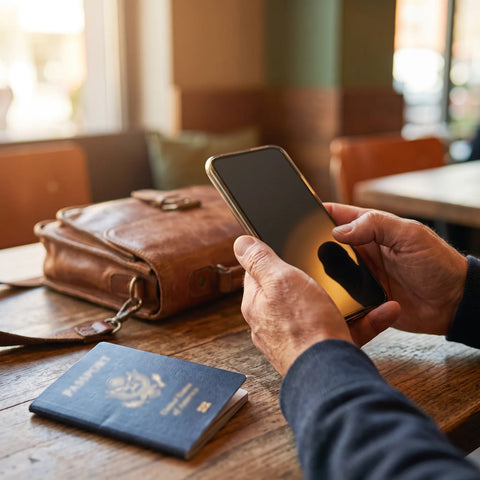
I'm Marc, from PuraSIM, and almost every time someone writes to me asking for advice on how to get internet in Guadeloupe, I expect the typical question about a distant and complicated destination... and it turns out to be one of the easiest answers on the blog. The reason? Guadeloupe is in the heart of the Caribbean, yes, but politically it's France, and that means the European Union. I'm not here to push anything on you: in many cases, your Spanish mobile plan already covers you, and in others you run out of data just as you get off the plane and don't realize it until it happens. Let's look at your actual situation case by case.
Do you need to sign up for anything or not?
Guadeloupe is a French overseas department and, therefore, European Union territory. With a Spanish plan from an EU operator, your roaming works just like on the Iberian Peninsula: data and calls without surcharge, with a reasonable usage limit. You only need to top up if that allowance falls short.
That's the honest starting point, and it already saves you 80% of the doubts. But "included" doesn't mean "infinite," and that's where the nuances appear. Based on that, there are four possible paths, and each has its moment:
- Your Spanish mobile plan (EU roaming). Zero hassle, zero extra cost within your allowance. Perfect if your included gigabytes last the trip.
- Hotel and local Wi-Fi. A useful complement, never the basis of your connection.
- Local Caribbean SIM. Makes sense for long stays or if you need a French Antilles number for administrative purposes.
- Data eSIM. The rescue option when your plan falls short or when you're traveling from outside the EU.
The rest of the guide will help you figure out which of those four categories you fall into. The right answer for a Spanish traveler with a €40/month plan is not the same as for one with a €6 low-cost plan, or for a Colombian or Argentinian landing in Pointe-à-Pitre from another continent. Keep reading, and in five minutes, you'll have it clear.
Guadeloupe is France: why the EU extends to the Caribbean
Here's the fact that changes everything and surprises many people: Guadeloupe is not a former colony or an associated country. It is a full-fledged overseas department (DOM), with the same status as Martinique or Reunion. People vote in French elections, they pay in euros, and, for our purposes, it is part of the European Union as an outermost region. You are 6,700 kilometers from Madrid, but legally you are still within the club.
That's why the European regulation "Roam Like At Home" accompanies you to the Caribbean beaches. Your Spanish operator cannot charge you a surcharge for using your plan there: you call, send messages, and browse with your usual conditions, exactly as if you were in Valencia. It sounds strange, but that's how it is.
The logic of a Caribbean tourist destination says "this is going to cost me a fortune in roaming." The legal logic says "this is France." And in Guadeloupe, legal logic wins.
A small print warning, to be rigorous: although the regulation is clear, some operators have mistakenly billed the French Antilles as a different zone or on old plans. It is not common, but before flying, take two minutes to confirm with your company that Guadeloupe is included in your EU roaming. That will save you any surprises.

Your Spanish mobile plan in Guadeloupe: how many gigabytes you really have
Here's the fact that almost no one tells you. The gigabytes you can use in the EU—and Guadeloupe is EU—are not those of your national plan: they come from a regulated reasonable use formula. In 2026, your roaming gigabytes are calculated as (monthly price without VAT ÷ 1.10) × 2. The divisor is the wholesale cap that a foreign operator can charge yours, which this year is €1.10 per gigabyte and will drop to €1/GB in 2027.
Translated into real numbers, with a plan of €9.99/month, you get about 15 GB to use in Guadeloupe. Sounds like plenty. But with a low-cost plan of €6, you're closer to 9 GB, and with a €5 plan, you're around 7 GB. If you're going to share your connection with your partner, use maps all day between the two wings of the island, and upload videos of the beaches, those gigabytes will fly by in four or five days.
What happens if you go over? They don't cut off your connection: they charge you an extra per-gigabyte surcharge that's around a euro and change plus VAT. Nothing dramatic for 1 or 2 GB, but it adds up. And if your plan is old or a cheap prepaid one, check the fine print. You can find the cost breakdown by scenario in how much international roaming costs.
When a data card pays off (to be honest)
If you have a good Spanish mobile plan and you're going to Grande-Terre for a week, you don't need to buy anything. I'm telling you this, and I make a living selling digital cards. Buying one would be a waste of money. However, there are specific situations where it does pay off, and they are more common than they seem:
- Your plan includes little data. With 7–9 GB of EU allowance and a two-week trip around the island, you'll definitely run short.
- You'll be away for a long time. The reasonable use policy monitors four-month windows: if you spend more time abroad than in Spain and consume more data abroad than at home, your operator may warn you and start applying surcharges.
- You have an old or corporate plan with worse roaming conditions, or a prepaid plan that doesn't directly include the EU.
- You're not traveling from the EU. If you're coming from Latin America, the UK, the United States, or Canada, "Roam Like At Home" doesn't apply to you, and your operator's roaming can cost you a fortune per day.
- You want abundant data without monitoring the counter or reasonable use, or you want to keep your national gigabytes intact because you share your connection with your laptop.
Aside from these cases, save your money. If you're torn between the two options, I have an in-depth comparison in eSIM vs. roaming, with numbers instead of slogans. And if the concept sounds like Greek to you, start with what an eSIM is before buying anything.
Hotel and local Wi-Fi: the plan B that isn't a plan
Hotels and resorts in Guadeloupe have Wi-Fi, many restaurants in Pointe-à-Pitre and Le Gosier also do, and in theory you could rely solely on that to avoid spending a single gigabyte. In practice, it doesn't work well as a primary strategy, and I'll explain why in a destination as spread out as this one.
Wi-Fi is where you are not when you need it. You need it crossing the bridge between Grande-Terre and Basse-Terre looking for the right turn, in the parking lot of the trail to the Carbet Falls, or checking ferry schedules to Les Saintes from the pier. In all those moments, you're on the road, not in the hotel lobby. The connection that works is the one you carry with you.
Furthermore, there are three specific drawbacks:
- Captive portals. Many Wi-Fi networks require registration with an email or an SMS to your number, and some reject foreign numbers. Without mobile data, you won't receive that SMS: a chicken-and-egg problem.
- Resort speed. Shared Wi-Fi at nine at night, with the entire hotel connected, won't sustain a decent video call.
- Security. On open networks, avoid banking and purchases, or use a trusted VPN.
My practical recommendation: use Wi-Fi for heavy tasks (uploading the day's photos, downloading offline maps) and save mobile data for getting around. Never the other way around. If you're considering a portable router as a substitute, read eSIM vs. pocket Wi-Fi first: the extra gadget and the deposit rarely pay off.
Local SIM: Orange Caraïbe, Digicel and SFR Caraïbe
Guadeloupe has its own ecosystem of Caribbean operators with their own network: Orange Caraïbe, SFR Caraïbe, Digicel, and Free Caraïbe. Buying a local SIM is viable and, for certain profiles, the best option. Keep in mind that in France, a prepaid card requires identification with a document, so bring your passport or ID.
| Operator | What to expect | Where to buy |
|---|---|---|
| Orange Caraïbe | The widest network on the island; good prepaid data packs | Orange stores, Pôle Caraïbes airport |
| SFR Caraïbe | Good coverage in tourist areas; competitive prepaid offers | SFR stores, shopping centers |
| Digicel | Strong Caribbean presence; easy top-ups at shops | Digicel points, tobacconists, supermarkets |
| Free Caraïbe | Aggressive pricing if you find a point of sale | Own stores (less widespread) |
When does it make sense? If you're staying for weeks or months, if you need a French Antilles number for reservations or procedures, or if you're going to consume huge amounts of data. When does it not? For a normal week: losing a morning looking for a store, showing your document, and changing your card, when your Spanish plan already gives you free gigabytes, doesn't make much sense. You can find the full breakdown in eSIM vs. local SIM.

The travel eSIM: how it works in practice
An eSIM is a digital card that is installed on your mobile by scanning a QR code. There is no plastic, no store, no queue at Pôle Caraïbes airport. You buy it before leaving home, install it with Wi-Fi, and it activates automatically when you land and connect to a local network. The entire process takes about three or four minutes, and you don't need to be tech-savvy.
The important thing for a trip to Guadeloupe is to understand what it gives you and what it doesn't:
- It does give you: mobile data over a Caribbean operator's network (usually with agreements with several networks, so your phone chooses the best available signal).
- It does give you: the ability to keep your Spanish number active for SMS and calls, because the digital line coexists with your physical SIM. You receive your bank's code without a problem.
- It normally does not give you: a local number. Travel plans are usually data-only. For calls, you use WhatsApp, FaceTime, or Telegram, like everyone else.
- Requirement: compatible and unlocked phone. Almost all models from recent years are, but check before buying.
A piece of advice I always give: install it at home, with Wi-Fi, but do not activate it until you arrive if your plan counts the days from activation. And deactivate the data on your Spanish line to avoid cross-consumption. The step-by-step process with the exact configuration is in the Guadeloupe eSIM guide.
Comparison of the four options
Putting it all together, here's the landscape for a typical week-long traveler in Guadeloupe, with indicative 2026 valuations and no euphemisms:
| Option | Real Cost | Effort | Local Number | Ideal for |
|---|---|---|---|---|
| Spanish plan (EU roaming) | €0 (within your allowance) | None | No | Short trips with generous plans |
| Hotel and local Wi-Fi | €0 | Low, but limited | No | Complement, never the basis |
| Local Caribbean SIM | €20–40 | High (store, document, changing SIM) | Yes | Long stays, residents |
| Data eSIM | From a few euros | Low (QR and done) | No (data only) | Short data plans and non-EU travelers |
The quick read: if you live in Spain and your plan gives you 15 GB in the EU, stick with what you already pay for. If your plan gives you 7 GB and you're going for twelve days with your family, a data card is cheaper than surcharges and saves you the mental rationing of constantly checking your usage. And if you're traveling from Bogotá, Mexico City, or Buenos Aires, don't even consider your operator's roaming: the daily rates are from another era.
A nuance that almost no one mentions: the digital card is also good insurance. It costs little, you have it installed as a backup, and if your operator limits your data just the day you need the map on the way to La Soufrière, you activate it in thirty seconds.
Real coverage: Pointe-à-Pitre, the two wings and La Soufrière
Guadeloupe is shaped like a butterfly, and that image also helps you understand the coverage. The right wing, Grande-Terre, is where the tourist beaches are—Le Gosier, Sainte-Anne, Saint-François—and there the signal is good or very good. The left wing, Basse-Terre, is home to the La Soufrière volcano, the National Park jungle, and the waterfalls: spectacular nature and much more irregular coverage as soon as you get into the mountains.
| Area | What to expect |
|---|---|
| Pointe-à-Pitre and Les Abymes | Good 4G/5G coverage; this is the urban and commercial core. |
| Grande-Terre (south and east beaches) | Solid in Le Gosier, Sainte-Anne, and Saint-François; some dips in summer due to saturation. |
| Basse-Terre and La Soufrière | Decent in coastal towns; weak or non-existent in the jungle, the heights of the volcano, and the Carbet Falls. |
| Les Saintes and Marie-Galante | Acceptable in the main settlements; irregular in coves and high areas of the islands. |
| Cousteau Reserve (diving) | Signal on the Bouillante coast; underwater, obviously, zero. |
Two practical tips. First: if you're going to climb La Soufrière or hike the park trails, download offline maps before starting; no technology will save you in a jungle valley without an antenna. Second: for boat trips to Les Saintes or the Cousteau Reserve, resolve reservations and tickets with a signal at the port, because offshore the connection disappears. In tourist areas, you'll have plenty; save your respect for the mountains and the jungle.
How much data you really need
Almost everyone overestimates how much they will spend. A tourist in Guadeloupe uses their phone for maps between the two wings, messaging, some social media, finding Creole food restaurants, and showing ferry tickets. That consumes much less than you think. What drives up consumption is something else: video streaming, uploading high-quality stories of every beach, and using your phone as a router for your laptop.
| Travel profile | Daily consumption | For 7 days |
|---|---|---|
| Light (maps, WhatsApp, some web) | 200–400 MB | 2–3 GB |
| Normal (social media, photos, music) | 500 MB–1 GB | 5–7 GB |
| Intensive (video, stories, sharing connection) | 1.5–3 GB | 10–20 GB |
| Remote work (video calls, cloud) | 2–4 GB | 15–30 GB |
Cross-reference this table with the formula in section 3, and you'll have your answer. If your plan gives you 15 GB in the EU and you're a normal user, you'll have plenty and won't need to buy anything. If it gives you 7 GB and you're a heavy user, or you're traveling between islands for two weeks, it won't be enough, and it's better to top up.
Three tricks I always use to make my gigabytes last twice as long: download offline maps of Grande-Terre and Basse-Terre before you leave (they're small and save a lot), put Instagram and TikTok in data-saver mode, and disable auto-play videos. And something boring but crucial: check your data usage on the third day. If you're below 40%, you won't have a problem.
Frequently Asked Questions
Do I have free EU roaming in Guadeloupe?
Yes. Guadeloupe is an overseas French department and part of the European Union. Your Spanish plan includes roaming under the "Roam Like At Home" regulation: calls, SMS, and data with your usual conditions, without surcharge, even if you're in the Caribbean.
Will my Spanish phone work as soon as I land?
Yes, just like in any EU country. You just need to have data roaming activated in your phone settings. When you get off the plane at Pôle Caraïbes, it will connect to a local network, and you'll browse with your usual plan.
How many gigabytes can I use in Guadeloupe with my plan?
It depends on what you pay. In 2026, the fair use formula is (monthly price without VAT ÷ 1.10) × 2. A €9.99 plan gives about 15 GB; a €6 plan, about 9 GB. Check it in your customer area before traveling.
Is a local Caribbean SIM worth it for one week?
Normally not. It requires going to a store with identification and changing your card, while your Spanish plan already includes data. It only pays off if you're staying for weeks, need a local number, or will consume huge amounts of data.
What if I'm traveling to Guadeloupe from outside the European Union?
Everything changes. Without "Roam Like At Home," your operator's roaming could cost you several euros a day or be charged per megabyte. In that case, a data eSIM or a local Caribbean SIM is clearly the best economic option.
Is there good coverage on the volcano and in the jungle?
In the tourist areas of Grande-Terre and in Pointe-à-Pitre, yes. In La Soufrière, the National Park jungle, and the Carbet waterfalls, the signal is irregular or non-existent. Download offline maps before going up and don't rely on a connection en route.
Can I have my Spanish number and Guadeloupe data at the same time?
Yes, this is normal with an eSIM: the digital line carries the data, and your physical SIM keeps your number active for calls and SMS from the bank. Just deactivate mobile data for the Spanish line to avoid overspending.
Conclusion
In short, without exaggeration: if you live in Spain, have a decent plan, and are going to Guadeloupe for a week, don't buy anything. It's France, it's the EU, and your European roaming covers you with data and calls without surcharge. If your plan is cheap and gives you 7 or 8 GB, if you're going to be away for weeks, if your plan is old, or if you're traveling from outside the European Union, then yes: a data card will be cheaper than surcharges and will relieve the stress of counting megabytes between the two wings of the island.
That's the mindset with which we built PuraSIM: not to sell for selling's sake, but to fill a real need. If you've done your calculations and see that your plan is insufficient, the eSIM for Guadeloupe installs in minutes, works as soon as you land, and lets you arrive in the Caribbean with internet already working, without queues or bill surprises. And if you don't need it, even better: you save money, and I have a clear conscience. Have a good trip to the butterfly island.