If you already have your flights to the Antilles and just need to decide on a data package, this guide is about that: how many GB you need for Guadeloupe and not a gigabyte more. I'll tell you from the first line something almost no one mentions: Guadeloupe is an overseas French department and an outermost region of the European Union, so your Spanish plan probably already covers it. Even so, there are legitimate reasons to get separate data, and I'll explain them plainly before giving you the number.
The direct answer: how many gigabytes for Guadeloupe
Guadeloupe is European Union territory, so your Spanish plan might cover your trip without extra charges. If it doesn't, for 10 days, most people will be fine with 3 GB; increase to 5 GB if you post photos daily, and 10 GB if you work from the island.
That's the answer, and you don't need to read anything else if you're in a hurry. Now for the nuance, because the number doesn't come out of nowhere. A typical trip to Guadeloupe involves renting a car, with maps open for much of the day, WhatsApp with home, some restaurant searches in Deshaies or Sainte-Anne, and uploading photos at night from your accommodation. This profile uses between 150 and 250 MB per day if you do backups over Wi-Fi, which means 3 GB for ten days leaves you with plenty of margin.
What really drives up the number isn't the days: it's video. Half an hour of nighttime social media scrolling costs more data than all the day's GPS navigation. If that sounds like you, don't overthink it and jump straight to the photos and social media profile. And if your question is more general and not just for this destination, I'll leave you with the main article on the topic at how much data do I need to travel, which applies to any country.
Before buying anything: Guadeloupe is EU (and what that implies)
I'm going to be honest, even if it costs me a sale. Guadeloupe is in the Caribbean, 6,700 kilometers from Madrid, but legally it is France and the European Union: it is on the official list of outermost regions along with Martinique, French Guiana, Mayotte, Reunion, Azores, Madeira, and the Canary Islands. That's why the European roaming regulations apply just as if you were going to Lyon, and most Spanish operators classify it as Zone 1 or EU Zone.
Practical translation: if your plan includes the EU, it's very likely you can use your home gigabytes in Guadeloupe without paying a single extra cent. Check this before buying anything.
That said, there are three real situations where it is worth getting separate data:
- Cheap plans with fine print. Some companies bill the French Antilles as Zone 2, claiming they don't have an agreement with local operators. Call and ask about Guadeloupe by name.
- Fair use limits. Your plan may include the EU but with a roaming gigabyte cap significantly lower than at home.
- You don't live in the EU or your contract is from another country: no argument there.
If, after that call, you find you're covered, great: save your money. If not, you can find a complete comparison of options at internet in Guadeloupe. Here, we'll continue with our topic, which is gigabytes and not technologies.
How much data each activity really consumes
These are the figures I use for my calculations. They aren't from a lab: they are average consumption figures for normal use, with the mobile on 4G and without fuss. I give them to you per hour so you can multiply by your own habits.
| Activity | Approximate consumption |
|---|---|
| GPS navigation (in-car maps) | 5-10 MB per hour |
| WhatsApp: messages, audio, and some photos | 5-15 MB per hour |
| Browsing, checking schedules, looking for a restaurant | 10-25 MB per hour |
| French translator (text or camera) | A few MB per query |
| Music streaming (normal quality) | 40-70 MB per hour |
| Facebook or X, mostly text and photos | Around 100 MB per hour |
| Video call home | 300-400 MB per hour |
| Instagram or TikTok with lots of video | 700 MB - 1 GB per hour |
| Video streaming in standard quality | 0.5-0.7 GB per hour |
| High-definition video | 2-3 GB per hour |
| Uploading 20 daily photos | 60-100 MB |
| Uploading a one-minute video | 60-150 MB |
Notice the leap: one hour of TikTok is equivalent to over a hundred hours of maps. That's the whole secret to the calculation. Navigation, WhatsApp, and searches, which are what you really need to get around, cost next to nothing. The expensive part is entertainment, and entertainment is almost always consumed at night at your accommodation, where there's usually Wi-Fi. If you want the expanded breakdown by applications, I have it in mobile data usage statistics by activity.
Recommendation by profile and trip duration
This is the table you came to see. Find your profile, cross-reference it with your trip days, and that's your number. I assume you'll be sleeping in a place with Wi-Fi, which is typical for hotels, gîtes, and apartments on the island.
| Traveler profile | 5 days | 10 days | 15 days | 30 days |
|---|---|---|---|---|
| Maps and WhatsApp, little else | 1 GB | 2-3 GB | 3-4 GB | 5-6 GB |
| Photos and social media: daily posting | 3 GB | 5 GB | 8 GB | 15 GB |
| Family sharing (2 mobiles + kids) | 5 GB | 10 GB | 15 GB | 25-30 GB |
| Digital nomad or remote work | 10 GB | 20 GB | 30 GB | 50 GB or unlimited |
A couple of honest clarifications about this table. First: the top profile is the most common among those traveling to Guadeloupe for two weeks, and for them, 3 or 4 GB is sufficient. I won't sell you 20 GB if you're only going to use four. Second: in the family profile, the data consumption isn't caused by the adults; it's caused by cartoons in the back seat while you're driving across the island. If you download that content before leaving, the family can easily move down to the row above.
The remote work profile is the only one where I recommend erring on the side of too much rather than too little: a video call cut off in the middle of a meeting costs more than a few extra gigabytes. With two or three one-hour meetings daily, you're already looking at 1.5 GB per day just for work.
The two wings of the butterfly change the number
Guadeloupe is shaped like a butterfly, and each wing behaves differently, including for data. Grande-Terre, the eastern wing, is where the beaches, hotels, and tourist towns are: Sainte-Anne, Saint-François, Le Gosier. Here, you'll find solid coverage, and this is where you'll spend most of your gigabytes, because it's where you have the inclination and time to check your phone.
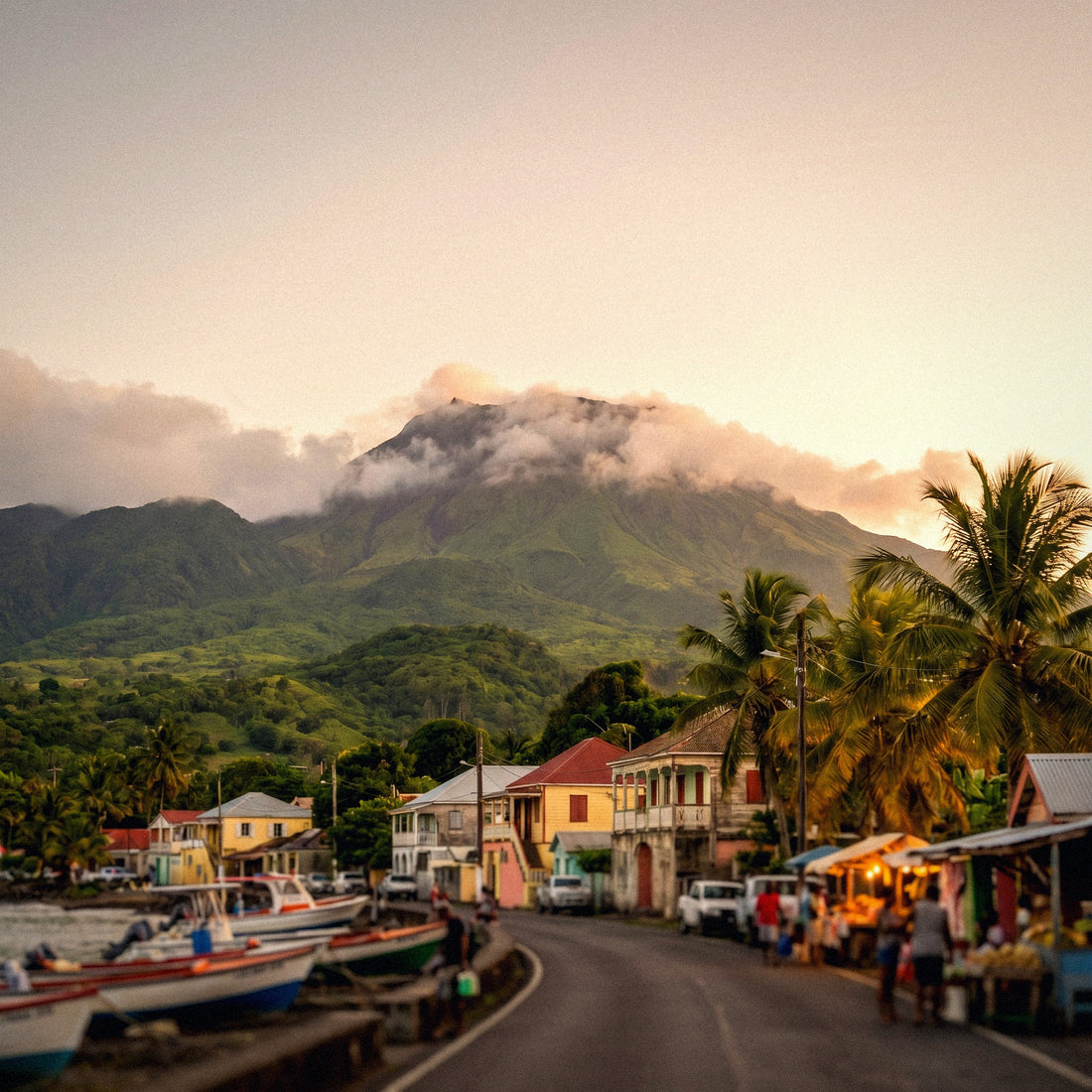
Basse-Terre, the western wing, is mountains, jungle, and the La Soufrière volcano. In the interior of the National Park, coverage is intermittent, and on the high-altitude trails, including the ascent to the volcano and the Carbet Falls area, there may be no signal at all. This has a good side and a bad side: you don't use data, but you also can't rely on your map if you haven't downloaded it.
| Area | Typical coverage | Effect on your consumption |
|---|---|---|
| Pointe-à-Pitre, Les Abymes, Baie-Mahault | 4G and 5G | High: where you check your phone |
| Beaches of Grande-Terre | Good 4G | High: photos and social media |
| Basse-Terre city and west coast | 4G, 5G in the core | Medium |
| Route de la Traversée and National Park | Intermittent | Low |
| La Soufrière and Carbet trail | None or very weak | Almost none |
| Les Saintes, Terre-de-Haut | 4G in the village | Medium |
| Ferry crossings | Irregular mid-crossing | Low |
A trip split fifty-fifty between the two wings consumes much less than people calculate, precisely because the days in the jungle and on the volcano are days with your phone in your pocket.
Rental car, maps, and ferries: where data goes
In Guadeloupe, almost everyone rents a car, and for good reason: it's the natural way to explore both wings, and that puts maps at the center of your daily consumption. The good news is that navigation is very cheap in terms of data. Five hours of driving in a day won't even reach 50 MB. What might surprise you is the initial map download, which is around 100-300 MB: do it at your hotel with Wi-Fi on the first night and forget about it.
These are the three situations during your trip where it's best to be prepared:
- The volcano day. Go up with the Basse-Terre map downloaded and your itinerary already loaded. You might lose signal at the top, and it's not a place to improvise.
- The ferry to Les Saintes. Buy or check schedules from land, where there's coverage. Mid-crossing, the signal comes and goes.
- Diving in the Cousteau Reserve. Booking your outing and checking the sea conditions uses less than 20 MB, but do it the night before: in Malendure, with wet hands and in a hurry, you won't want to struggle with the network.
Another tip that saves more than it seems: the island is French-speaking, and many menus and trail signs are only in French. A translator with the French language pack downloaded for offline use will solve your entire trip for just a few MB. If you want the complete list of tricks, I have them in how to save data while traveling.
Calculate your real consumption before leaving home
All of the above are averages. Your exact number is already in your pocket and can be checked in two minutes, which is the most useful advice in the entire article.
- On Android: Settings, Network & Internet, SIM or Data Usage. You'll see the gigabytes for the last month and the breakdown by application.
- On iPhone: Settings, Mobile Data. Scroll down to the list of apps and check the period it covers; it's a good idea to reset the counter at the beginning of a month to get clean data.
Take your monthly consumption, divide it by 30, and multiply it by the number of days of your trip. That's your honest starting point. Now adjust it with two very Guadeloupe-specific corrections: subtract what you consume at home on the subway, at work, or in the supermarket line, because that disappears on vacation; and add the photos and videos you're going to share, which multiply on a Caribbean trip.
There's a third factor people forget: at home, many phones are almost always on Wi-Fi, so the mobile data counter underestimates. If your actual internet usage is high but your counter shows little, it's better to look at your Wi-Fi consumption for the last month and consider the part you'd do outside the house. With these three adjustments, the calculation becomes much more accurate, and you stop buying blindly.
How to stretch your gigabytes on the island
With four adjustments made before boarding, the same trip can consume half as much. None of them detract from your trip, which is what's important.
- Downloaded maps. Save Grande-Terre, Basse-Terre, and Les Saintes over Wi-Fi. This saves you data and helps you in the National Park.
- Backups only over Wi-Fi. This is the number one tip. Caribbean photos are heavy, and an automatic backup can eat up a gigabyte in an afternoon without you realizing it.
- Data saver mode activated. It's in any phone's settings and limits background consumption.
- Autoplay video disabled on Instagram, TikTok, X, and Facebook. This is the biggest real saving, no question.
- Video and music in standard quality while traveling, and music playlists downloaded before leaving for long drives.
- App updates only over Wi-Fi. A single large update can cost hundreds of MB.
| With 1 GB you can... | Approximate amount |
|---|---|
| Navigate with car maps | More than 100 hours |
| Chat on WhatsApp | 70-100 hours |
| Upload trip photos | 200-300 photos |
| Make a video call | About 3 hours |
| Watch standard quality video | One and a half hours |
| Scroll through video on social media | Around 1 hour |
Look at it carefully, because it explains why almost no one needs huge packages: a gigabyte goes a long way if you don't burn it on video.
What happens if you run out
Not much, and that's precisely why I recommend aiming low. When you run out of data, you simply stop browsing: there are no surprise bills or excess charges, which did happen with roaming fifteen years ago. You connect to the Wi-Fi at your accommodation, a café in Pointe-à-Pitre, or a restaurant, and recharge in a few minutes from your phone.
Compare the two possible errors and you'll see they are not symmetrical. If you buy too much, the leftover money doesn't come back: the gigabytes expire and are useless for the next trip. If you run out, you lose five minutes and only pay for what you actually use. That's why my rule is always the same: buy the package that covers your estimate and recharge if necessary.
I prefer a customer to buy 3 GB and come back for another 3 than to sell them 20 GB and have them use six. The second is more profitable once; the first is always more profitable.
There's only one exception to this rule, and I've already mentioned it: if you're traveling for work and rely on video calls, round up. In that case, the cost of running out of data at the wrong moment is much higher than having a few extra gigabytes. For the rest of us mortals, starting with less is the cheapest and most stress-free decision. If you've never used this technology and wonder how to activate and recharge it, I explain it step-by-step in what is an eSIM.
Frequently asked questions
How many GB do I need for 15 days in Guadeloupe?
Between 3 and 4 GB if you travel with maps and WhatsApp, and about 8 GB if you post photos and videos daily. Fifteen days allow for plenty of volcano, plenty of beach, and many hours without checking your phone, so daily consumption tends to be lower compared to a short, urban trip.
Will my Spanish plan work in Guadeloupe?
In most cases, yes, because Guadeloupe is part of the European Union. It is an overseas French department and an outermost region, so the European roaming regulations apply. Still, confirm two things with your provider: that it includes Guadeloupe by name and how many gigabytes you can use outside Spain.
Is there coverage on La Soufrière volcano?
Don't count on it. On the ascent and in the upper area of the National Park, the signal is intermittent or non-existent, as it is on several trails to the Carbet Falls. Go up with the map downloaded and inform someone of your plan beforehand; it's a matter of safety, not gigabytes.
What about in Les Saintes or on the ferry?
In Terre-de-Haut there is 4G in the village; on the crossing, the signal comes and goes. Buy tickets and check schedules from the mainland. The day in Les Saintes is spent walking or on a scooter, and you will spend very little: estimate 100-150 MB if you take photos and upload them at night.
How much data does a day of diving in the Cousteau reserve consume?
Practically nothing: less than 50 MB. Booking the outing, checking the sea conditions, and locating Malendure on the map barely consumes any data. Your phone stays in your bag while you're in the water, so diving days are among the cheapest of the whole trip in terms of data.
Is it better to buy a large package just in case?
No, it almost never pays off. Unused gigabytes are lost when the package expires, while running short only costs a few minutes and a top-up from the accommodation's Wi-Fi. Buy according to your estimate and extend if you see that consumption is faster than expected.
How much data do maps use if I drive all day?
Between 5 and 10 MB per hour, so a full day behind the wheel won't reach 100 MB. Navigation is one of the cheapest things there is. What takes up space is the initial download of the island map, from 100 to 300 MB, and it's best to do that with Wi-Fi before getting in the car.
Do I need more data if I travel with children?
Yes: calculate double or triple that of an adult trip. Consumption doesn't come from you, it comes from video during travel between the two wings of the butterfly. Downloading cartoons and movies before leaving home is the difference between needing 5 GB or needing 15.
Conclusion
To summarize bluntly. Guadeloupe is in the European Union, so the first thing to do is call your provider: if your plan includes enough gigabytes, don't buy anything and enjoy your trip. If it doesn't cover you, if your roaming cap is ridiculous, or if your line is from outside the EU, then it makes sense to have separate data, and the number is simple: 3 GB for ten days if you're using maps and WhatsApp, 5 GB if you post daily, and 10 GB or more if you telework from the island.
Start small, check your consumption on the third day, and top up if necessary. It's the cheapest way to avoid mistakes, and with the hours you'll spend in the water of the Cousteau reserve, climbing the volcano, or crossing to Les Saintes, you'll almost certainly spend less than you think. If you want the specific packages with their prices, you can find them in our eSIM guide for Guadeloupe and you can buy it directly from the eSIM for Guadeloupe.