First of all, a clarification that would save me many emails: searching for internet in Guinea-Bissau is not the same as searching for it in Guinea (Conakry) or Equatorial Guinea. They are three different countries, with three different official languages and three different coverage realities. Guinea-Bissau is the small Portuguese-speaking country in West Africa whose capital is Bissau and whose jewel is the Bijagós archipelago. If you have come here looking for Malabo or Conakry, this is not your article. If you are going to Bissau, Bubaque or Orango, keep reading: I'll tell you what works, what doesn't, and where there's nothing at all.
Guinea-Bissau is not Guinea or Equatorial Guinea
To connect in Guinea-Bissau, it is practical to bring an eSIM activated from home: it works as soon as you land in Bissau, with no queues or passport registration. A local MTN or Orange SIM is cheaper, and Spanish roaming is not included in the EU, so it is paid separately.
Let's address the confusion, because it is constant and has practical consequences. Guinea-Bissau is a country of about two million inhabitants on the Atlantic coast of West Africa, a former Portuguese colony, independent since the 1970s. Its official language is Portuguese, although Creole (Kriol) is mostly spoken in the streets. Its capital is Bissau and its international airport is Osvaldo Vieira (code OXB).
Guinea, simply put —also called Guinea-Conakry— is its southern neighbor, is Francophone, and has other operators and other rates. Equatorial Guinea is more than 2,000 kilometers away, in the Gulf of Guinea, is Spanish-speaking, and its capital is Malabo. And then there's Papua New Guinea, which is another continent altogether. Four countries, zero relation between their mobile networks.
Why does it matter? Because many regional data cards and many operator bundles include "Guinea" or "Equatorial Guinea" but not Guinea-Bissau, or vice versa. If you buy blindly, you could end up in Bissau with a plan that doesn't work in the country you're in. Before paying for anything, literally search for the full name, with a hyphen: Guinea-Bissau, Guinea-Bissau or GW in international listings. That two-word detail is the difference between landing connected and landing looking for Wi-Fi at a hotel counter.
What is the actual coverage like: Bissau, inland and Bijagós
Here's the part that almost no one tells you clearly. Guinea-Bissau has a mobile network that works reasonably well in the capital and degrades quickly as you leave it. There is no 5G in the country. What there is is 4G LTE in Bissau and some cities, and 3G or even 2G in much of the territory.
In central Bissau, with 4G and on a good day, the realistic range is 10-25 Mbps download speed. That sounds low compared to Spain, but it's more than enough for WhatsApp, maps, email, uploading photos, and some video calls. In the interior of the country—Gabú, Bafatá, the road to the border—it drops to 3G and single-digit speeds, with sections of road having no signal.
And then there are the Bijagós. There, the message is different: don't count on being connected. There are islands with some intermittent 2G or 3G near settlements, and there are spots where you have one bar and fifty meters further you have nothing. In the most remote islands of the archipelago, including parts of Orango, it's normal to have no coverage at all for hours or days.
Add a local factor: power outages are frequent, and when the power grid goes down, so do cell towers. You can have perfect coverage at six in the afternoon and none at nine at night without having moved from your spot. Plan with that in mind and not with the European habit of taking connectivity for granted.
The four options to connect, compared
For a trip to Guinea-Bissau you have exactly four paths, and each has its moment. I'll put them in a table and then break them down one by one in the following sections, with real prices in CFA francs.
| Option | Estimated cost | Process | When it makes sense |
|---|---|---|---|
| Roaming with your Spanish operator | High: Guinea-Bissau is in zone 3 for Movistar and Vodafone | None, but it needs to be activated | Emergencies and 24-48 hour trips |
| Hotel Wi-Fi | Included, almost always | Ask for the password | Email and messages, little else |
| Local SIM (MTN or Orange) | SIM 500 XOF (~€0.80) + data plan | Passport and 15-30 min at official store | Long stays and those who want a local number |
| Travel eSIM | Bought in euros, no surprises | QR from home, zero paperwork | Most travelers |
My honest summary: if you're going for two weeks to Bissau plus the Bijagós, the eSIM saves you the only really annoying hassle upon arrival, which is queuing with your passport at an operator's store while your taxi waits. If you're staying for a month or plan to make many calls to local numbers—guides, boatmen, island hotels—a physical card with a local number is worth it. And if your trip is a three-day work trip in the capital, with hotel Wi-Fi and a small backup eSIM, you'll be fine. What I don't recommend to anyone is traveling without deciding and leaving your phone on automatic.
Roaming from Spain: outside the EU, outside the bundle
This is the first thing that needs to be made clear, because it's the most expensive mistake: Guinea-Bissau does not belong to the European Union or the European Economic Area. It is not an outermost region like the Canary Islands, Guadeloupe, or Reunion. Therefore, "Roam Like at Home"—that European rule that lets you use your gigabytes in France or Portugal as if you were at home—does not apply here. Not one bit.
In practice, Spanish operators classify Guinea-Bissau in their most expensive zones: zone 3 for both Movistar and Vodafone, according to their own destination tables. This means that your monthly rate covers absolutely nothing there, and that every megabyte, every call, and every SMS is billed separately at out-of-bundle prices.
The expensive surprise doesn't arrive at the airport, it arrives three weeks later on the bill. And by then you're already back and have already used the data.
Some operators offer daily bundles for international destinations, but it's advisable to check two things before trusting them: if Guinea-Bissau is on the specific list of countries for the bundle (often it isn't, or only "Guinea" appears) and how many megabytes it includes per day. If you have doubts, in how much international roaming costs I break down how these rates are constructed and where the traps are.
My practical advice: before leaving home, go into your operator's client area and deactivate data abroad. Leave calls and SMS active just in case, but cut off data. Then connect via another route. If you want the long comparison, you can find it in eSIM vs roaming.
Local SIM: MTN Guiné-Bissau and Orange Bissau
The mobile market in Guinea-Bissau is divided between two operators: MTN Guiné-Bissau, which has been operating in the country since 2007 and is the historical dominant player with over half a million customers, and Orange Bissau, which inherited the network from the former Areeba/Spacetel and is now competing head-to-head.
The useful difference for you is this: Orange usually provides better 4G within the capital Bissau, while MTN has a slightly wider rural footprint. If your trip is urban, Orange. If you are going to move inland, MTN. If you can, many long-stay travelers end up carrying both.
| Concept | Price in XOF | Approx. equivalent | Notes |
|---|---|---|---|
| SIM card without credit | 500 XOF | ~€0.80 | Same for MTN and Orange |
| 5 GB data bundle | ~3,500 XOF | ~€5.30 | Limited validity, usually monthly |
| Credit recharges | From 500 XOF | From ~€0.80 | Scratch cards from street vendors |
| MTN balance inquiry | Free | — | Code *134# |
The price, as you can see, is ridiculously low. The real cost is the paperwork. SIM registration is mandatory and requires a passport, and in an official store it will take 15-30 minutes; in a small stall it can take much longer. MTN and Orange stores are concentrated on Avenida Amílcar Cabral and around Praça dos Heróis Nacionais, in Bissau. Airport kiosks are unreliable, especially if you arrive at night. If you are interested in a full analysis of this option, you can find it in eSIM vs local SIM. The currency, by the way, is the West African CFA franc (XOF), which is pegged to the euro at a rate of 655.957 XOF per euro.
Hotel Wi-Fi and the power problem
Wi-Fi exists in Guinea-Bissau, but it's wise to manage expectations. In hotels and guesthouses in the capital, it's common to find an open network or one with a single shared password for the entire establishment, relying on a connection shared among all guests. It works well for email and messaging, and poorly for almost everything else: uploading a video, a long video call, or downloading heavy offline maps is an exercise in patience.
The second factor is electricity. Power outages are a routine part of life in the country, and medium-sized hotels rely on generators. When the generator kicks in, it takes time for the router to come back online, and sometimes the outage also affects the mobile antenna in the neighborhood. This means that a power cut can leave you without Wi-Fi and mobile data at the same time.
Outside Bissau, the equation changes completely. In the Bijagós accommodations—fishing camps, small lodges—electricity is usually provided by a generator for a few hours a day, usually at night, and Wi-Fi simply doesn't exist in many of them. What there is, if anything, is a specific spot in the camp where someone has confirmed that there's a mobile signal.
Domestic tip: bring a generous external battery, at least 20,000 mAh, and a European Type C plug (the grid is 220 V, so your Spanish charger will work). And download everything heavy—maps, series, documents—before leaving home or from your hotel in the capital. If you're considering a portable router, read eSIM vs pocket wifi first: in a country like this, the extra gadget rarely pays off.
Why I travel with an eSIM to Guinea-Bissau
An eSIM is a SIM card that, instead of coming in plastic, is downloaded to your phone with a QR code. If you've never used one, in what is an eSIM I explain it from scratch, without jargon. The condition is to have a compatible mobile: basically iPhone XS and newer, and most mid-to-high-end Android phones from recent years.
For a destination like Guinea-Bissau, the advantage is not so much the price as the convenience. You buy and activate it from home, with your Wi-Fi, without rushing and in your own language. You land at Osvaldo Vieira and your phone already connects to the local network without you having to do anything. You don't waste half an hour of your first day at an operator's store with your passport in hand, you don't have to understand a contract in Portuguese, and you don't depend on the airport kiosk being open at eleven at night.
The second advantage is that you keep your active Spanish number on your physical SIM or in the second profile. If your bank sends you the code via SMS—and on a trip with international payments, it will—you still receive it. That, for me, is the number one reason not to change cards.
The third is cost control: you pay a fixed amount before you leave and there are no surprise bills afterwards. If you want the specific plans for this destination, you can find the details in the guide for the eSIM for Guinea-Bissau. However: no eSIM invents coverage where there isn't any. It connects to the same MTN and Orange antennas as everyone else, with their same gaps.
Bijagós: 88 islands, canoe, and real disconnection
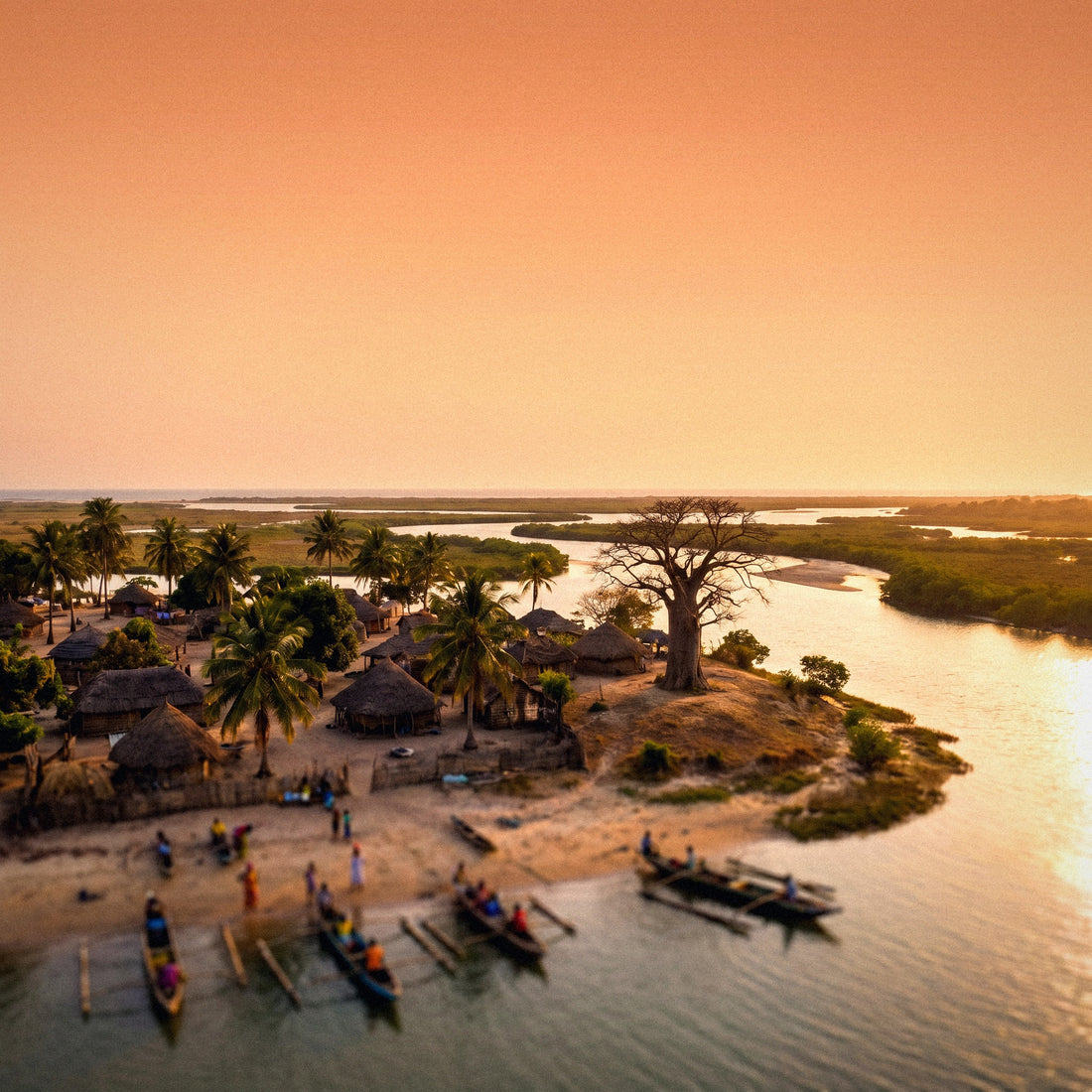
The Bijagós archipelago is the reason why most travelers come to Guinea-Bissau, and it deserves a serious warning regarding connectivity. There are about 88 islands and islets off the coast, declared a UNESCO Biosphere Reserve, of which only about twenty are permanently inhabited. There you will find the nesting beaches of green turtles, the famous hippos that swim in saltwater in Orango National Park, and a matriarchal culture in which women choose their husbands and sustain much of the social and ritual structure.
Tourism here is very nascent. There are no roads between islands or frequent European-style ferries: you get to Bubaque by boat from Bissau and from there you hop from island to island in a motorized canoe, with schedules that depend on the tide and the weather. Journeys are measured in hours, not minutes.
And now the part that needs to be said without embellishment: in much of the archipelago there is no stable coverage or electricity. You can have intermittent 2G or 3G near large towns and nothing as soon as you move away. You can have a signal on the beach and lose it when you enter the lodge. No eSIM, no local SIM, and no magic router will change that.
How I manage it: I download the offline map of the area, notify home that I will be unreachable for X days, leave the contact information of the tour operator in Bissau in writing, and forget about it. In the Bijagós, disconnection is not a travel flaw, it is the journey.
Bissau city: Portuguese quarter, CFA francs and useful apps
Bissau capital is where you will have all the connectivity the country can give you, and also where you will need it most. It is a small, hot city with a semi-ruined Portuguese colonial quarter —Bissau Velha— which is one of the most striking images of West Africa: pastel facades eaten away by humidity, bougainvillea growing out of roofless buildings, and neighborhood life among the ruins. Keep your phone charged, because you will be taking pictures.
A couple of practical things. Here, payments are made in CFA francs (XOF) and the country largely operates in cash: ATMs are scarce, do not always accept foreign cards, and many accommodations and guides charge in cash or euros. Have a cushion of banknotes and do not rely on paying with your mobile, because you will hardly be able to anywhere.
The apps you will truly use are few and all lightweight: WhatsApp, which is the default channel for talking to guides, hotels, and boatmen; Google Maps or Maps.me with the area downloaded offline, because the signal drops; the translator with Portuguese downloaded, which saves conversations; and the camera. None of this consumes much, which works in your favor.
To call a local number from your Spanish mobile, remember the prefix +245. And if you are coordinating transfers to the Bijagós, finalize everything possible while you are still in the capital with data: once you embark for the islands, changing plans by message ceases to be a reliable option.
How many GB you need depending on your trip
With the coverage available, data consumption in Guinea-Bissau is almost necessarily low: you won't be watching Netflix in 4K in Orango. This means you don't need to sign up for huge plans. This is my estimate by profile, designed for a typical one or two-week trip.
| Travel profile | Recommended data | Intended use |
|---|---|---|
| Business trip to Bissau, 3-4 days | 1-2 GB | Email, WhatsApp, a few short video calls |
| Tourist, one week between capital and Bijagós | 3 GB | Maps, messaging, uploading photos from the hotel |
| Two weeks with inland travel | 5 GB | Constant browsing, coordinating transfers |
| Long stay or remote work | 10 GB or more | Video calls and files, only from Bissau |
Three tricks to make your data last. One: activate data saver mode on WhatsApp and disable automatic photo and video downloads, which in an active family group can consume a gigabyte in no time. Two: download offline maps of Bissau and the archipelago before leaving home, along with any travel documents. Three: set your mobile's automatic backups to Wi-Fi only, otherwise your entire gallery will try to upload to the cloud over the mobile network.
And a warning about validity: both local bundles and travel plans have an expiration date in addition to a data limit. A 30-day plan is of little use if your trip is 12 days; even less so a 7-day plan if you're staying for three weeks. Always look at both figures together, not just the gigabytes.
Frequently asked questions
Is Guinea-Bissau the same as Guinea or Equatorial Guinea?
No, they are three completely different countries. Guinea-Bissau is Lusophone, its capital is Bissau, and it is located on the Atlantic coast of West Africa. Guinea (or Guinea-Conakry) is its Francophone neighbor, with its capital in Conakry. Equatorial Guinea is Spanish-speaking, located more than 2,000 kilometers away in the Gulf of Guinea, and its capital is Malabo. Their mobile networks are completely unrelated, so when buying data, make sure the description explicitly states Guinea-Bissau, with a hyphen.
Does European roaming work in Guinea-Bissau?
No. Guinea-Bissau is not in the EU or EEA, so "Roam Like at Home" does not apply. Spanish operators place it in their expensive zones—zone 3 for Movistar and Vodafone—and everything you consume there will be billed outside your plan. Before traveling, deactivate international data from your client area and connect with an eSIM or a local SIM. If your operator offers an international bundle, check that the country appears on the list with its full name.
Is there coverage in the Bijagós?
Very little, and intermittent. In the islands of the archipelago, 2G or 3G is common near the main villages, with large areas having no signal at all. In remote islands like parts of Orango, you can go days without coverage. Also, electricity is usually provided by generators for a few hours a day, and when the power goes out, the antennas also go down. No card or device changes this: assume you'll be disconnected and notify home before you embark.
How much does a local SIM cost in Guinea-Bissau?
The SIM card costs about 500 XOF (~€0.80) and a 5 GB bundle is around 3,500 XOF (~€5.30). The two operators are MTN Guiné-Bissau and Orange Bissau. The price is very low; what's expensive is the time: passport registration is mandatory and takes between 15 and 30 minutes at an official store, more if you go to a smaller stall. Top-ups are bought as scratch cards from street vendors, in denominations starting from 500 XOF.
MTN or Orange? Which has better coverage?
Orange usually provides better 4G within Bissau; MTN reaches a bit further in rural areas. MTN has been operating in the country since 2007 and is the dominant historical player, with over half a million customers. If your trip is urban and you need speed in the capital, choose Orange. If you're going to move inland or to less populated areas, choose MTN. Those who stay for weeks often carry both. Neither offers 5G: the country has not deployed it.
Can I use an eSIM in Guinea-Bissau?
Yes, as long as your mobile is compatible: iPhone XS or later and most recent mid-to-high-end Android phones. The eSIM connects to the same MTN and Orange networks, so coverage is identical to a physical card; what changes is that you activate it from home with a QR, without passport registration or queues upon arrival, and you keep your Spanish number active to receive bank SMS. Activate it with Wi-Fi before leaving Spain.
What currency is used and can I pay with my phone?
The West African CFA franc (XOF) is used, pegged to the euro at 655.957 XOF per euro, and the country operates mostly on cash. ATMs are scarce and don't always accept foreign cards, so bring enough cash and don't count on paying with your phone except in rare cases. Many guides, boatmen, and accommodations in the Bijagós charge in cash. It's advisable to exchange or withdraw money in Bissau before heading to the islands, as there's nowhere to do so there.
Conclusion
To recap: Guinea-Bissau is not Guinea or Equatorial Guinea, and this detail determines which SIM card will work for you and which won't. In the capital Bissau, you'll have decent 4G, between 10 and 25 Mbps, with Orange strong in the city and MTN better distributed in rural areas. A local SIM is very cheap—500 XOF for the card, about 3,500 XOF for 5 GB—but requires passport registration and half an hour of your first day. Spanish roaming is not included in the European bundle because the country is outside the EU, in zone 3. And in the Bijagós, there will simply be long stretches without coverage or electricity: no one can fix that, so it's best to accept it and enjoy it.
If you want to land connected and without paperwork, prepare it before leaving home: activate it calmly from your Wi-Fi and forget about it until you return. Here is the eSIM for Guinea-Bissau with data for the entire trip, without changing your number and without unpleasant surprises on your bill.