You've already decided on the important part: you're taking data to Guinea-Bissau and won't rely on finding Wi-Fi along the way. The only thing left to know is how many GB to buy so you don't overspend or run out. And this is one of those destinations where the honest answer is "less than you think" because you'll spend entire days without coverage. Here's the number, with reasoning and without beating around the bush.
Don't confuse it: why Guinea-Bissau uses little data
First, the basics so you don't buy a package for another country: Guinea-Bissau is not Guinea (the one in Conakry, Francophone and larger) nor Equatorial Guinea (the Spanish-speaking one in the Gulf of Guinea). It is a small, Lusophone, and very untouristed country on the Atlantic coast of West Africa. With that clarified, here's the short answer.
For 10 days in Guinea-Bissau, most travelers will have plenty with 2 or 3 GB. You'll spend much of your trip in the Bijagós, without coverage, and you won't use any data there: data only counts in Bissau and on the larger islands.
What makes this destination special, in terms of data, is precisely that: disconnection is not a risk, it is the default plan. In many countries, you calculate GB by what you consume per day; here, it's better to calculate by the few days when you will actually have a signal. If you spend four days on the islands and three in the capital, only those three truly count.
Therefore, if you're coming from the article how much data do I need to travel with a general rule in mind, lower it for Guinea-Bissau. Buying too much here is a waste of money, because your phone will be in de facto airplane mode for a good part of the trip, whether you like it or not. A small package and the option to top up is the smart move.
How much each activity truly consumes
Before deciding on the size, it's good to have a realistic idea of how much each activity consumes. Almost everyone overestimates: we think WhatsApp or maps devour gigabytes, when what really drains the package is video and endless social media scrolling. These are approximate and reference figures (they vary depending on the quality you have configured):
| Activity | Approximate consumption |
|---|---|
| Maps with navigation (Google/Apple Maps) | ~5 MB per hour (first load, 50-100 MB) |
| WhatsApp text only | 1-5 MB per day |
| WhatsApp voice call | ~30 MB per hour |
| Video call (WhatsApp) | ~440 MB per hour |
| Social media with scrolling (Instagram, TikTok) | 600-720 MB per hour |
| Uploading photos | 3-5 MB per photo |
| Streaming music (Spotify) | 50-150 MB per hour |
| Streaming video (YouTube, Netflix) | 700 MB to 3 GB per hour |
| Email and light browsing | 10-20 MB per hour |
The takeaway is clear: maps and messaging barely use any data, and these are precisely what you'll use most here. What truly skyrockets your data bill is watching videos or leaving autoplay enabled on social media. If you want the details by app, you can find them in our mobile data usage statistics by activity. In a destination where much of your leisure will be looking at the sea, not the screen, these numbers work in your favor.
Coverage by zone: where there's signal and where there isn't
Here's the key to why you'll spend little. Guinea-Bissau has two operators, MTN and Orange, and both concentrate their network in the capital and main roads. As soon as you move away from Bissau, the signal thins out quickly, and in the most remote islands, it simply doesn't exist. This table summarizes what to expect in each place:
| Zone | Coverage | What to expect |
|---|---|---|
| Bissau (capital) | Acceptable 4G | Maps, messaging, short video calls |
| Main islands (Bubaque, Rubane, Bolama) | Irregular 3G in villages | WhatsApp and email, with patience |
| Remote and uninhabited islands | None | No signal; don't even try |
| Canoe or boat trips | Dead zones | Download everything before you leave |
Translated into gigabytes: the only days that truly consume data are those you spend in Bissau and, hopefully, some time in Bubaque. Everything else is bonus time where your package remains untouched. That's why the winning strategy isn't to buy a lot "just in case," but to buy little and know that you'll only have coverage at specific times. If your itinerary is mostly islands, a 1-2 GB package might even be enough for two weeks.
The Bijagós: the archipelago where your data freezes
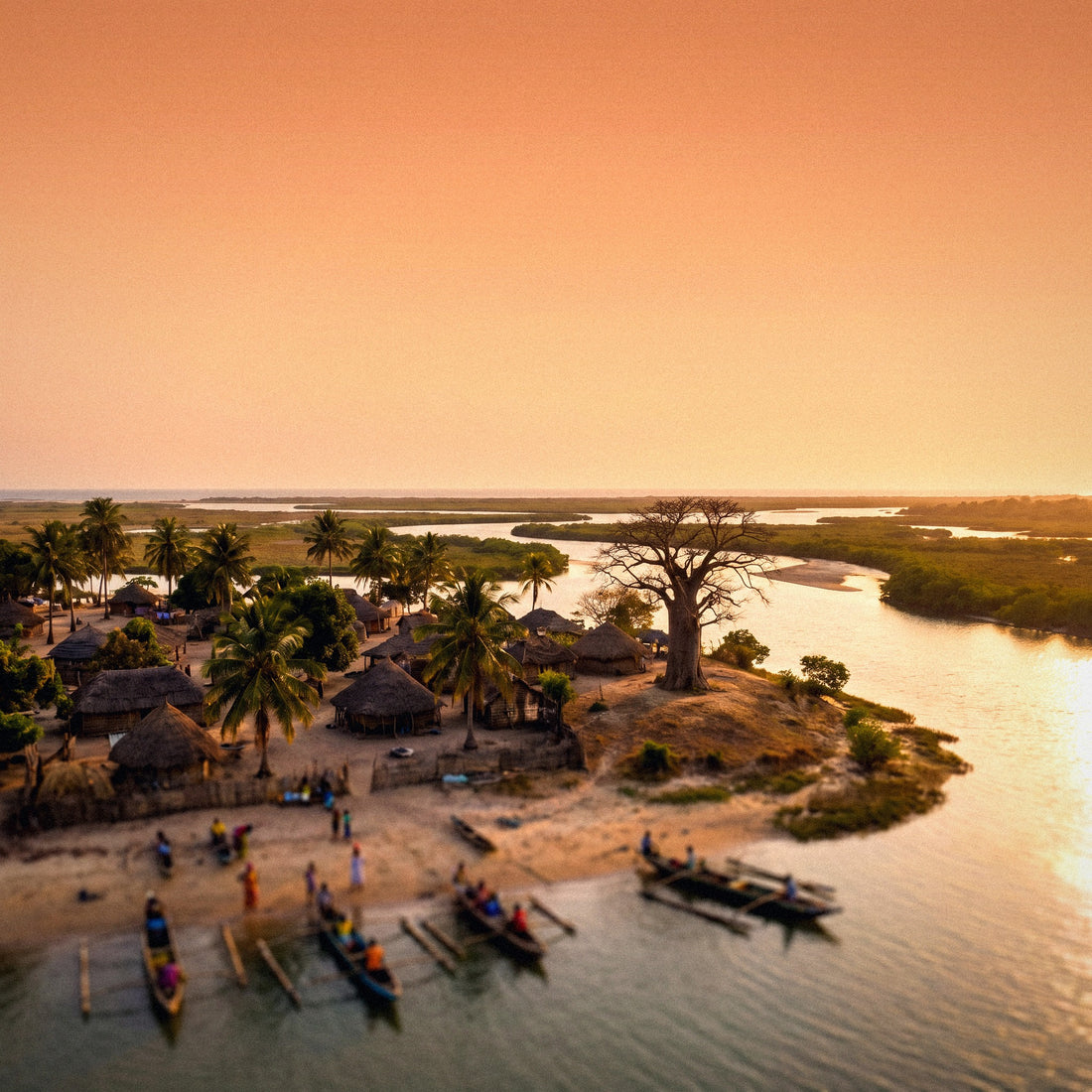
The heart of the trip, and the reason this article recommends small packages, is the Bijagós archipelago: 88 islands and islets declared a UNESCO biosphere reserve, with sea turtles nesting in the sand, mangroves, saltwater hippos, and a matriarchal culture where women play a central role in community life. You arrive by canoe or boat from the mainland, and once there, the rhythm is set by the tide, not the clock.
What's important for your data: on most of the islands, there is no mobile coverage or stable electricity. Many accommodations run on a generator for a few hours a day or with solar panels, so it's not even realistic to assume you can charge your phone whenever you want. Here, it's not about stretching your data: it's about accepting that your phone will be in airplane mode and enjoying it.
My honest advice is to plan for the disconnection rather than fighting it. Download offline maps, let your loved ones know you'll be unreachable for a few days, and carry a charged power bank for photos. The Bijagós are one of those places where the lack of signal is part of the experience, not a flaw. And, incidentally, your data package will thank you: it's impossible to use gigabytes where there's no network.
Bissau and the mainland: 4G is available here
Your actual consumption will be concentrated in the capital. Bissau retains a somewhat chipped but charming Portuguese colonial quarter, with the old port, Amura Fortress, and streets that breathe that quiet, Lusophone air. It's here that you'll have decent 4G to post photos, check the map, find a place to eat, or make a quick video call home. It's also the natural point to top up your data before venturing back to the islands.
Since it's a very untouristed country, don't expect the infrastructure of a mass tourist destination: fewer reliable Wi-Fi connections in cafes, less of everything. That's why bringing your own data ceases to be a convenience and becomes the sensible thing to do. If you're still debating between different ways to connect, I broke it down in internet in Guinea-Bissau; this article assumes you've already decided and just need to know the size.
An important logistical note: before traveling, check the official travel recommendations from the Ministry of Foreign Affairs. Guinea-Bissau requires a visa for Spaniards, the yellow fever vaccine is mandatory, and insurance with medical evacuation and registration in the Travelers Registry is advised. This doesn't affect your gigabytes, but it does ensure your trip goes smoothly, and having data helps resolve any unforeseen issues in the capital.
Recommendation by profile and travel days
This is the table you've been looking for. I've calibrated it for Guinea-Bissau, meaning it already assumes you'll spend several days without coverage on the islands and that your consumption will be concentrated in Bissau. Find your profile and your days, and you'll have a figure with a margin without overdoing it:
| Travel profile | 5 days | 10 days | 15 days | 30 days |
|---|---|---|---|---|
| Maps and WhatsApp (minimal use) | 1 GB | 2 GB | 3 GB | 5 GB |
| Photos and social media | 2 GB | 3 GB | 5 GB | 8 GB |
| Nomad / remote work (from Bissau only) | 5 GB | 10 GB | 15 GB | 25 GB |
| Family sharing a package | 3 GB | 5 GB | 8 GB | 12 GB |
Two honest caveats. First: if your trip is primarily to the islands, stick to the top row even if your normal usage is higher, because you won't be able to use data. Second: the remote work profile is the only one that needs large packages, and with a clear warning: don't count on working from the Bijagós. If your plan is to make work video calls, you'll have to do them from Bissau, and even then, allow for interruptions. For other profiles, any figure in this table will leave you feeling secure without overspending.
Calculate YOUR consumption before leaving home
Tables provide a good basis, but nobody knows your phone better than you do. There's a simple and reliable trick to fine-tune: check how much you spent last month and extrapolate. On an iPhone, go to Settings > Mobile Data and review the total for the period. On Android, in Settings > Network & Internet > Data Usage, you'll see a breakdown by app for the last month.
With that number, do a quick rule of three: if in 30 days of normal life you spent, say, 8 GB, that's about 0.27 GB per day. But in Guinea-Bissau, only days with coverage count. If out of a 12-day trip you'll have signal for 5 days, multiply by 5, not by 12: that comes out to about 1.3 GB. Round up to 2 GB and you're good to go.
This method is honest because it's based on your actual data usage, not an inflated calculation. And you can still lower the estimate further if you consider that there will be nothing to spend on the islands and that many heavy apps (Netflix, uploading videos) you probably won't even open on such a trip. My advice: write down your daily consumption number before you leave; it's the best starting point for deciding without hesitation and without being swayed by the fear of running short.
Tips for extending your data
Although it's hard to overspend here, these habits make a small package perform like a large one, especially on capital days:
- Offline maps. Download the entire area of Bissau and the islands in Google Maps with Wi-Fi before you move; then navigate using almost no data.
- Lower video quality. Set YouTube and social media to 480p and disable autoplay: this saves the most data.
- Backups only via Wi-Fi. Prevent photos from uploading automatically to the cloud using mobile data; let them wait for Wi-Fi.
- Data saver mode. Activate it in the system and within apps like WhatsApp and Instagram.
Golden rule for this destination: download anything you'll need offline (maps, music, a couple of series) with Wi-Fi before embarking for the Bijagós. Once in the canoe, there's no turning back and no network to be found.
You have the complete guide to these habits in how to save data on your travel eSIM. Applied here, they make 2 GB enough for an entire trip unless you're doing intensive remote work from the capital.
SIM with passport and what happens if you run short
Regarding local paperwork: if you buy a physical MTN or Orange SIM in Bissau, they will ask for your passport to register it, as it is mandatory. The process is done in official stores in the capital and is not always quick. That's why many people prefer to arrive already connected with a Guinea-Bissau eSIM: you activate it before flying and land with data, without queues or photocopies. If this is the first time you've heard the term, here's an explanation of what an eSIM is in two minutes.
What if you run short? Good news: running short here has almost no cost. When you run out of data, you'll probably be on an island without coverage, where you wouldn't have used it anyway; and when you return to Bissau, you can top up in minutes from your phone. It's much better to buy little and top up than to pay in advance for gigabytes you won't be able to use among the mangroves.
The logic is simple: overspending means money wasted on a large package that expires unused; running short means, at most, spending five minutes to top up when you have a signal. In a destination with such forced disconnection, the real risk is not running out of data, but having overpaid for it. Start small with peace of mind.
Frequently asked questions
The doubts I repeatedly receive about data in this destination, answered directly. If your case isn't here, opt for the small package and top up as you go.
Is Guinea-Bissau the same as Guinea or Equatorial Guinea?
No, they are three distinct countries. Guinea-Bissau is a Lusophone country on the Atlantic coast, with its capital in Bissau. Guinea (capital Conakry) is its larger, Francophone neighbor, and Equatorial Guinea is the Spanish-speaking one in the Gulf of Guinea. Make sure you buy data for "Guinea-Bissau" or "Guinea-Bisáu," not for the others.
How many GB do I need for 7 days in Guinea-Bissau?
2 GB is more than enough for a week of normal use. If a good part of your trip is spent on the islands, even 1 GB might suffice, as you'll only consume data in Bissau. Only increase to 3-4 GB if you plan long video calls or remote work from the capital.
Is there internet in the Bijagós?
Almost none, and that's the beauty of it. Main islands like Bubaque have irregular 3G in villages, but most islands have no coverage or stable electricity. Assume you'll be disconnected for several days and download maps and content before boarding.
Does an eSIM work in Guinea-Bissau?
Yes, in areas with coverage, which are Bissau and the main roads. You need an eSIM-compatible phone and to activate it before traveling. Where there's an MTN or Orange network, it works like a local SIM; where there's no network, there's nothing you can do, neither with an eSIM nor a physical SIM.
Do I need my passport to buy a local SIM?
Yes, passport registration is mandatory. MTN and Orange require you to identify the card with your document at their official stores in Bissau. This is another reason why arriving already connected saves you time and hassle upon landing.
Will my Spanish operator's roaming work?
It will work, but it's usually very expensive outside the EU. Guinea-Bissau is not included in European rates, so traditional roaming can be prohibitively expensive per megabyte. For a trip like this, a small local package is much cheaper and more predictable. Compare it yourself before you leave.
What happens if I run out of data on an island?
Nothing, because you wouldn't have coverage on the island anyway. When you return to Bissau, you can top up in minutes from your phone. That's why it's best to start with a small amount: running short in this destination has almost no consequences.
Do I need a VPN in Guinea-Bissau?
Not generally. It's not a country that blocks common apps, so you don't need a VPN just to use WhatsApp or social media. If you use it for security on public Wi-Fi, keep in mind that it consumes a bit more data, but it's not a decisive factor here either.
Conclusion
Guinea-Bissau is the perfect destination not to obsess over gigabytes. Between days of disconnection in the Bijagós and coverage concentrated in Bissau, most travelers will be fine with 2 or 3 GB for one or two weeks. Only if you plan to work remotely from the capital does it make sense to go up to 10-15 GB. For everything else, a small package, downloaded maps, and enjoy a country that, for once, forces you to put down your phone.
My honest recommendation: start small and recharge if necessary, which only takes a few minutes. Once you've decided, sort it out before you fly with PuraSIM's eSIM for Guinea-Bissau: activate it at home and land connected in Bissau without queues or paperwork. Have a good trip, and enjoy the disconnection of the Bijagós.