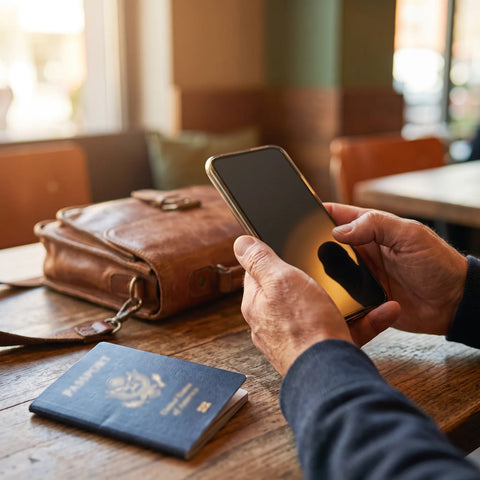
If you're already dreaming of Negril's beaches, sunset at Rick's Café, or a plate of jerk chicken in Montego Bay, there's one detail to sort out before packing your bags: how to get internet in Jamaica without overpaying or getting stranded searching for a signal. You'll need it for maps, to call a taxi, to send photos via WhatsApp, and to book your excursion to the waterfalls. In this guide, I compare, with no fluff and real data, all the options available to tourists —roaming, resort Wi-Fi, local SIM, and my recommended solution— so you can stay connected with your phone always at hand from the moment you land in Sangster.
All the ways to get internet in Jamaica
To get internet in Jamaica, you have four options: roaming with your operator (convenient but expensive and without European rates), resort Wi-Fi (free but weak in the room), a local SIM from Digicel or Flow (cheap, but requires a passport), and an eSIM you activate before flying. For most, the eSIM wins.
Jamaica is a very convenient destination in this regard: almost everyone lands and moves around well-covered tourist areas, so the challenge isn't so much having a signal as it is not paying too much for it. Before going into detail for each option, here's the summary I wish I had before landing, with the essentials at a glance.
| Option | Approx. Cost | Convenience | Ideal for |
|---|---|---|---|
| Spanish Roaming | High (bundles or per usage) | Zero hassle | Very short trips |
| Resort Wi-Fi | Free | Only at the hotel | Occasional inquiries |
| Local SIM (Digicel/Flow) | Low (from ~$3-15) | Requires passport and store visit | Long stays |
| Travel eSIM | Medium-low | Activates automatically | Most travelers |
None is "the best" in abstract: it depends on how many days you're staying, whether you're traveling alone or with family, and how far you'll venture from the tourist coast. In the following sections, I break down each with indicative prices and their drawbacks. If you're in a hurry, skip directly to the eSIM section.
Roaming with your Spanish operator
Roaming is the most convenient option available: you land in Sangster, turn on your phone, and you already have data without touching anything. The problem is the bill. Jamaica is not part of the European Union, so your "roam like home" rate does not apply here: as soon as your phone connects to Digicel or Flow, you enter international rates, which are among the most expensive available.
Without a contracted bundle, data can cost you several euros per MB, and with a couple of videos, you've blown your day's budget. Almost all Spanish operators sell daily bundles for "zone 2" or "rest of the world" that range between €6 and €15 per day for a few data; multiply that by a week on the island and you'll see that convenience comes at a very high price.
My personal rule: I only leave roaming on as an emergency network on the day I arrive, until I have a cheaper option ready. Never as a plan for the entire stay.
If you want specific numbers for your company, I've got my guide on how much international roaming costs and a direct comparison of eSIM vs. roaming. In short: convenient yes, but the most expensive way to stay connected in the country.

Resort and all-inclusive hotel Wi-Fi
If you're traveling with an all-inclusive package, Wi-Fi is your natural ally for everything that's not urgent. Almost all resorts in Montego Bay, Negril, and Ocho Rios offer free Wi-Fi in common areas, and many hotels in Negril have already installed fiber optic with very decent speeds. To upload photos, make a video call at night, or plan the next day, using the lobby Wi-Fi late at night is more than enough and doesn't cost a dime.
The classic drawback: that Wi-Fi usually works fine in the lobby, bar, or by the pool, but it's weak inside the room, especially in blocks far from reception or on higher floors. And as soon as you leave the premises —to the public beach, Dunn's River Falls, or an inland tour— the Wi-Fi doesn't come with you.
Another downside is security: on open networks, it's best not to enter bank details without a VPN. I always treat it as a complement, never as my sole network. If you're considering renting a portable router, in my comparison of eSIM vs. pocket Wi-Fi, I explain why it rarely pays off in a destination like this.
Local SIM: Digicel and Flow
A local SIM is the cheapest option if you're staying for many days or use a lot of data. In Jamaica, there are only two operators: Digicel and Flow. Digicel is the king of coverage —it controls around 70% of the market, reaches nearly 98% of the population, and has over 600 antennas, so it holds up better in villages and rural areas. Flow performs very well in cities and tourist corridors (Kingston, Montego Bay, Ocho Rios, Spanish Town, Portmore), but loses steam in the countryside.
Digicel has packages designed for tourists: for example, a 3-day SIM with 7 GB for about $12 or a 10 GB SIM for up to 7 days for about $15, and a standalone SIM costs around $3-25 depending on the bundle. You can buy it at Montego Bay (Sangster) or Kingston (Norman Manley) airports, in official stores, or at an authorized booth.
The downside is the process: by law, you have to wait in line with your passport in hand to register the SIM, and then deal with recharges and the operator's app. If you're staying for a month or want a Jamaican number, it pays off. For a week at a resort, many find it a hassle. I detail this in my comparison of eSIM vs. local SIM.
The eSIM, my recommended option
For the vast majority of trips to Jamaica, my recommendation is a data eSIM. It's a digital SIM you buy online, receive by email, and install by scanning a QR code: you can get it ready from your sofa at home a few days before flying and land in Sangster already connected, without looking for stores or registering anything with your passport. If you've never used one, in my guide on what an eSIM is, I explain it step by step.
The advantages are clear. You keep your Spanish number in your phone's physical slot —for receiving bank SMS or calls— while data travels via the eSIM connected to the local network with the best coverage, usually Digicel. There's no plastic to lose, no deposit, and you don't depend on finding an open store on the day you arrive.
The honest downside: for very long stays and huge data consumption, a rechargeable local SIM might be slightly cheaper per GB. But when you add up the convenience and zero paperwork, the balance tips toward the digital option for the average traveler. You'll find all the fine print, prices, and coverage in my eSIM guide for Jamaica.
Coverage by area: coast yes, mountains no
This is the section most people skip and later regret. The good news: in tourist areas, Jamaica is well-covered. In Montego Bay, Negril, Ocho Rios, and Kingston, you'll have plenty of 4G for maps, social media, and video calls. Keep in mind that as of 2026, there is still no general 5G deployment on the island: both operators primarily rely on 4G/LTE, which works perfectly for what a tourist needs.
The problem arises when you go up into the mountains. In the Blue Mountains, deep inland, or on secondary roads towards waterfalls and coffee farms, the signal drops, and there are stretches where you'll be deep in the mountains without a single bar, and not even the best eSIM can fix that. Here, Digicel holds out slightly better than Flow, but neither works miracles.
| Area | Mobile Coverage | What to Expect |
|---|---|---|
| Montego Bay and Negril | Very good (4G) | Smooth connection at resort and beach |
| Kingston and Ocho Rios | Very good (4G) | Ideal for maps, social media, and work |
| Cruise ports (Falmouth, Ocho Rios) | Good | Decent signal at the port |
| Inland roads | Irregular | Stretches with intermittent signal |
| Blue Mountains | Scarce or none | Be prepared to be disconnected |
Moral of the story: on the tourist coast, you're covered; for days exploring the interior, download maps and expect periods without connection.

How much data do you really need?
The million-dollar question. The good news is that calculating gigabytes wisely is easier than it seems if you separate by usage type. As a general rule, an average traveler uses about 1 GB per day: light use (maps, messaging, some web browsing) is around 0.4 GB, while intensive use with social media, video, and uploading beach photos goes up to 2.5 GB daily or more.
For a week at a resort, that's about 7-15 GB; for two weeks exploring the island, between 15 and 30 GB. If you use the hotel Wi-Fi a lot at night, you'll stay on the lower end. Here it is in a table for clarity.
| Profile | Daily Consumption | 7-14 Days |
|---|---|---|
| Light (maps and chat) | ~0.4 GB | 3-6 GB |
| Medium (social media and browsing) | ~1 GB | 7-15 GB |
| Intense (video and live streaming) | ~2.5 GB | 18-35 GB |
My trick: since you'll often be on resort Wi-Fi or without coverage in the mountains, don't inflate your estimate. And if in doubt, choose a plan with some margin or with a top-up option; running out on the second to last day is the typical avoidable hassle.
Special section for cruises and all-inclusive resorts
Jamaica receives many cruise passengers in Falmouth, Ocho Rios, and Montego Bay, and also many resort travelers who barely leave the premises. If this is your case, the equation changes slightly. Cruise days are short: you get off in the morning and return to the ship in the afternoon, so you don't need a huge plan. At the port, coverage is good, and with a small eSIM of 1 or 2 GB, you'll have plenty for maps, calling a taxi, and sharing your excursion, without paying the ship's rip-off satellite data rates.
Tip for cruisers: activate data as soon as you set foot on land and put your phone in airplane mode when you return to the ship. This way, you make the most of every minute in port and don't accidentally enable the expensive onboard Wi-Fi.
If you're going all-inclusive and plan to mostly stay within the resort, combine the resort Wi-Fi for heavy use with a modest data plan for excursions: the public beach, the craft market, or that trip to Dunn's River Falls. This way, you can make the most of every hour on land without struggling with your phone.
How to choose and activate your connection
Choosing wisely means crossing three pieces of data: travel days, estimated gigabytes, and how far you'll venture from the tourist coast. If your plan is resort and beach, almost any option works, and convenience dictates; if you're going to explore the island and hike in the mountains, prioritize the network with the best rural reach. The best thing is to get everything ready before taking off and not improvise at the airport.
With an eSIM, the process is quick. These are the steps I follow:
- Check that your phone is eSIM compatible (phone settings or manufacturer's website).
- Buy the plan with the right GB and days for you, a few days before flying.
- Install the profile by scanning the QR code you receive by email, using Wi-Fi at home.
- Set the eSIM for "data" and your Spanish SIM for calls and SMS.
- Upon landing in Sangster, activate data roaming for the eSIM, and you're good to go.
A practical note: install the profile at home, but don't activate it until you arrive, to avoid using up plan days prematurely. With this, you'll leave the airport with Google Maps working and without losing a minute searching for where to buy a signal.
Tips to avoid losing signal
Even with the best connection, you'll spend some time without coverage in Jamaica, especially if you venture inland, and a couple of habits can make a difference. Most importantly: download offline maps from Google Maps for your entire route before leaving the hotel. Having offline maps downloaded will save you from getting lost on un-signed mountain roads, which do exist.
Other habits that have saved me from more than one tight spot:
- Download tickets, reservations, and e-tickets to your phone in case there's no network when you arrive.
- Save music or podcasts offline for long road trips.
- Take advantage of the fact that almost all Digicel plans include WhatsApp, Facebook, and Instagram without using up data.
- Carry a power bank: searching for a signal in fringe areas drains your phone's battery quickly.
And a useful warning: in Jamaica, they drive on the left, and roads can be challenging, so GPS will be your best friend, and it's advisable to keep it always operational. By combining a good data connection for daily use, resort Wi-Fi for heavy tasks, and these little tricks for gaps, your trip will be covered from start to finish without surprises.
Frequently asked questions
Does my Spanish operator's roaming work in Jamaica?
Yes, but at international roaming prices, not European rates. Jamaica is not in the EU, so "roam like home" doesn't apply. Check the exact cost per MB or travel bundle before you leave, as it's usually among the most expensive options available.
Do I need my passport to get internet in Jamaica?
Only if you buy a local SIM: the law requires you to register it with your passport at a store or authorized point. With a travel eSIM or your operator's roaming, no in-person process or document is needed.
Is 5G available in Jamaica in 2026?
Generally, not yet. Both Digicel and Flow primarily operate on 4G/LTE, which is more than sufficient for maps, social media, streaming, and video calls. Don't expect stable 5G, but you won't miss it as a tourist either.
Digicel or Flow, which has better coverage?
Digicel, by far, for island-wide travel: it reaches nearly 98% of the population and holds up better in rural areas. Flow performs very well in cities and tourist corridors, but loses signal inland and in the mountains.
Will I have signal in the Blue Mountains?
Little to none in many sections. The mountains and roads leading to coffee farms are poorly covered by any operator. Download offline maps before heading up and assume you'll be disconnected for much of that excursion.
How many gigabytes do I need for a week in Jamaica?
For average use, between 7 and 15 GB is usually enough; if you take many photos, videos, or live stream, aim higher. Remember that you'll use resort Wi-Fi and won't consume data in the mountains, so don't inflate your estimate.
Is resort Wi-Fi alone enough for me?
For nightly and non-urgent tasks (uploading photos, video calls, planning), yes. But it's weak inside the room and doesn't accompany you outside the premises: neither on the public beach nor on excursions. Treat it as a complement, not as your only network.
Conclusion
To summarize the map: roaming is convenient but expensive and without European rates, resort Wi-Fi is free but stays within the hotel, a local SIM from Digicel or Flow is worthwhile if you stay long but requires a passport, and an eSIM is the sweet spot for most travelers. And the Jamaican lesson: on the tourist coast, you're well-covered; in the Blue Mountains, assume you'll be without a signal and have maps downloaded.
If you want to forget about it and be connected from the very first minute, take a look at the PuraSIM eSIM for Jamaica: you buy it, install it at home, and land in Montego Bay with Google Maps working. Have a great trip and enjoy the reggae. One love.