Every time someone writes to me asking about internet in Switzerland, the conversation ends at the same point: "But if it's Europe, don't I have free roaming?" And that's where the cold shower comes in. Switzerland is surrounded by European Union countries, you can get there by train from Milan, you pay with a card... but it is not part of the EU or the European Economic Area. That changes the rules of the game for your mobile. Here I compare all the real options for Spanish tourists, with prices, actual coverage in the Alps, and a clear recommendation at the end.
Switzerland is not in the EU: the detail that changes everything
Quick answer: Switzerland does not belong to the European Union or the EEA, so the European "roaming like at home" rule does not apply there by default. Some Spanish operators include it anyway as a promotion, while others charge separately, sometimes very expensively. Always check before traveling.
The European regulation that eliminated roaming surcharges covers the 27 EU countries plus Iceland, Norway, and Liechtenstein. Switzerland, despite being in the center of the continent, was left out. Swiss telecom companies negotiate their wholesale rates freely, so each Spanish operator decides on its own how to charge you for the data you use there.
The result is an uneven map. There are companies that have included Switzerland in their European zone as a commercial gesture, with an expiration date and fine print. Others treat it as if it were Japan, with daily or per-megabyte rates. And there are old or low-cost tariffs where it is not included and the list price applies.
So the first thing, before looking at prices: open your operator's customer area and literally search for "Switzerland" in their list of roaming zones. Don't trust what they told you two years ago. I detail the updated information in my guide on whether there is roaming in Switzerland.
Your Spanish operator in Switzerland: who includes it and who doesn't
This is what I find in 2026. Note: these are promotional conditions, with an end date and subject to change. Use them as a guide, not as a guarantee.
| Operator | How Switzerland is treated | What it means for you |
|---|---|---|
| Vodafone | Included in its European zone (Zone 7) as a promotion, with an announced deadline and fair use policy | You browse with your national tariff, but check that your specific plan includes that zone and until when |
| Movistar | Paid destination: around €6 per day with an approximate cap of 500 MB daily | A week costs about €40 for very little data |
| Orange | Outside the European zone; resolved with "Destinos Plus" type bonuses (about €25 for 20 GB / 7 days) | Reasonable if you activate it, very expensive if you forget |
| Yoigo, MásMóvil, Pepephone and others | Special tariffs that can reach €25 per GB | This is where three-figure bills come from |
Notice the pattern: even in the best-case scenario, Switzerland's inclusion is a temporary exception, not a right. Virtual operators rarely inherit promotions from the parent operator.
My rule: if your company confirms in writing that Switzerland is included at no cost and your plan has plenty of data, take advantage of it. If they answer ambiguously, assume you're going to pay and look for an alternative. The full figures are in my comparison of eSIM vs. roaming.

How much it costs not to check before leaving
This is where the real damage is done. A typical trip to Switzerland lasts between five and eight days, and it's a destination where you use your mobile a lot: train schedules, maps, cable cars, photos you upload instantly because the landscape demands it. In that context, using 5 or 6 GB in a week is normal.
Do the math with the table above. With an operator charging €25 per gigabyte, those 5 GB are €125. With a €6 per day model limited to 500 MB, eight days are €48 for barely 4 GB, and with the scare of running out by mid-afternoon. If two of you are traveling, multiply.
The worst part is not the amount, it's the feeling of constantly watching the meter. I've seen people turn off their data when getting off the plane and navigate blindly through Zurich. That's not saving money, it's ruining your trip for twenty euros.
Don't trust automatic warnings either: outside the EEA, the mandatory €50 spending limit imposed by the EU does not always apply equally, and some operators only activate it if you ask. If you want to see the range for other destinations, I have it broken down in how much international roaming costs. Switzerland is always at the top of that list.
Hotel Wi-Fi: useful, but not a plan
Switzerland has good Wi-Fi in accommodations: almost all hotels and apartments include it for free and it works well. Many museums and cafes also offer open networks. If your trip consists of sleeping, having breakfast, and returning, you might get by.
The problem is that a trip through Switzerland is just the opposite. You spend the day out: climbing to a viewpoint, changing trains in Spiez, looking for the right path in Grindelwald, checking if the last funicular leaves at 5:40 PM or 6:10 PM. All of that happens far from any hotel network, and that's when you need data the most.
There are three drawbacks to be aware of:
- Scarce public Wi-Fi outside cities. In alpine villages and intermediate stations, there are no reliable open networks.
- Security. Open networks at airports and cafes are the least suitable places to access your bank or buy tickets with a card.
- Reliance on pre-download. You can download maps and tickets in PDF, but a change in schedule or a canceled train leaves you stranded.
My conclusion after several trips: hotel Wi-Fi is a good complement for uploading photos at night, and a terrible main plan. Treat it as dessert, not the main course.
Local Swiss SIM: Swisscom, Salt and Sunrise
The second classic option is to buy a Swiss prepaid card upon landing. There are shops for the three major operators at Zurich and Geneva airports. Whether it's worth it is another matter.
Swisscom is the operator with the best coverage in the country, especially in the mountains, and it has tourist tariffs: "flat" packages with data and calls for 7 days for around 20 francs (about €20), extendable up to 90 days. Salt is the cheapest option, with plans starting from 1.99 francs per day, which you only pay on the days you use it. Sunrise is in the middle, with pay-as-you-go prepaid.
On paper, it's not bad. In practice, there are frictions that put me off:
- You have to register the SIM with your passport: it is mandatory by law in Switzerland and takes time at the counter as soon as you land.
- You change your Spanish number during the trip, so you lose calls and bank verification SMS.
- You need an unlocked phone and to keep your original SIM card in a safe place.
- Prices are in Swiss francs and recharges are made on websites not always translated.
If you're staying for two or three months for work or study, a local SIM makes perfect sense. For a week-long getaway, the hassle is not worth it. I compare it in eSIM vs. local SIM.
The eSIM: why I recommend it
An eSIM is a digital card that you install on your mobile without changing anything physical. You buy it from home, activate it upon landing, and keep your Spanish number for calls and SMS while data runs on the new plan. If this is the first time you've heard of this, I explain it in what an eSIM is.
For Switzerland, the advantages are clear. You connect to Sunrise and Salt in 5G, top-tier networks within the country, without relying on expensive roaming agreements. There's no counter, no passport, no recharging in francs. And the price is known before you leave home, which for me is the definitive argument.
PuraSIM's eSIM for Switzerland plans start at €7.95 for 1 GB for 7 days and go up to €13.95 for 3 GB, €16.95 for 5 GB in 30 days, or €25.95 for 10 GB. They include hotspot data sharing, so if you're traveling as a couple or family, it's enough for one person to have the large plan and the others to use it.
The only requirement is that your mobile is compatible: iPhone XS or later, Samsung Galaxy S20 onwards, Pixel 3, and over five hundred current models. You have the step-by-step installation in my Switzerland eSIM guide.

Comparison of the four options
This is the panorama for a typical week-long trip. The amounts are indicative, calculated based on realistic consumption of about 5 GB.
| Option | Approximate Cost (7 days) | Advantage | Disadvantage |
|---|---|---|---|
| Roaming with your operator | From €0 (if included) to €125 or more | Zero hassle if your plan covers it | Depends on a promotion that may end; risk of a surprise bill |
| Hotel Wi-Fi only | €0 | Free and sufficient at night | Leaves you disconnected just when you're out |
| Local Swiss SIM | €15-25 plus processing time | Excellent national coverage | Passport registration, number change, unlocked phone |
| Data eSIM | €14-17 for 3-5 GB | Fixed price, instant activation, keep your number | Requires compatible mobile |
My rule in Switzerland is simple: if your operator confirms in writing that it's included at no cost, use it. If they don't confirm, don't guess. An eSIM costs less than two coffees in Zurich and solves the problem before you pack your bag.
And a clarification: these options are not mutually exclusive. You can keep your Spanish line active to receive bank SMS, use data with the eSIM during the day, and take advantage of hotel Wi-Fi at night. That's what I do, and it's the combination that causes the fewest headaches.
Real coverage: Zurich, Geneva, Interlaken and Zermatt
Here, Switzerland plays in another league. It is one of the best-connected countries in the world. But it is important to distinguish between city, valley, and high mountains, because the experience is not the same.
Zurich and Geneva have dense 5G throughout the urban area, airports, and stations. The same applies to Bern, Basel, Lausanne, and Lucerne: you browse just like in Madrid or Barcelona, often with better speeds. At airports, the eSIM connects before you even reach the baggage claim.
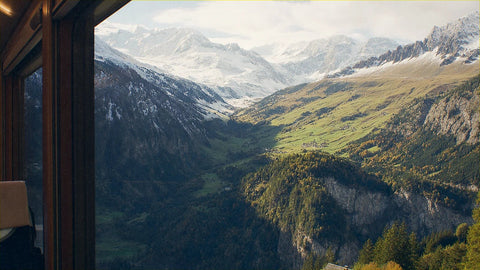
Interlaken and the Bernese Oberland valley work very well: solid coverage in the village, in Lauterbrunnen, in Grindelwald, and on the trains climbing towards the Jungfrau.
Zermatt is an interesting case: the village has very good signal, with stable 4G and 5G, because it thrives on tourism and the infrastructure is well-maintained. In the ski area, coverage is partial: good on the lower slopes and at the lift stations, more irregular at higher altitudes and on north faces, where topography dominates. The same applies to St. Moritz, Verbier, or Davos.
In short: wherever there is a village, a hotel, or a station, you will have data. Gaps appear on ridges, glaciers, and very enclosed valleys.
Panoramic trains and high mountains
Trains are the main reason to go to Switzerland, so they deserve their own paragraph. The good news is that the Glacier Express, the Bernina Express, and the GoldenPass have mobile coverage for most of the journey. You'll be able to check the map, send photos via WhatsApp, and look up the name of that peak you just saw.
The realistic part: there are cuts in tunnels, and there are many in Switzerland. The route between Zermatt and St. Moritz crosses dozens, and in each one, the signal disappears for a few seconds. It's not a card malfunction, it's physics: download music beforehand and don't count on making video calls from the panoramic carriage.
Be careful with a widespread idea: Swiss trains do not have free Wi-Fi on board as a general rule, and that of stations is limited. In addition, the windows of panoramic carriages have coatings that hinder the signal.
In the high mountains, Swiss infrastructure is surprising. At the Jungfraujoch, at 3,454 meters, there is signal. At the major viewpoints (Schilthorn, Gornergrat, Pilatus) too, because they are tourist destinations with their own antennas. You won't have it while trekking off the main routes or in isolated refuges: if you're going to hike on your own, download offline maps before leaving.
How much data you really need
The question I get asked most. Short answer: less than you think, unless you upload video daily. On a leisure trip, consumption is dominated by maps, messaging, and social media, and none of these are data-hungry if you're not streaming video on a loop.
| Traveler Profile | Typical Usage | Recommended Data |
|---|---|---|
| Light (4-5 days) | Maps, WhatsApp, email, some digital tickets | 1-3 GB |
| Standard (7-10 days) | All of the above plus social media, photos, and constant searches | 5 GB |
| Intensive or sharing as a couple | Daily stories, video, continuous GPS navigation, hotspot | 10-20 GB |
| Long stay or remote work | Video calls, cloud, use as primary line | 20-50 GB |
Three tricks I always apply that reduce consumption by almost half without giving up anything:
- Download offline maps of the areas you are going to visit before leaving home. Google Maps allows this, and GPS works without data.
- Disable automatic video playback on Instagram, TikTok, and X. This is the biggest data drain.
- Upload photos and backups only with Wi-Fi. Leave iCloud or Google Photos in "Wi-Fi only" mode and sync at night at the hotel.
With these three measures, a 3 GB plan will last a week of normal tourism. If you're torn between two sizes, choose the medium one: three extra euros for peace of mind always pays off.
Frequently Asked Questions
Do I have free roaming in Switzerland?
Not by default. Switzerland is not in the EU or the EEA, so the European "roaming like at home" rule does not cover it. Some Spanish operators, like Vodafone, include it as a temporary promotion; others charge up to €25 per GB. Check with your company before traveling.
How much does it cost to connect to the internet in Switzerland?
It depends on the method. A data eSIM costs around €14-17 for 3-5 GB. A prepaid local SIM costs between €15 and €25. Roaming without a promotion can skyrocket to over €100 in a week. Hotel Wi-Fi is free, but only works within the hotel.
Does my eSIM work in the Alps and in the mountains?
Yes, in the vast majority of tourist locations. Swiss networks cover alpine villages, ski resorts, ski lifts, and viewpoints like Jungfraujoch, at 3,454 meters. Gaps appear on isolated ridges, glaciers, and off-the-beaten-path trails, where it's advisable to carry offline maps.
Is there free Wi-Fi on Swiss trains?
As a general rule, no. Swiss trains, including panoramic ones like the Glacier Express, do not offer free Wi-Fi on board, and Wi-Fi at stations is limited. Mobile coverage does work for almost the entire journey, with occasional cuts when passing through tunnels.
Can I use the same eSIM if I also visit France or Italy?
It depends on the plan. A Switzerland-specific eSIM only covers Switzerland. If your route includes neighboring countries, you might be interested in a regional European plan that includes Switzerland, or combining two eSIMs. Always check the list of covered countries before purchasing.
Can I share data with my partner or family?
Yes, if the plan includes a hotspot. PuraSIM eSIMs allow this, so one person only needs to have the large plan and share the connection with the rest of the group. It's the cheapest way to connect two or three people on the same trip.
Do I need to register my passport to get internet in Switzerland?
Only if you buy a local physical SIM. Swiss law requires the identification of the holder of any national prepaid card, which means going to a counter with your passport. With an international eSIM, no in-person procedures are necessary.
Do I keep my Spanish number if I use an eSIM?
Yes. The eSIM is installed as an additional line: data goes through it, and your Spanish card remains active to receive calls and SMS, including bank verification codes. You only need to deactivate mobile data on your Spanish line to avoid charges.
Conclusion
If you take away one idea from all of this, let it be this: Switzerland seems like Europe in every respect, but for your mobile phone, it is not. European roaming does not apply by default, and that's where many Spaniards are surprised when they return home. The solution is not complicated; you just have to take it before you leave.
Check your rate. If your operator confirms that Switzerland is included at no cost, travel with peace of mind. If not, get an eSIM and forget about it: you connect to Sunrise and Salt's 5G networks as soon as you land, keep your Spanish number, share data with whoever travels with you, and know what you're paying before you pack your bags.
Prepare your trip well-connected: get your eSIM for Switzerland from €7.95, install it in two minutes from home, and arrive in Zurich or Geneva with internet working from the first minute.