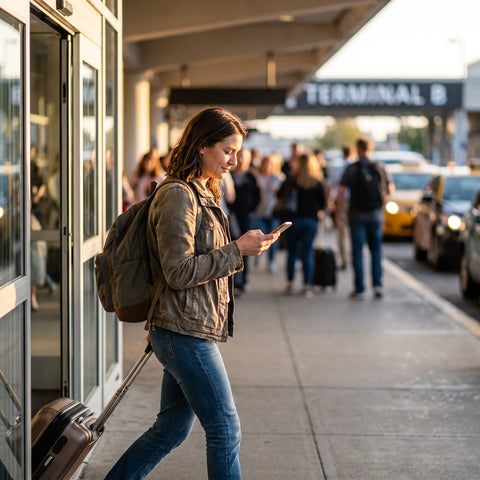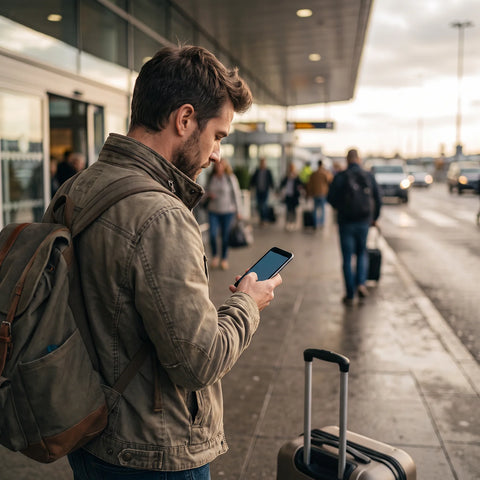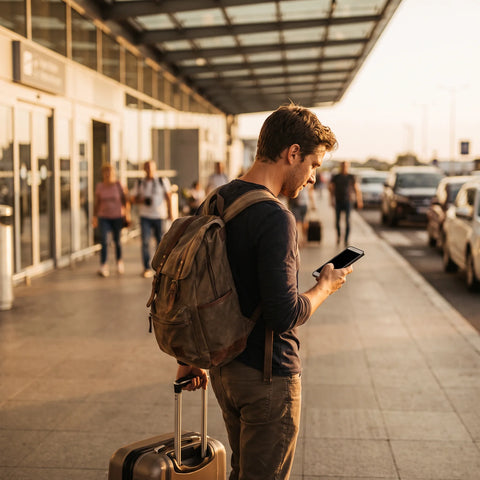
How can I get internet when I travel?
To have internet while traveling, you have three options: activate your carrier's roaming, buy a physical SIM upon arrival, or install a digital eSIM before leaving home. eSIM is the most practical option: you don't need to change cards or buy an extra device; just scan a code and activate it from the phone you already use.
If you searched for "travel internet modem," you've probably already come across portable routers, words like "mifi" or "hotspot," and also "eSIM" without clearly understanding what each one is. Let's break it down from scratch, without assuming you know what each term means.
What is a travel internet modem and how does it work?
When someone looks for a "travel internet modem," they almost always refer to a small device, about the size of a deck of cards, that has a SIM card inside and creates its own Wi-Fi network. You connect to that network from your cell phone, tablet, or laptop, just like you would connect to a cafe's Wi-Fi. The device communicates with the cell tower in the country you are in; your devices only communicate with the device itself.
This idea was born because, for years, the only way to have mobile data abroad was to pay your home carrier's roaming fees (expensive and with fine print) or find a store that sold you a local SIM upon arrival (with queues, identification paperwork, and sometimes out of stock of the plan you wanted). The portable modem solved a real problem: it gave you your own internet without relying on hotel Wi-Fi.
What many people don't know is that the same problem, today, can be solved without carrying an additional device. There is a digital version of the SIM card that goes directly inside your cell phone: it's called an eSIM, and it performs the same function as a physical modem without the bulk, the extra battery to manage, or the risk of losing it in your backpack.
Types of travel internet solutions available today
Before comparing which one is best for you, it's worth looking at the complete picture. When people say "I need internet for travel," they are actually describing four different solutions, each with a different way of working:
- Portable router or mifi with local SIM: the device described above. You need to buy (or rent) it, charge it, and insert a SIM from the destination country or an international SIM.
- USB modem or "internet stick": similar to the mifi, but connects directly to a laptop's USB port instead of creating Wi-Fi. Increasingly less common because almost no one travels with only a laptop and no cell phone.
- International roaming from your home carrier: your own number continues to work abroad because your carrier has an agreement with a local one. Convenient, but usually the most expensive option per megabyte if you didn't buy a specific package before leaving.
- Travel eSIM: a digital profile that is downloaded to your compatible cell phone or tablet and gives you a local or regional data number, without a physical card or additional device. You can thoroughly compare this option against a traditional physical SIM in our eSIM vs. physical SIM comparison.
All four solve the same problem—having mobile data outside your country—but they differ greatly in how much you have to carry, how long it takes to activate them, and what happens if you lose or forget them.

Which internet is best for traveling?
There isn't a single answer because it depends on how many devices you need to connect and how much luggage you want to carry. But there are objective criteria you can compare before deciding:
| Criterion | Portable router (mifi) | Carrier roaming | Travel eSIM |
|---|---|---|---|
| Do you need to buy or rent a device? | Yes | No | No |
| Do you have to carry an extra battery? | Yes | No | No |
| Connects multiple devices simultaneously | Yes, several via Wi-Fi | No, only the cell phone with that line | Depends on the cell phone; many share data via hotspot |
| Requires picking up or returning something | Yes, if rented | No | No |
| Do you continue to use your same cell phone number? | Yes, in parallel | Yes | Yes, in parallel |
| What happens if you lose or forget it? | You lose your own internet | Not applicable, it's on your physical SIM | Not applicable, it's installed on the cell phone |
For a traveler carrying multiple devices (e.g., a work laptop and a tablet for the kids), a portable router still makes sense because it shares a single connection among all of them. For someone traveling with their cell phone as the center of everything—which is most people—the eSIM eliminates steps without removing that function: almost all current cell phones can share their own data via hotspot with another device, so you end up solving the same problem without the extra device.
What is travel internet called?
This is the confusion that brings most people to this article: there isn't just one name, because there are several different products disguised by the same question. These are the terms you'll see used—sometimes correctly, sometimes as loose synonyms—when someone is looking for internet for a trip:
- Mifi or pocket wifi: the most common commercial name for the portable router with a SIM inside.
- Portable hotspot: the same as mifi, described by what it does (creates a Wi-Fi access point).
- Travel 4G/5G modem: another way to name the same device, focusing on the network technology it uses.
- Travel SIM or international SIM: the physical card you buy to insert into your cell phone or router.
- Travel eSIM: the digital version of that SIM, which doesn't need a card or tray.
If you saw any of these names and weren't sure if they were the same thing or different things, now you have the complete picture. The important thing is not to memorize the correct term, but to understand that they all aim for the same goal: having mobile data outside your country without relying on third-party Wi-Fi.
Which internet can you take everywhere?
If your priority is not to carry anything additional and for it to work the same in every country on your itinerary, the eSIM is the closest thing to "internet you wear." It lives inside your cell phone, doesn't take up space in your suitcase, and doesn't depend on an extra device having battery beyond the one you already carry in your pocket.
With a single international coverage eSIM profile, you can move between more than 200 destinations without buying a new SIM at each border. This doesn't mean that a single plan will work for your entire trip without thought—each plan covers certain countries or regions—but it does mean that you don't have to find a physical store or wait in line at the airport to get data as soon as you land.
The best travel internet is the one you stop noticing: it activates before you leave, works when you land, and doesn't force you to think about it until you need it.
However, the eSIM has an entry requirement: your cell phone must be compatible. Most mid-range and high-end models from recent years are, but it's worth checking before counting on it as your only solution; you can verify it in our guide to eSIM-compatible cell phones.
A real example: how it looks on a trip
To make this less abstract, imagine a twelve-day trip starting in Mexico City, continuing in Bogotá, and ending in Lima—a common itinerary for those visiting family or sightseeing in more than one country in the region.
With the portable modem route, the person would have to choose between renting a device with coverage for all three countries (and returning it upon return, usually by mail or at the departure airport), or buying a local SIM in each city, which involves finding a store, completing identification procedures, and repeating the process three times.
With a regional coverage eSIM, the process changes significantly. The person buys and installs it from home in Mexico before traveling—using their home Wi-Fi, because installing the profile requires being connected to the internet once. Upon landing in Bogotá, they activate the corresponding plan and have data in approximately one minute, without searching for a counter or a store. When they arrive in Lima, they only repeat the activation step, not the installation. And if the flight is delayed or the trip is postponed, they don't lose the plan: they have 180 days from purchase to activate it, so there's no pressure to "use it now or it expires."
If the same itinerary included a boat trip—for example, a two-day cruise between ports—it's worth reading separately about how the connection behaves at sea, because it doesn't work the same as on land: we explain it in internet on a cruise.

Physical modem vs. eSIM: advantages and disadvantages
Neither option is "better" in the abstract; each one solves a different scenario better. This table summarizes where each excels:
| Situation | Portable modem (mifi) wins | eSIM wins |
|---|---|---|
| Large group connecting several devices without their own data (cameras, kids' tablets) | ✔ | |
| Solo traveler with their cell phone as the hub | ✔ | |
| You want to continue receiving calls and messages from your usual number | ✔ (the number remains on your cell phone, the mifi only provides data) | ✔ (the eSIM provides data and your physical SIM remains active for calls) |
| You prefer not to carry an extra device or battery | ✔ | |
| You are going to several countries on the same trip | Depends on whether the mifi plan covers all | ✔, if you choose a regional or global plan |
| Your cell phone does not support eSIM | ✔ | Not applicable |
One piece of information that almost no one considers when comparing both options: most cell phones that do support eSIM also support having your usual physical SIM inserted at the same time, with both working simultaneously. This means you don't have to "remove" your home line to insert the travel line: you keep your number for calls and WhatsApp while browsing data runs on the eSIM, without touching the cell phone tray or risking losing the original card along the way.
If you've had a bad experience with an eSIM that didn't activate or showed an error, before dismissing the entire option, it's worth checking if the problem had a simple fix: we cover it in common eSIM problems and how to solve them.
How to choose based on traveler type
The right solution changes based on how you travel, not on which is "the best" in theory:
- Business traveler in a single country for a few days: your carrier's roaming might be sufficient if you bought a specific package before leaving; if not, a local eSIM is usually more streamlined because you activate exactly what you'll use.
- Backpacker or traveling through several countries consecutively: this is where the difference is most noticeable. Buying a physical SIM at each border consumes travel time; a regional or global eSIM avoids that repeated hassle. You can see the complete contrast in eSIM vs. international roaming.
- Family or group with multiple devices: a portable router is still reasonable if no one in the group wants to rely on sharing data from a single cell phone.
- Digital nomad who needs stable internet for work: it's advisable to have an eSIM as a backup even if the accommodation has Wi-Fi, because third-party Wi-Fi fails precisely when you need it most.
- First time using something other than regular roaming: before deciding, it's worth understanding what an eSIM is and how to install it step by step, without rushing, checking each requirement calmly before traveling.
Frequently Asked Questions
Do I need to buy a physical modem to have internet when traveling?
Not necessarily. A portable modem (mifi) is one of several options, especially useful if you are traveling in a group and need to share a single connection among several devices. If you are traveling alone or as a couple and your cell phone is compatible, an eSIM performs the same function without buying or carrying an extra device.
Does a portable router (mifi) work in any country?
Only if the plan it comes with covers that country. As with any SIM, the device itself does not provide coverage on its own: it depends on the data plan you have put on it, whether it's a local SIM purchased upon arrival or an international plan configured before leaving.
What is the difference between a travel modem and an eSIM?
A modem is a physical device that you need to buy, charge, and transport, and that creates its own Wi-Fi network. An eSIM is a digital profile that is installed directly on your compatible cell phone or tablet; there is no additional device or battery to manage apart from your own device's.
Can I use my cell phone as a modem or hotspot with travel data?
Yes. Most current cell phones can share their own mobile data with other devices via Wi-Fi, just like a portable router would. If your cell phone has an active travel eSIM, you can turn it into an access point for your laptop or tablet without buying a separate device.
How many devices can I connect with a travel modem?
It depends on the router model: each manufacturer indicates a different limit in the device's technical specifications, so it's worth checking before buying or renting it if you are in a group. A cell phone sharing data via hotspot usually supports fewer simultaneous devices than a dedicated router.
What if my cell phone doesn't have an eSIM?
If your model is not compatible, the alternatives are still valid: a local physical SIM, your carrier's roaming, or a portable modem with its own SIM. You can check the list of compatible models before deciding which option suits you best.
Does eSIM work on a cruise or in areas without signal?
eSIM works just like any SIM: it needs coverage from a terrestrial mobile network. At sea, without being close to the coast, no SIM (physical or digital) has a signal on its own; cruises usually resolve the connection with their own satellite system, which is a separate case.
Do I need Wi-Fi to activate travel internet upon arrival?
To install an eSIM profile, you do need an internet connection once—that's why it's best to do it before leaving home, using your Wi-Fi. To activate it later, upon landing, you no longer need Wi-Fi: it activates using the same mobile network that will provide you with data.
Conclusion and next step
If you got this far looking for an "internet modem for travel," the short answer is that you probably don't need to buy a device: you need to solve the same problem—having mobile data outside your home country—in the way that causes you the least friction. For a group with multiple devices, a portable router is still reasonable. For most travelers who already carry a cell phone as the center of everything, an eSIM solves the same problem without a device, without waiting in line, and without relying on a third-party's Wi-Fi.
The next natural step is to install it before leaving home, calmly, following our eSIM first-steps installation guide, and choose the plan according to your destination in the international eSIM collection, where you can see the available coverage in more than 200 destinations before buying. With 24/7 support via email and WhatsApp in all languages, if something is unclear during activation, you have somewhere to ask without waiting for a store to open.