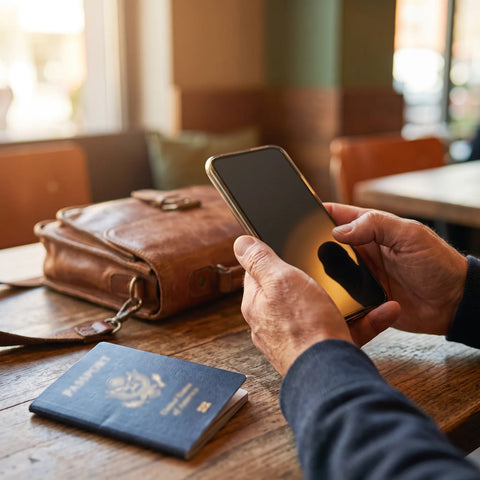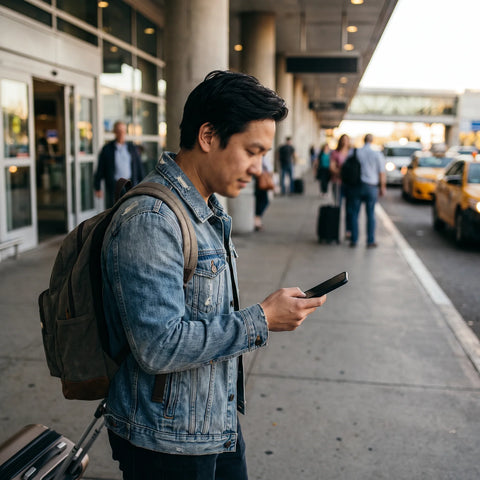
In short: For an au pair or anyone starting work abroad, an eSIM for au pairs and working abroad bridges the gap of the first few days: you arrive with active data before you have a local SIM, bank, or permanent address. Afterwards, combine it with a local SIM if you stay 6-12 months, or keep it as a backup for weekends and errands.
No one tells you this in the agency interview: the first real problem of being an au pair isn't the language or the host family, it's landing without coverage. You need to confirm your return flight, send your location to your pick-up person, open the map to find the house, and if something goes wrong, have a way to call. All of that happens before you can get a local SIM, because that usually requires an ID document, sometimes proof of address, and an open telecom store — which won't be open at nine on a Sunday night.
This guide isn't your typical country list. It's for anyone moving abroad for a season — au pair, intern, seasonal worker, working holiday visa holder — who needs to sort out connectivity in an organized way: what to use on day one, what to use in the first month, and what to keep throughout the stay without overpaying or getting cut off from home.
The first few days: the gap no one solves for you
The agency gives you the family's contact, the plane ticket, and little else. What it usually doesn't give you is a data solution for the first 48-72 hours, which is exactly when you need it most: coordinating the meeting point at the airport, showing the itinerary if there's a delay, contacting insurance if a suitcase is lost, or simply telling your mom you arrived safely.
This is where an eSIM versus Spanish operator roaming makes a difference: you install it before leaving home, activate the plan upon landing, and have data working as soon as the plane touches down, without searching for airport Wi-Fi or relying on the host family having a decent router. If you've never used one, you should know how to install an eSIM step-by-step before traveling — the process takes five minutes, but it's better to do it with calm Wi-Fi at home than nervously at the terminal.
A detail often overlooked: many host families expect you to be reachable from the first minute, especially if children are involved. "I'll connect when I get a local SIM next week" won't do. The eSIM covers exactly that gap without committing you to a contract or a minimum term.
eSIM, local SIM, or roaming: what's best depending on how long you stay
There's no single answer — it depends on the length of your stay and how much you'll be moving around. This table summarizes the real criteria, without price figures that we cannot guarantee because each operator constantly changes its rates: always check the current price before deciding.
| Situation | What to use | Why |
|---|---|---|
| First 3-7 days in any country | eSIM activated before leaving | You don't depend on a physical store or having an address for local SIM processing |
| Long stay (6-12 months) in a single country | Local country SIM + eSIM as backup | Local SIM is usually more cost-effective for constant daily use over months |
| Weekend or getaway within the EU/EEA from Spain | Your Spanish plan ("roaming like at home") | Already covered by European roaming regulations, no need to buy anything |
| Short trip to a third country (UK, USA, Switzerland) during your stay | eSIM for the specific country | Spanish roaming doesn't cover these destinations the same way as the EU, and getting a local line isn't worth it for a few days |
| Occasional visit back to Spain during your stay | Your usual Spanish SIM | No point in buying anything to return to your own country |
If you're still unclear on the difference between these options, you should first read international chip vs. eSIM — it's the foundation for understanding why European roaming doesn't work the same outside the EU.
Staying in touch with family in Spain without bill surprises
The most common scenario is dual SIM: your Spanish line remains active (so people can still reach you on your usual number) and the eSIM handles daily data. Some things to adjust from day one:
- Deactivate mobile data on your Spanish line and only leave the eSIM with active data, to avoid risking a roaming charge if your operator doesn't include the destination country.
- Incoming calls to your Spanish number may incur roaming costs depending on the operator and country — check the specific rate with your company before leaving, don't assume.
- WhatsApp, video calls, and Wi-Fi calls work the same with eSIM and are free compared to traditional calls — this is the method most au pairs use for daily contact with family.
- If you travel outside the EU, activate bank notifications via app instead of SMS: in several countries, bank SMS don't arrive well with a foreign line, and you might miss a charge notification.
Specific cases by destination
Connectivity changes depending on the host country, and it's best to know this before you arrive, not afterwards:
United Kingdom. Since Brexit, "roaming like at home" in the EU no longer applies in many cases: several Spanish operators started charging roaming in the UK as if it were a third country again. Don't assume your plan covers you there — check with your operator or get a specific eSIM so you don't rely on the accommodation's Wi-Fi, which in many British host homes is slower than you expect.
United States. If you're going with a J-1 au pair visa, the agency usually provides a local line, but often with limited data. For the first few days before it's active, or for weekend trips outside your local operator's area, an eSIM for the United States fills the gap without relying on public Wi-Fi.
Australia and New Zealand. Common working holiday visa destinations. The distance from Spain means the time difference makes coordinating a local SIM even more complicated upon landing — arriving already connected avoids losing half a day searching for a telecom store while jet-lagged. You have the full breakdown in this eSIM guide for Australia and New Zealand.
South Korea. There are increasing numbers of interns and au pairs in exchange or teaching programs in Seoul and Busan. Local SIM registration there usually requires more paperwork than in Europe, so it's worth sorting out connectivity before landing — you can see the details in eSIM for South Korea: Seoul and Busan.
Continental Europe (France, Germany, Italy...). Here, a local SIM usually pays off once you settle in, because the cost of a local operator for constant daily use over months ends up being more affordable than maintaining an international data plan all year. The eSIM serves as a wildcard for the initial period and for trips outside the host country.
Apps actually used by those working abroad
- Duolingo or Babbel: for the host country's language, especially if you work with children and need specific vocabulary quickly.
- Google Maps with downloaded offline maps: download the host family's neighborhood before landing, because the first journey from the airport is when you'll have the least reliable coverage.
- Wise (formerly Transferwise): for sending or receiving money from Spain without the fees of a traditional bank transfer.
- Facebook or Telegram groups for au pairs in your destination city: they are usually the fastest source of real recommendations (which local SIM company to use, which doctor speaks Spanish, where to buy Spanish products).
- A VPN app if you're managing Spanish banking or watching geo-restricted content from abroad — especially in non-EU countries, where some banks block access from foreign IPs if you don't use one.
What almost no one tells you before you leave
"My Spanish plan covers me in any country." False. Roaming without surcharges only applies within the European Union and the European Economic Area. As soon as you leave that — UK, USA, Australia, South Korea — you're back under your operator's international roaming conditions, which can skyrocket without you realizing it until the bill arrives.
"Any mobile phone has eSIM." No. Some models — especially older devices or versions specifically sold for certain markets — don't support it, and some phones unlocked by the operator instead of the factory have issues installing an additional eSIM profile. Check this before you travel, not at the airport.
"I need to wait until I have a local SIM to start moving around." It's the opposite: the more urgent it is to sort out paperwork (bank, insurance, registration in some countries), the more convenient it is to arrive already connected. Going to a telecom store without coverage to ask for directions on how to get there is a contradiction that happens to more people than you think.
"The host family's Wi-Fi will always be enough." Don't count on it. In rural areas of France or Germany, and in some old homes in the UK, Wi-Fi coverage is weak or the router is shared with the whole house. Having your own data avoids relying on the router password and hoping it works exactly when you need it.
"Buying a local SIM is as easy as in Spain." In several European countries, you're asked for an ID document and sometimes proof of address to activate the line — something you, as a newcomer, might not have yet. This is another reason not to rely on a local SIM from minute one.
When NOT to buy a travel eSIM
Here we need to be honest, because it's not always the best option: if you're going to spend 6-12 fixed months in the same country without moving much, a local SIM from the host country will almost always be more cost-effective for constant daily use — it's the option for truly integrating (local number for work, for the bank, for medical appointments). In that case, use the eSIM only as a bridge for the first few days and save the profile for when you leave the country on an occasional trip.
Also, don't buy anything if your getaway is a weekend within the European Union from the country where you already live with a local SIM or from Spain: European roaming regulations already cover you at no additional cost. And if you return to Spain for a visit, obviously use your usual line.
Procedures that depend on having an active number and data
Something that surprises first-time travelers: almost no procedure in the host country waits until you are "well settled." The bank may ask for SMS verification on the same day you open the account. The agency's health insurance may require online confirmation within the first 24 hours. The host family itself may need to sign digital documentation with you present. All of this goes more smoothly if you arrive with data, instead of chasing café Wi-Fi to fill out forms from your phone with 3% battery.
For those who will be moving through several European countries during their stay — many au pairs take advantage of free days to visit neighboring countries — it is worth having an eSIM for Europe handy that covers several destinations with a single profile, instead of contracting a new line every time you cross a border. And if the trip is back home for a few days, the eSIM for Spain solves connectivity for any foreign companion who comes to visit you.
How not to run out of data halfway through the month
A classic mistake for those using mobile data intensively for the first time: automatic app updates and photo backups to the cloud eat up the plan without you noticing. Before leaving home, check that automatic updates are restricted to Wi-Fi and that photo backup does not use mobile data — this is one of the most common reasons why a plan designed for the entire month runs out in ten days.
Frequently asked questions
Do I need an eSIM if my au pair program already gives me a local SIM?
It depends on when you receive it. If the agency or host family gives it to you on the same day at the airport, you might not need anything else. If it takes a few days — which is typical — the eSIM covers that initial gap without relying on external Wi-Fi.
Can I keep my Spanish number active while working abroad?
Yes, with dual SIM: your Spanish line remains active for calls and SMS to your usual number, while the eSIM handles daily data in the destination country. Check with your operator if incoming calls to your Spanish number incur roaming charges in the country where you are.
How many GB do I need per month as an au pair or temporary worker abroad?
It depends a lot on usage: weekly video calls with family, maps, social media, and language apps are the most common package. If you stream or upload photos and videos frequently, you'll need significantly more than if you only use messaging and occasional browsing. There's no single valid figure for everyone — estimate based on your actual habits from the previous month.
Does eSIM work on any mobile phone?
Not all models support it, and some devices unlocked by the operator have problems installing a second profile. Check your specific model's compatibility before traveling, don't assume.
What if my flight arrives in the middle of the night and I need immediate connection?
This is precisely the scenario where eSIM proves its value: you activate it before leaving Spain and have data as soon as you land, without relying on any store or counter being open at those hours.
Is it worth buying an eSIM for the entire au pair year?
Normally no, if you stay in one country permanently: a local SIM is usually more cost-effective for constant consumption over months. The eSIM makes more sense as a solution for the first few days and as a backup for occasional trips outside your country of residence.
How do I avoid running out of data just when the family needs me?
Monitor the consumption of apps that update or back up in the background, and activate consumption alerts if your plan allows it. Keeping your Spanish line as an emergency backup (with data deactivated unless needed) is a reasonable safety net for those days when the plan runs out sooner than expected.