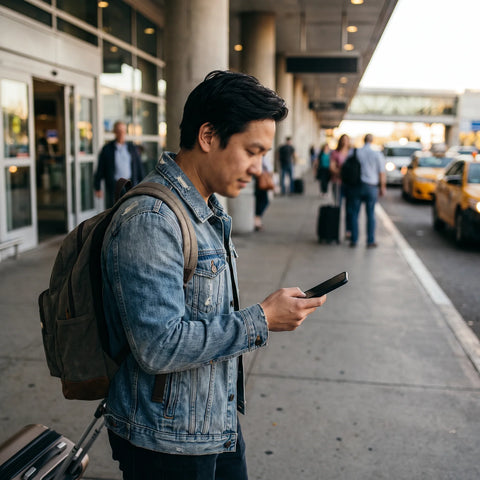
In summary: the eSIM for Bogotá is actually a Colombia eSIM that you install before flying and activate upon landing at El Dorado, without roaming or queuing to buy a physical SIM. For a 3 to 5-day trip with maps, Uber, and social media, 3-5 GB is usually sufficient; if you work or share data with a laptop, increase to 8-10 GB.
If your plan is to spend a few days in the Colombian capital, you don't need a physical card or to look for a SIM stand at the airport: the eSIM for Bogotá is installed from your home country using Wi-Fi and activates automatically as soon as your mobile phone connects to the Colombian network. You land, leave the terminal, and already have Google Maps, WhatsApp, or Rappi working while you look for a taxi. In this guide, you will find out how much coverage Bogotá actually has, how many GB to get depending on your type of trip, how to activate it at the exact moment, and what things almost no one tells you until you're already in trouble.
Do you need an eSIM just for Bogotá or does a country-wide one work?
There isn't an eSIM that literally says "Bogotá" on the label. What you buy is a Colombia eSIM, and that same one works just as well in the capital as in Cartagena or Medellín. The difference is not in the profile you install, but in how many GB and days you choose when purchasing it: a weekend getaway requires a different plan than a two-week tour of the Coffee Axis and the coast.
The profile automatically connects to the operator with the best signal in each area—Claro, Movistar, or Tigo—so you don't have to manually select anything or worry about which one has better coverage in your neighborhood. If you are also going to visit Cartagena or Medellín on the same trip, you might be interested in reading eSIM for Colombia: Medellín, Bogotá, and Cartagena, where we compare how to distribute data if you visit several cities with the same profile.
Actual coverage in Bogotá: neighborhoods, altitude, and TransMilenio
Bogotá is at 2,600 meters of altitude, but that doesn't affect the mobile signal: it's a myth perpetuated by people who confuse altitude with isolation. It's a dense city, with more than seven million inhabitants, and 4G networks more than cover the north-south axis that a tourist usually travels.
In La Candelaria, Zona T, Usaquén, Chapinero, or Parque de la 93, you will browse without interruptions. The spots everyone visits—Monserrate, the Gold Museum, Plaza de Bolívar—have stable coverage, even inside shopping centers like Andino or Santafé, where some underground levels do experience some signal loss near the parking lot. On the TransMilenio, especially when passing under pedestrian bridges or in the most deeply buried stations, it's normal for the connection to drop for a couple of seconds: it's not a fault of your eSIM, it happens to any operator.
The savanna surrounding the city also has good coverage in inhabited sections, so day trips won't leave you without data halfway through. Only on very remote mountain roads or in unpopulated rural stretches might there be occasional gaps, which happens to any SIM, local or foreign.
Day trips from Bogotá: what to expect from the signal
| Destination | Distance from Bogotá | Typical Coverage | Recommendation |
|---|---|---|---|
| Salt Cathedral, Zipaquirá | ~50 km | Good in the town, weak inside the mine | Download tickets and map before going down |
| Guatavita Lake | ~75 km | Stable in the town, irregular on the trail | Save the route offline on Maps.me or Google Maps |
| Villa de Leyva | ~160 km | Good in the urban area | Perfect for a day trip with normal data usage |
| Monserrate Hill | Within Bogotá | Solid at the viewpoint and cable car | No surprises, use it normally |
El Dorado Airport: getting connected from the first minute
El Dorado (BOG) is one of Latin America's busiest airports, and arriving at dawn with luggage in tow looking for a SIM counter is exactly what eSIM helps you avoid. You install it at home, with Wi-Fi, before leaving your home country; the profile is saved on your phone without consuming anything. Upon landing, you just need to activate data for that profile from your settings.
Traveler's tip: pre-program the data roaming option for that eSIM profile before takeoff. That way, as soon as the plane touches down and your phone connects to the Colombian network, you'll already have Uber, Cabify, or your hotel map loading as you walk towards immigration.
If it's your first time installing one, don't overcomplicate it: in how to install an eSIM, we explain it step by step with screenshots, and in what data roaming is, we clarify why activating the profile early costs you nothing extra: consumption starts when you connect to the network, not when you install the QR.
Beware of a detail almost no one mentions: if your flight has a layover in Bogotá and you don't leave El Dorado's transit area, you don't need to activate the eSIM for those few hours. The airport has plenty of free Wi-Fi to check your phone while you wait for the next flight; save your data for when you actually go out.
How many GB you need according to your trip type
For a 3 to 5-day getaway in Bogotá, with maps, messaging, and some social media, 3-5 GB is more than enough. If you're going to make long video calls, work remotely for a while, or share data with your laptop via hotspot, it's better to go up to 8-10 GB from the start: running out halfway through your trip is more inconvenient than having a little too much.
| Traveler Profile | Days in Bogotá | Estimated GB | Typical Usage |
|---|---|---|---|
| Express Getaway | 2-3 | 3 GB | Maps, WhatsApp, some social media |
| Long Weekend | 4-5 | 5 GB | Uber, photos, stories, maps |
| Full Week | 6-8 | 8-10 GB | Intensive social media, video, occasional hotspot |
| Occasional Remote Work | 5-7 | 10+ GB | Video calls and shared data with laptop |
Most hotels and tourist apartments in Bogotá have Wi-Fi, so your mobile data will mainly be used outdoors: finding a restaurant, checking the TransMilenio route, comparing Uber prices, or uploading a photo from Monserrate. If you end up calculating short, extending the plan can be done from your mobile in a couple of minutes, without having to go out and look for anything. If you're going to travel through more countries on the same trip, also check how to save data with an eSIM on a trip to extend your plan without running out of coverage on the last day.
Step-by-step eSIM installation and activation
The process is the same as for any destination and does not affect your physical SIM from your home country: your number continues to receive bank SMS while the eSIM handles only data in Colombia.
- Check that your mobile supports eSIM (most models from recent years do).
- Purchase the Colombia eSIM and receive the QR code via email within seconds.
- Scan the QR from your mobile settings, always with Wi-Fi and before traveling.
- Upon landing in Bogotá, activate the data for that profile and you're good to go: you have internet.
If you're torn between an eSIM and a physical card bought at the airport, in international chip vs. eSIM, we compare the two options without embellishment: the eSIM wins in terms of time and convenience, while a physical chip might make sense if your phone doesn't support eSIM.
eSIM vs. public Wi-Fi and your operator's roaming
Bogotá has Wi-Fi in hotels, many cafes in Chapinero, and shopping centers like Andino or Titán. It's good for downloading offline maps or making a long video call without touching your data, but relying solely on Wi-Fi leaves you unconnected precisely when you need it most: inside a taxi, looking for an address on the street, or negotiating a price in a market.
Open networks also have their risks: it's better not to enter banking details on public Wi-Fi without extra protection. If you plan to do sensitive transactions on a shared network, check out eSIM and VPN for private travel. The combination that really works is simple: eSIM always active for moving around the city, and accommodation Wi-Fi for heavy downloads.
Compared to roaming from your Spanish operator, the difference is notable in terms of time and peace of mind: you don't depend on your company activating an international data bundle on time or monitoring consumption from an app. If you want to see it in more detail, in eSIM vs. roaming, we break down the differences operator by operator. However, if your trip to Bogotá is only a very short weekend and your Spanish rate already includes data in Latin America at no extra cost—some premium plans do—first check your operator's terms: you might not even need to buy anything.
Myths and what almost no one tells you about eSIM in Bogotá
Myth: Bogotá's altitude affects the mobile signal. This is not true. Coverage depends on the operators' antennas, not on the height above sea level. Bogotá has a dense network precisely because it concentrates a large part of the country's population.
Myth: if you have an eSIM, you have to turn off your physical SIM. Not necessary. Compatible phones have two active profiles at the same time without any problem: one for data (the Colombian eSIM) and another for your regular number, which continues to receive calls and SMS even if you don't use it for browsing.
Myth: the more people use tourist plans, the worse the network performs. There is no public data to support this idea for Bogotá and, in practice, the infrastructure of Colombian operators is designed for peak traffic in tourist areas.
What almost no one tells you: if you are going up Monserrate by cable car or funicular, the coverage at the top is good, but on the walking ascent section (if you choose that option) there may be short cuts due to vegetation. Another detail: in some tourist apartments in the north of the city, the Wi-Fi is slower than advertised, so don't rely solely on it for an important work video call; keep the eSIM as a backup always on. And if you are going to travel on TransMilenio with large luggage, have the route map already loaded before going down to the station: the signal in the transfer tunnels is the weakest in the entire system.
Frequently Asked Questions
Does the eSIM for Bogotá include calls?
No, the plans are data-only. For calls, you use WhatsApp, Telegram, or internet calls, which work perfectly with an active eSIM. Your home country number remains on your mobile to receive SMS, although calling with it while roaming would incur an extra cost.
Can I use the same eSIM if I later go to Cartagena or Medellín?
Yes. It's a Colombia eSIM, not one exclusive to Bogotá, so it continues to work in Cartagena, Medellín, the Coffee Axis, or any other part of the country as long as you have data left from the contracted plan.
Do Rappi, Uber, and DiDi work with the eSIM?
Without a problem. Rappi, Uber, Cabify, DiDi, and Waze work with normal mobile data, and the eSIM provides it from the moment you land, without depending on hotel Wi-Fi to request your first ride.
When should I activate the eSIM, before flying or upon arrival?
Install it in your home country with Wi-Fi, but only activate data upon landing in Bogotá so that the plan's day counter starts at the correct moment. Installing the profile consumes nothing; consumption begins when you connect to the Colombian network.
Do I need a special phone to use eSIM in Colombia?
No, you need your own mobile to be eSIM compatible, which is common in mid-range and high-end models from recent years. No special phone is needed for Colombia: it's the same technology you would use in any other destination.
What happens if I run out of GB halfway through my trip?
You can buy another eSIM or top up the plan in a few minutes directly from your mobile, without going to any physical store. That's why it's advisable to start with a realistic estimate of your days and only expand if really necessary, instead of overestimating from the beginning.
Does the eSIM work the same if I go to Bogotá for work, not just tourism?
Yes, and in fact, this is where the difference from roaming is most noticeable: if you are going to make video calls or send large files, it is advisable to choose a plan with more GB from the beginning instead of expanding on the fly in the middle of a meeting.
Conclusion
For a getaway to Bogotá, there's no need to overcomplicate things: a few well-calculated GBs, the eSIM installed from home and activated right upon landing at El Dorado, will give you reliable internet throughout the city, without roaming scares or queues at the airport. Arrive connected, order your first Uber without thinking twice, and forget about searching for SIM card stores with your luggage in tow.