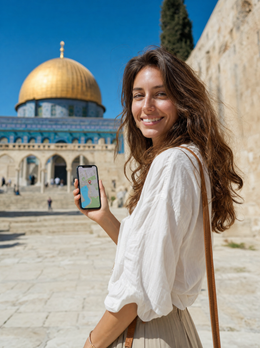
In short: A Middle East eSIM connects you with mobile data as soon as you land in the UAE, Qatar, Oman, Bahrain, Kuwait, Saudi Arabia, Jordan, or Israel, without having to find a store or register your passport. For a one- or two-week trip combining several countries, 10 GB is usually enough; install the QR code before you fly and activate it only when you land.
What is a Middle East eSIM?
A Middle East eSIM is a digital data plan that is installed with a QR code and connects to local networks in several countries in the region without changing physical SIM cards. You arrive in Dubai with internet already working, cross into Oman by road a few days later, and the same line continues to provide data. There's no store to look for at the airport, no queue to register a SIM with your passport, which is the usual process for local physical cards in much of the Gulf.
The advantage of a multi-country plan is particularly noticeable when your trip involves multiple destinations, which is common in this region: Dubai, a quick trip to Abu Dhabi, a flight to Doha, perhaps Amman and Petra at the end. With a physical SIM, you would have to buy and activate three or four different cards, each with its own registration. If you are still unsure about the format, it is advisable to first review what a virtual eSIM is and how it works, as the concept of a digital line without a physical card is the basis of everything that follows.
Which countries does a regional eSIM cover exactly?
The Middle East package usually groups major destinations in the Gulf and the Levant: United Arab Emirates, Qatar, Oman, Bahrain, Kuwait, Saudi Arabia, Jordan, and Israel. Coverage relies on national operators in each country through data roaming agreements, so in major cities, you'll see stable 4G/5G, and in rural or desert areas, reasonable 4G with some weaker spots.
| Country | City coverage | Typical traveler use |
|---|---|---|
| UAE (Dubai, Abu Dhabi) | Excellent 5G | Maps, social networks, streaming, taxi apps |
| Qatar (Doha) | Excellent 5G | Long layover, business trip, events |
| Saudi Arabia (Riyadh, Jeddah, Mecca, Medina) | Good 4G/5G in city | Umrah, Hajj, cultural tourism |
| Bahrain (Manama) | Good 4G/5G | Short trip from Dubai or Doha |
| Kuwait (Kuwait City) | Good 4G/5G | Business, transit |
| Oman (Muscat) | Good 4G in city, patchy in desert | Road trip, mountains, Musandam fjords |
| Jordan (Amman, Petra) | Good 4G | Cultural tourism, desert |
| Israel (Tel Aviv, Jerusalem) | Good 4G/5G | City, coast, holy sites |
If your itinerary extends beyond the Gulf and the Levant to include a North African country, there's also the Middle East and Africa eSIM plan, designed for routes that combine both regions in one trip. If, however, your trip is focused on a single country in the region, the specific Middle East eSIM plan allows you to choose the exact amount of GB you need without paying extra for coverage you won't use.
Real coverage: city, desert, and border
The network is not uniform across the region, and this is where it's worth getting into detail instead of just saying "coverage is usually good." In Dubai and Doha, the signal holds up even in giant shopping malls and on the metro; these are among the most robust networks you'll find when traveling. The problem appears in three very specific places that almost no one mentions until it happens to them:
- Wadi Rum (Jordan): In the desert, among the dunes and Bedouin camps, coverage almost completely disappears. It's not an operator problem, it's the topography: download an offline map and notify your accommodation before entering.
- Wahiba Sands and inland Oman: On the road to the desert or the Jebel Akhdar mountains, the signal comes and goes, even with a local SIM. If you're in a rental car, have the route downloaded beforehand.
- Mutrah Souq in Muscat, or the covered alleys of Amman's medina: The thick stone roofs and walls temporarily weaken the signal. Nothing serious, but if you're waiting for a real-time location to meet someone, it's better to do it outside the souq.
Another point that surprises those crossing by land between Jordan and Israel over the King Hussein Bridge (Allenby): border control can take several hours, the Jordanian signal is lost before reaching the Israeli post, and there's a stretch with no coverage from any operator while the crossing is processed. Keep your battery charged and something downloaded to entertain yourself, because no SIM, physical or digital, works there. To make the most of your data in such stretches, check out these tips for saving eSIM data while traveling.
How many GB do you need depending on your route?
For a one- or two-week trip through the Gulf, most travelers manage well with 5 to 10 GB. Maps, WhatsApp, social media, and reservations consume little; what drives up usage is video streaming or uploading high-quality content daily.
Traveler's tip: Download offline maps of Dubai, Doha, and Amman before leaving your hotel. Offline Google Maps can easily save you 1-2 GB on a long desert route, and it will save you if you lose coverage in a section like those in Wadi Rum.
As a rough guide: 5 GB is enough for a long weekend in Dubai with normal use; 10 GB covers two weeks combining Emirates, Oman, and Qatar; 20 GB or more if you plan to telework or upload video daily. A particular case is the Umrah or Hajj in Saudi Arabia: in the vicinity of the Sacred Mosque in Mecca and the Prophet's Mosque in Medina, millions of people gather on specific dates, and although the network holds up, congestion makes the connection slower than usual just when you need it most to locate your group or check prayer times. If your trip falls during peak pilgrimage season, don't limit your GB.
That said, there are situations where you don't need to buy anything at all: if your layover at Doha or Dubai airport is less than 24 hours and you don't leave the terminal, the free Wi-Fi at these airports is among the best in the world and more than enough for managing emails or boarding. Saving the plan money for your next trip, in that case, is the right decision.
WhatsApp, VoIP, and calls in the Gulf
Here's a nuance that many people discover too late, with their bags already packed: in the United Arab Emirates and Saudi Arabia, internet calls and video calls via WhatsApp, FaceTime, or Skype are restricted by local telecom providers. Text messaging, photos, and voice notes work perfectly fine; what may fail is live voice over the internet.
A data eSIM does not change this restriction, which depends on the country and not the line provider: it's a network policy of the local telecom, not something a chip or another solves. If you absolutely need to make voice calls during your stay in the Emirates, be aware that you may have to resort to a locally authorized paid calling app. For chatting, sending locations, or browsing, you won't have any problems. Some travelers use a VPN to try to circumvent these restrictions; it's worth knowing that it's not a guaranteed solution and that it's important to understand the implications before using it, something we cover in more detail in this guide on VPN and privacy when traveling with eSIM. In Jordan and Israel, however, this type of restriction does not exist, and internet calls work normally.
Regional eSIM vs. per-country eSIM vs. operator roaming
The decision boils down to your itinerary. If you're visiting three or more countries in the region, a regional eSIM wins for convenience: one QR, one plan, zero changes when crossing borders. If you're only going to Dubai for five days, a country-specific plan might be more cost-effective per GB, so it's worth comparing before buying. If your trip involves a physical SIM at some point (for example, because you need a local number for some procedure), this comparison between physical international chip and eSIM will help you decide without getting confused.
- Regional: ideal for multi-country routes (Gulf + Jordan + Israel), a single plan and a single activation.
- Per country: better if you stay in a single destination and are looking for the most adjusted price per GB for your exact route.
- Spanish operator roaming: The Middle East is outside the European Union's "roaming at home" policy, so the cost skyrockets as soon as you use data outside of Wi-Fi. Before relying on your usual rate, check the current price with your operator: in most cases, you'll find it's much more expensive than any eSIM in the region.
To understand why traditional roaming is so expensive outside the EU and what alternatives you have, we elaborate on it in eSIM vs. roaming.
How to activate your eSIM before flying
The process is the same for the entire region and, once you have the QR code in front of you, it takes about a minute. You buy the plan, receive the code by email, scan it from your phone settings with Wi-Fi at home, and leave the eSIM installed, but without activating data yet.
- Check that your phone is eSIM compatible (almost all mid-to-high-end phones from recent years are).
- Purchase the Middle East plan and receive the QR code in your email.
- Scan it from home with Wi-Fi: Settings > Mobile Data > Add eSIM.
- Leave the data for that line off until you land, so it doesn't start consuming data prematurely.
- Upon arrival, activate the mobile data for the eSIM line and you're good to go: you have internet without having to find a store.
If this is your first eSIM and you want the complete step-by-step with screenshots, check it out in how to install an eSIM. PuraSIM support is available 24/7 by email and WhatsApp in your language in case anything gets stuck upon landing.
Errors and myths: what almost no one tells you
Myth: "A Middle East eSIM covers the entire region, without exception." This is not true. Countries like Iran, Iraq, Syria, or Yemen are usually excluded from these plans because there are no data roaming agreements with international operators on those networks, apart from political or sanction-related restrictions. If your route touches any of these countries, always check the plan's exact coverage list before buying; don't assume that "Middle East" means all countries in the area.
Myth: "Hotel Wi-Fi is enough, and I don't need data outside." In five-star hotels in the Gulf, fast Wi-Fi is sometimes paid or has limits, and above all, you need it outside the hotel: to order a Careem or Uber, to show the e-visa QR code at border control, or to translate a sign in a market. Hotel Wi-Fi solves part of the trip, but not all of it.
Myth: "Any mobile phone supports eSIM." Some phone variants sold specifically in Gulf markets have dual physical SIMs instead of eSIMs, to adapt to the local regulations of those countries. If you bought your phone there or it's a regional version, check compatibility before paying for the plan.
When you should NOT buy a regional eSIM: if your trip is a short layover at the airport without leaving the terminal, or if you will be inside a facility with free Wi-Fi the entire time and do not need to move around the city, save yourself the expense. And if your route is only a weekend in a single country with low data usage, compare it first with the plan for that specific country: it may be more cost-effective per GB than the regional package.
Frequently asked questions
Which countries does a Middle East eSIM cover?
Typically, the United Arab Emirates, Qatar, Oman, Bahrain, Kuwait, Saudi Arabia, Jordan, and Israel, all under the same plan and a single QR code. Always check the product description before purchasing, as not all regional plans include exactly the same countries.
Does a Middle East eSIM cover Iran, Iraq, or Yemen?
Generally not. These countries are usually excluded from regional plans because there are no data roaming agreements with international operators on their networks. If your route includes any of them, specifically check before purchasing.
Does WhatsApp work in Dubai or Riyadh with an eSIM?
WhatsApp messages, photos, and voice notes work normally. Internet calls and video calls are restricted by telecom companies in the UAE and Saudi Arabia, so live voice may fail. For chatting and browsing, you will not have any problems.
How many GB do I need for two weeks in the Gulf?
With 10 GB, you can cover two weeks combining the Emirates, Oman, and Qatar with normal use of maps, social networks, and messaging. If you telework or upload videos daily, increase to 20 GB. Downloading offline maps before road trips greatly reduces consumption.
Does the eSIM work well during Umrah or Hajj in Saudi Arabia?
Yes, it works, but in the vicinity of Mecca and Medina, during peak seasons, the network gets saturated due to the large number of people connected at once, and the connection runs slower than usual. This is not an eSIM failure; it's network congestion. Allow for some extra GB during those times.
Do I need to register the eSIM with my passport upon arrival?
No. Unlike local physical SIMs, which in several Gulf countries require passport registration at a store, the eSIM is purchased online and activates itself. You save yourself the queue at the airport and the in-person identification process.
Can I keep my Spanish number active while using the eSIM?
Yes. The eSIM coexists with your primary SIM in dual mode: you continue to receive calls and SMS to your Spanish number while browsing with the eSIM's data. You just need to keep your Spanish line's data turned off to avoid roaming charges.
Conclusion
The Middle East is a region made for traveling with an eSIM: itineraries that connect several countries in a few days, huge airports where wasting time looking for a SIM card store makes no sense, and Spanish operator roaming that skyrockets as soon as you leave the European Union. With 5-10 GB for most routes, the plan activated before flying, and desert area maps downloaded beforehand, you'll land connected in Dubai, Doha, Riyadh, or Amman without surprises. Prepare your Middle East eSIM before taking off and leave the airport kiosks for something else.