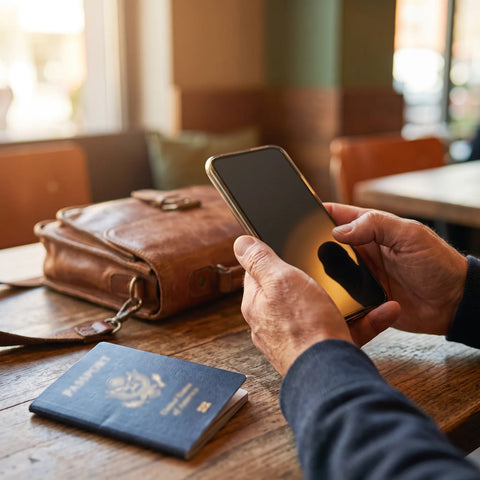
In summary: for traveling to Uruguay, the most practical option is to activate a Uruguay eSIM before leaving home: you save on roaming, cover Montevideo, Punta del Este, and Colonia del Sacramento with 4G or 5G, and you can top up data if you run out. For a week, 5-7 GB is usually enough; if you plan to cross into Argentina or Brazil by land, it's advisable to check border coverage before you leave.
Traveling to Uruguay is an incredible experience, but arriving without data can ruin the first moments: no Google Maps to leave the airport, no way to find your hotel, no way to contact whoever is waiting for you. The solution is simple and has been the standard among experienced travelers for years: an eSIM for Uruguay.
In this guide, we tell you everything you need to know before traveling to Uruguay: what coverage you can expect in Montevideo, Punta del Este, and Colonia del Sacramento, how many GB you really need, how to activate your eSIM, and the best connectivity tips from those who have already traveled there.
Spoiler: with PuraSIM, you have local data from the moment your plane lands, with no contracts, no physical SIM, and no surprises on your bill.

Why do you need an eSIM to travel to Uruguay?
International roaming from European and Latin American operators can cost you between 10 and 30 euros or dollars per day in Uruguay. A local eSIM gives you data at local prices, with no absurd daily limits and with 4G or 5G speeds where the network allows.
The difference between going with roaming and with a PuraSIM eSIM is stark:
- Traditional roaming: fixed daily rate even if you barely use data, speed often limited to 3G, surprise bills upon return.
- PuraSIM eSIM for Uruguay: you only pay for what you contract, full local data at maximum available speed, activation in 5 minutes from anywhere.
If you want to understand in more detail the technical difference between both options, in this comparison between eSIM and roaming we break it down point by point. And if you're not clear on what data roaming exactly is and why you're charged what you're charged, we explain it from scratch here.
| Option | Cost | Installation | Keep your number | Recommended for |
|---|---|---|---|---|
| PuraSIM eSIM (Uruguay) | Fixed price for the plan you choose, no surprises | QR code, 5 minutes, no physical store | Yes, in separate slot | Most travelers, especially for stays of days or weeks |
| Home operator roaming | Cost skyrockets depending on operator and destination; check before leaving | Automatic, no setup required | Yes, it's your usual SIM | Very short stays (1-2 days) if your plan already includes Uruguay at no extra cost |
| Local physical SIM (Antel, Movistar, Claro) | Local price, but adds time lost in formalities | Requires document, queue in store, and sometimes changing numbers | No, new local number | Long stays (months) or anyone needing a Uruguayan number |
Furthermore, with an eSIM, you can keep your original phone number active to receive calls and SMS, as the eSIM operates in a separate virtual slot. You don't have to choose between local connectivity and your usual number.
Uruguay has one of the highest connectivity penetration rates in Latin America, so generally you won't have coverage problems on the usual tourist route. Even so, coverage in Montevideo, Punta del Este, and Colonia del Sacramento is generally good, but there are areas where without a well-configured local eSIM, you would be without service.
Data coverage in Uruguay: what to expect
Coverage in Uruguay varies quite a bit depending on the area. In major urban and tourist areas (Montevideo, Punta del Este, and Colonia del Sacramento), you will find 4G and in some cases 5G networks. The experience is comparable to what you would have at home.
However, as in any destination, there are areas where the signal is more limited:
- Main cities: Stable 4G/5G, perfect for streaming, browsing, and video calls.
- Rural and natural areas: Coverage can drop to 3G or even lose signal in remote spots.
- Transportation: Trains, ferries, and intercity buses have variable coverage; generally good in cities.
A useful fact for planning: in Punta del Este, during the high summer season (December-March), you are most likely to find 5G already deployed; the rest of the year, 4G remains the standard.
To maximize coverage in Uruguay, PuraSIM uses local networks with the best available infrastructure through local roaming agreements. This means your eSIM automatically connects to the network with the best signal at all times.

How many GB do you need for traveling to Uruguay?
This is the million-dollar question. The short answer: 5-7 GB for 1 week. The long answer depends on how you use your phone during the trip.
Here's a guide to actual consumption by daily usage type:
- Basic use (maps, messages, occasional searches): 300-500 MB/day
- Moderate use (social media, photos, continuous browsing): 800 MB-1.5 GB/day
- Intensive use (remote work, streaming, video calls): 2-4 GB/day
For a trip to Uruguay lasting 1 week, our recommendation is to contract 5-7 GB for 1 week. This is enough for most travelers with normal use: constant Google Maps, Instagram, WhatsApp, and some occasional searches.
If you plan to work remotely or make frequent video calls, upgrade to the next plan immediately. PuraSIM plans allow you to top up data if you run out, so it's not a big deal if you fall short: you won't suddenly lose coverage.
PuraSIM offers specific plans for Uruguay with different data and duration options. Check out the full collection on our plans for Uruguay.
How to activate your eSIM for Uruguay step-by-step
Activating a PuraSIM eSIM is as simple as scanning a QR code. There's no need to go to a store, no need to wait for a delivery. The entire process takes less than 5 minutes:
- Purchase your plan on purasim.com for Uruguay. You will receive an email with the QR code.
- Install the eSIM: Go to Settings → Mobile Data → Add Data Plan (on iPhone) or Settings → Connections → SIM Manager (on Android).
- Scan the QR code or manually enter the activation data.
- Configure mobile data: Make sure to select the PuraSIM eSIM as your default data line.
- Activate data roaming in the PuraSIM eSIM settings (necessary for it to work on local networks).
You can install the eSIM before leaving home and set it to activate automatically when you arrive in Uruguay, or activate it manually when you land.
Important: verify that your phone is eSIM compatible before purchasing. Most iPhones from XS onwards, Samsung Galaxy from S20 onwards, and Google Pixel from 3 onwards are compatible. Check the full list on purasim.com.
What if you don't arrive via Carrasco Airport?
Not everyone enters Uruguay by plane, and the moment to activate the eSIM changes depending on where you arrive:
- Carrasco Airport (Montevideo): the classic scenario. Install the eSIM at home, activate it as soon as you step into the terminal or even before takeoff if your plan allows it, and you'll leave passport control already with data to order a transfer or open the map.
- Ferry from Buenos Aires (Buquebus or Colonia Express) to Colonia del Sacramento: this is the most common entry point for those coming from Argentina, and many guides forget to mention it. During the crossing of the Rio de la Plata, you won't have coverage from any operator, so activate it as soon as you disembark at the Colonia terminal, not during the journey.
- Laguna del Sauce Airport (Punta del Este): operates mainly during high season (December-March) with direct flights from Argentina and Brazil. Coverage in the terminal itself is good, so you can activate the eSIM as soon as you land.
- Land border via Chuy or Rivera: if you enter by car or bus from Brazil, do so with the eSIM already active before crossing: at the border crossing itself, your phone might switch between Brazilian and Uruguayan networks for a few minutes.
Local connectivity tips for Uruguay
Beyond getting the right eSIM, there are some tricks that make a difference in staying connected throughout your trip to Uruguay:
- Download offline maps before you leave. Google Maps and Maps.me allow you to download maps of all of Uruguay or specific cities. This way you can navigate without using data when you're in areas with a weak signal.
- Use airplane mode strategically. On long flights, trains, or ferries, activating airplane mode preserves battery and data. Connect to available WiFi if there is any.
- WhatsApp and Telegram over data. Calls via these apps consume much less data than an international call. Set them to high-quality calls only when you are on WiFi.
- Share connection with care. Hotspot consumes data quickly, especially if other devices are connected (laptop, tablet). Use it only when necessary.
And a tip that avoids more than one headache: if your itinerary includes a day trip to Buenos Aires on the same Buquebus, deactivate data roaming on your usual physical SIM before boarding the boat. This ensures that only your PuraSIM eSIM consumes data and you don't incur charges by mistake while you're on the other side of the river.
With these tricks and a good PuraSIM data plan, your trip to Uruguay will have the connectivity you need without unnecessary expenses.
What almost no one tells you about connecting in Uruguay
There are several ideas circulating among travelers that should be debunked before leaving home, plus a couple of very specific details that are only discovered once you are there.
Myth: "Uruguay has free WiFi everywhere, I don't need data"
Montevideo does have quite a bit of public WiFi in squares and on the Rambla, that's true. But outside the capital, things change quickly: in Punta del Este, outside of high season, many establishments turn off WiFi to save money; and in Colonia del Sacramento, the WiFi in the historic quarter is often slow and shared among dozens of tourists at once. Connecting to unknown open networks is also not a good idea for anything involving passwords or payments: if you're concerned about security on public networks, in this guide on eSIM, VPN, and travel privacy we explain it in detail.
Myth: "My EU roaming or my operator already covers me in Uruguay"
"Roam like at home" agreements are almost always designed for the European Union, not for South America. Outside that zone, the cost skyrockets and is usually charged per day or per MB consumed, not like in your usual plan. If you've also used an eSIM in another destination and are wondering what the real difference is compared to a traditional physical SIM, in this comparison between an international chip and an eSIM you'll find the practical differences, not just the technical ones.
The detail no one mentions: the Rivera border
Rivera, in northern Uruguay, and Santana do Livramento, in Brazil, are literally separated by an avenue: one side of the street is Uruguayan and the other Brazilian. If you pass through there, don't be surprised if your phone detects a Brazilian network for a while even if you're technically still in Uruguayan territory. It's not a fault with your eSIM, it's the city's own geography.
The other detail: Cabo Polonio
If your route includes Cabo Polonio, that dune village accessible only by 4x4 truck because there are no paved roads, keep in mind that coverage there is irregular even with a good eSIM: it's a nature reserve with minimal infrastructure on purpose. Download the offline map and notify whoever is waiting for you before entering, not when you're already inside.
When is it NOT advisable to buy an eSIM for Uruguay?
If you're making a one-day stopover in Montevideo before continuing your journey, you'll only be moving between the hotel and the city center, and your operator already includes Uruguay at no extra cost in your usual plan, you probably don't need anything else. Nor does it make much sense to buy a large data plan if you're going to spend most of your time in a rural accommodation with its own WiFi: in that case, a small backup plan for travel is enough.
Before buying any eSIM, whether for Uruguay or your next destination, it's worth reviewing some simple tricks to save data while traveling: they make the difference between a 5 GB plan being too much or not enough halfway through the week.
Frequently asked questions
When should I activate the eSIM for Uruguay?
You can install it on your phone before leaving home. Most PuraSIM eSIMs for Uruguay can be set up days in advance and activated automatically upon arrival at your destination, or manually when you want to start using it.
Is my phone compatible with the eSIM for Uruguay?
Most smartphones manufactured since 2018-2019 are compatible: iPhone XS and later, Samsung Galaxy S20 and later, Google Pixel 3 and later, and many more. Check in Settings → General → About that your device lists 'eSIM' among its options.
Can I keep my usual phone number while using the eSIM in Uruguay?
Yes. The eSIM works in a separate slot from your physical SIM. You can configure your local SIM for calls and the PuraSIM eSIM for data. You will continue to receive calls and SMS on your usual number.
What happens if I run out of data in Uruguay?
You won't suddenly lose coverage. You can buy a data top-up directly from the PuraSIM app or the customer panel. The top-up is applied within minutes, and you don't need to change your plan or buy a new eSIM.
Does the PuraSIM eSIM work throughout Uruguay?
The eSIM works through the local networks available in Uruguay. In major cities and tourist areas, coverage is excellent (4G/5G). In rural or remote areas, the signal may be more limited, especially in places like Cabo Polonio. We recommend downloading offline maps for those areas.
I'm arriving in Colonia by Buquebus ferry from Buenos Aires. When should I activate the eSIM?
During the crossing of the Río de la Plata, you won't have coverage from any operator, so don't waste data activating it on board. Activate it as soon as you disembark at the Colonia del Sacramento port terminal; in a couple of minutes, you'll have data to order a taxi or bus to Montevideo.
Do I need an eSIM if I'm only going to Colonia del Sacramento for one day from Buenos Aires?
It depends on how much you use your mobile. For a quick one-day visit to the historic center, with your hotel or ferry already sorted, many travelers manage with the port and cafe Wi-Fi. If you prefer to have a map and guaranteed data at all times, or you're going to take photos and upload them immediately, a small one-day plan is sufficient and avoids relying on external networks.
Activate your eSIM before you leave and arrive connected from the very first moment.
See eSIM plans →