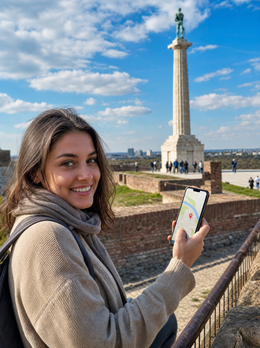
Are you escaping to Belgrade this summer, or perhaps to the EXIT festival in Novi Sad, and assuming that having internet in Serbia will be as smooth as in Croatia or Greece? Well, hold on a second, because there's a surprise here that you should know before packing your bags: Serbia is not in the European Union, so your usual data plan won't work the same way and could skyrocket your bill without you even realizing it. In this guide, I compare all the real ways to get connected—from hotel Wi-Fi to a local Serbian SIM card—and tell you which one I'd choose and why.
Why connecting in Serbia isn't like the rest of Europe
Serbia is not a member of the European Union, so European "roam like at home" doesn't apply when you travel with a Spanish SIM card. To browse without bill shock, you need an alternative: a local Serbian SIM or a travel eSIM that you set up before leaving home.
It's a deceptive destination precisely because it feels so close and European. You fly two hours from Spain, land in Belgrade, and everything feels familiar: cafes open late, wide avenues, and the hustle and bustle of Savamala. But Serbia is an EU candidate country, still outside the bloc, and that has a direct consequence for your mobile phone. All the European regulations that eliminated surcharges for browsing abroad work only between member countries. As soon as your phone connects to a Serbian network, your Spanish operator puts you in its expensive zone—zone 2, "rest of the world"—and prices skyrocket. It's the classic Balkan trap, the same one you find in Montenegro, Bosnia, or North Macedonia. The good news: getting connected well is easy and cheap if you sort it out before flying, instead of improvising at the airport with your phone searching for a network on its own.
The big misunderstanding: you don't have free roaming in Serbia
Here's the mistake that costs many people money every summer. You land in Belgrade, turn on your phone, and use it as you would at home. The problem is that, outside the EU zone, your plan doesn't include Serbia, and "rest of the world" prices kick in. It depends on the operator, but the numbers are dizzying:
- Movistar: around €12 per MB if you don't activate a bundle; their world bundles range from about €60 for 150 MB to €290 for 1 GB.
- Vodafone: around €0.85/MB on contract, plus €1.69/min for calls to Spain with a connection charge.
- Orange: daily world zone bundles that activate automatically as soon as you browse, with very little data for about €6 a day.
- DIGI: usually the slightly more economical exception, but it's worth checking their fine print for Serbia.
Translated: two Instagram videos from Kalemegdan Fortress and you've already spent what an entire trip's data plan would cost.
The surprise bill from Balkan roaming is almost a classic among travelers. Don't let it happen to you: check your plan before you leave, not when you get back and open the bill.
You can find the fine details in my guide on how much international roaming costs, and I compare the two options in eSIM vs. roaming. With those numbers in front of you, the decision makes itself.
The Balkan pact and future EU entry: why it doesn't cover you today
Here's a nuance that confuses many people, and it's worth explaining honestly. You may have read that the Western Balkan countries have their own "Roam Like at Home" agreement: since 2021, a Serbian traveling to Montenegro, or a Bosnian going to Belgrade, can browse at local prices without surcharges within the region. Sounds great... until you read the fine print. That agreement only covers SIM cards issued within the region itself and to its residents. You, with a Spanish SIM card in your pocket, are outside the pact: for your operator, Serbia is still that expensive "rest of the world" zone.
And what about that good news that's being announced so much? The European Union is indeed working on it: in June 2026, the Council authorized opening negotiations to eliminate surcharges between the EU and the six Balkan countries, including Serbia. Montenegro and Albania have been mentioned as first in line, perhaps by the end of this year, and 2028 as the target for completely eliminating them. But it's not yet in force today for Serbia, so you can't count on it this summer. My advice: plan as if cheap roaming doesn't exist in Serbia, because for an average Spaniard, today it doesn't.
All your options for internet, compared
For a tourist, there are basically four paths, and each has its moment. Hotel Wi-Fi is free but ties you to the building; roaming is convenient but very expensive; a local Serbian SIM is very cheap for data but requires on-the-ground management; and an eSIM seeks a balance between price and convenience. Here's how I see it:
| Option | Estimated cost | Coverage | Ideal for |
|---|---|---|---|
| Spanish roaming | Very high (up to €12/MB) | Your operator's coverage | Occasional emergencies |
| Hotel Wi-Fi | Free | Only within the premises | Video calls in the room |
| Local Serbian SIM | €2.5-€17 depending on data | Excellent in almost the entire country | Long stays and groups | Travel eSIM | Reasonable, depending on GB | Local network, without changing SIM | Most tourists |
There's no single answer. If you're going for two weeks and exploring monasteries and mountains by car with friends, a local SIM might be worth it for the data volume. If you're traveling for four days to Belgrade and want zero complications, an eSIM almost always wins. The key is to cross-reference three variables: how many days you're staying, how much you'll consume, and how much on-the-ground management you're willing to do. With those three answers, the right option usually becomes clear.
Hotel Wi-Fi: useful, but not your plan A
Almost all hotels, hostels, and apartments in Serbia—in Belgrade, Novi Sad, Niš, or Zlatibor—offer free Wi-Fi, and it usually works well for the basics: uploading photos from the day, making a video call at night, or downloading a series before bed. Belgrade, in addition, is a very cafe-centric city, and many bars will give you the password without hesitation, which helps stretch your data. It's a good complement. But as a primary plan, it falls short for an obvious reason: it only works where there's a network, and you're going to spend the day out and about, strolling through Skadarlija, crossing the Danube to Petrovaradin, or driving to the southern monasteries. Without a connection, you'll be without maps, without a translator, and without a way to call a taxi.
And there's a security issue that I never tire of repeating: open public networks are not trustworthy. Never enter your banking details there without a VPN, and disable automatic connection to unknown Wi-Fi networks. If you're interested in why your own plan almost always beats relying on someone else's Wi-Fi or a portable router, I compare them in depth in eSIM vs. pocket Wi-Fi. My summary: use hotel Wi-Fi as a backup, never as the only way to stay connected during your trip.
Local Serbian SIM: MTS, A1, and Yettel
Serbia has three main operators: MTS (from Telekom Srbija), the largest and with the best coverage; Yettel (formerly Telenor), very strong in tourist plans; and A1 Serbia (formerly Vip mobile), aggressive in unlimited data. All three have stores and counters at Belgrade airport, with tourist packages offering lots of data for little money. The Serbian Dinar (RSD) exchanges at about 117 to the euro, so these 2026 prices are very good:
| Package | Data | Duration | Price |
|---|---|---|---|
| MTS Tourist | 5 GB | 7 days | ~300 RSD (≈€2.5) |
| MTS Tourist MAX | 10 GB | 14 days | ~600 RSD (≈€5) |
| Yettel Tourist | 50 GB | 30 days | ~999 RSD (≈€8.5) |
| A1 Welcome Unlimited | Unlimited | 30 days | ~1,999 RSD (≈€17) |
In terms of volume, the local SIM is unbeatable: for less than €10, you get tens of gigabytes or even unlimited data. The downside? Management. You have to go to a store or the airport counter and, by law, you'll be asked for your passport to register it in your name: all SIM cards in Serbia must be registered. Plus, you change your number to a Serbian one, which can be a hassle if you're expecting SMS from your bank. If you're torn between this option and a digital card, I'll help you decide in eSIM vs. local SIM. For long stays and groups, it makes perfect sense.
The eSIM: my recommendation for most travelers
For the average traveler visiting Belgrade for a few days or exploring the country for a week, my clear recommendation is an eSIM. It's a digital card installed on your phone with a QR code, without having to insert or remove anything physical. It connects to the same Serbian networks as a local SIM (MTS, Yettel, or A1), so the coverage is virtually the same, but with two huge advantages: you set it up from your couch at home and you keep your Spanish number active for calls and bank SMS. You land in Belgrade, activate data, and you're already browsing, without queues, without counters, and without leaving your passport on the table.
If you've never used one and it sounds like rocket science, in what is an eSIM I explain it step by step; and if you want the specific details for this destination—plans, GB, and activation—you can find it in the Serbia eSIM guide. The only thing you need to check beforehand is that your phone is compatible: almost all iPhones from the XS and recent mid-to-high-end Androids are. For price, convenience, and zero risk of surprise bills, it's the option I recommend to nine out of ten people who ask me how to connect in Serbia.
Coverage by area: Belgrade, Novi Sad, Niš, and the monasteries
Coverage in Serbia is solid, and it has improved significantly since the three operators launched commercial 5G in December 2025. In cities, you'll be more than well-served; problems only appear in some secluded valleys. Here's a breakdown of key areas:
- Belgrade, Novi Sad, and Niš: Fast 4G everywhere and 5G already active in central districts. Streaming, maps, and video calls without a hitch.
- Highways and corridors (the A1 between Belgrade, Novi Sad, and Niš): very well covered, so your car or bus journey will be connected almost the entire time.
- The EXIT festival (Petrovaradin Fortress, Novi Sad): good coverage, but crowds can overload the network during peak night hours; don't count on uploading live stories without interruptions.
- Monasteries and mountains (Studenica, Sopoćani, Žiča, Fruška Gora, and mountain ranges like Tara, Zlatibor, or Kopaonik): generally decent 4G, but in gorges and closed valleys, the signal can be weak.
My advice for the monastic south and the mountains is simple: download offline maps from Google Maps before going up and treat those routes as semi-offline territory. No card will give you magical signal at the bottom of a canyon. For everything else—the vast majority of a typical trip through Serbia—you'll be connected without a problem.
How much data do I really need?
This is the most common question I get, and the answer is almost always the same: you don't need as much data as you think. Unless you're going to telework or do a lot of high-quality streaming from your phone, a moderate plan will be more than enough. What really consumes data are long videos and video calls; maps, messaging, and social media consume very little. This is the table I use for calculation:
| Type of trip | Recommended data |
|---|---|
| Weekend in Belgrade | 2 GB |
| One week (Belgrade + Novi Sad) | 3-5 GB |
| Two weeks with monasteries and mountains | 8-10 GB |
| EXIT, digital nomad, or intensive use | Large plan or unlimited SIM |
A trick: rely on hotel Wi-Fi for heavy downloads (uploading photo albums, updating apps) and reserve mobile data for when you're out and about. With that, a 3 to 5 GB plan is more than enough for a week of urban tourism. And if you run short, you can always top up. Another reference: an hour of maps while driving consumes a few megabytes, while half an hour of high-quality video eats up more than 1 GB.
How to get everything ready before flying
So you don't forget anything, this is the little ritual I follow before any trip to a non-EU country like Serbia. It takes ten minutes and saves you 100% of the scares:
- Disable data roaming in your phone settings, so that expensive roaming doesn't accidentally kick in as soon as you land in Belgrade.
- Check that your phone supports eSIM (Settings > Phone information, or search for your model online).
- Choose and purchase your data plan in advance, calculating the GB with the table above.
- Install the eSIM at home, with Wi-Fi, by scanning the QR code. Don't activate it until you arrive if your plan counts days from first use.
- Download offline maps of the mountain and monastery areas you plan to visit in the south.
I check it the night before flying, with my suitcase already packed, so I arrive at the airport knowing that as soon as I turn on my phone, I'll be connected. No searching for stores, no queues, and no crossing my fingers about the return bill. Preparing your connection is as important as booking your hotel: you'll use it every day, from the map to the menu translator.
Frequently asked questions
Do I have free roaming in Serbia?
No. Serbia is not part of the European Union, so "roam like at home" does not apply. With your Spanish plan, you will pay "rest of the world" prices, which some operators charge up to €12 per MB. To get connected cheaply, you need a local SIM or an eSIM.
Do I need a passport to buy a local Serbian SIM?
Yes. By law, all SIMs in Serbia are registered under the buyer's name: at the store or airport, they will ask for your passport. With a travel eSIM, you avoid this process because you activate it online.
Is there 5G in Serbia?
Yes, and it's recent. The three operators (MTS, Yettel, and A1) launched commercial 5G in December 2025, with coverage currently focused on Belgrade, Novi Sad, and Niš. Outside major cities, you'll have more than enough fast 4G.
How much data do I need for a week in Belgrade?
For a week in the city, 3 to 5 GB is more than enough if you use hotel Wi-Fi for heavy downloads. Maps and messaging consume very little; what significantly increases consumption is high-quality video.
Does the Balkan roaming agreement apply to me?
No. That "Roam Like at Home" pact only covers SIMs issued within the region and to its residents. With a Spanish card, you're excluded: for your operator, Serbia is still a high-rate zone.
When will European roaming be free in Serbia?
In June 2026, the EU opened negotiations to eliminate surcharges between the bloc and the Balkans, including Serbia, with a target of 2028. However, it is not yet in force, so today you should expect high rates or use an eSIM.
Does the internet work well at the EXIT festival in Novi Sad?
Partially. Petrovaradin Fortress has good coverage, but crowds overload the network during peak night hours. Get your data ready beforehand and don't count on uploading live videos without some interruptions.
Conclusion
Getting connected in Serbia is easy once you understand the essentials: you're not in the EU, so your usual roaming won't work and can be very expensive, and the Balkan agreement doesn't cover you if you have a Spanish SIM card. From there, choose wisely. Hotel Wi-Fi is good support, a local SIM is unbeatable for data on long stays, and an eSIM is the most convenient option for most. Calculate your GBs, prepare everything at home, and forget about the problem. My advice, after comparing everything: get your phone ready before you leave with a Serbian eSIM. You can activate yours here and land already connected in Belgrade, without queues or counters. Have a good trip along the Danube.