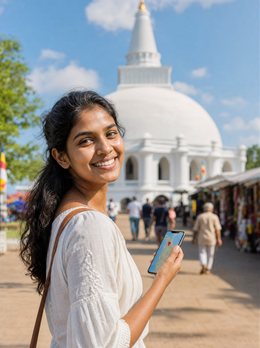
Sri Lanka is one of those trips where your phone goes from being an extra to being your co-pilot: checking the train schedule to Ella, locating the safari jeep in Yala, or letting your guesthouse in Mirissa know you'll be late. That's why it's good to decide before you fly how you're going to get internet in Sri Lanka. In this guide, I compare all the real options for tourists: your Spanish operator's roaming, hotel Wi-Fi, the local Sri Lankan SIM (Dialog, Mobitel, or Hutch, very cheap and with tourist counters at Colombo airport), and the eSIM. I'll tell you about coverage in Colombo, Kandy, the famous mountain train, Sigiriya, safaris, and the southern beaches, and how much data you'll need.
Internet in Sri Lanka: the quick answer
For a tourist, the eSIM is the best way to get internet in Sri Lanka: it activates in minutes on the Dialog network, avoids queues at Colombo airport, and works as soon as you land. The local SIM is cheaper; roaming is convenient but expensive.
That's the short conclusion, but it's worth understanding the nuance. Sri Lanka has ridiculously cheap mobile data: for less than €5 you can get 20 or 30 GB with a local SIM, so the "impossible paperwork" argument that applies to India doesn't apply here. On the island, buying a SIM is easy and quick, with counters designed for travelers right outside arrivals.
So why do I recommend the eSIM? Because the convenience of arriving with data already working, without changing cards or queuing, outweighs the small price difference for most two- or three-week trips. I'll keep roaming as an emergency backup and hotel Wi-Fi as support. In the following sections, I break down each option with real prices and coverage so you can decide with data, not gut feelings, and choose the one that best fits your itinerary on the island.
All options at a glance
Here's the full picture. There are five realistic ways to get connected in Sri Lanka, and not all of them cost or weigh the same. Pay less attention to the price and more to the "but" column: that's where this comparison is decided, because on the island, the cheap SIM doesn't come with the infernal bureaucracy of other destinations.
| Option | Approximate price | Process | Its big "but" |
|---|---|---|---|
| Operator roaming | €10-15/day or up to ~€12/MB | None | Very expensive and with limited data |
| Free Wi-Fi (hotel, cafés) | Free | None | Only works where you are stationary |
| Local SIM (Dialog, Mobitel, Hutch) | €3-7 for 15-50 GB | Low: passport and 10 min at the counter | Change card and lose your number |
| Portable router (pocket Wi-Fi) | €5-10/day | Medium: rental and return | Device, battery, and deposit |
| Travel eSIM | From ~€10 for 5 GB | None: QR and ready | Requires compatible phone |
As you can see, the local Sri Lankan SIM wins hands down on price: €3-7 for dozens of gigabytes is unbeatable, and it's realistic to buy it upon landing. The portable router is less common on the island and I would only consider it for a group; if that's your case, check out the eSIM vs. pocket Wi-Fi comparison. And the eSIM is a very convenient middle ground: it's the only thing that keeps you connected without visiting a counter or touching your phone's SIM slot.
Roaming with your Spanish operator
Roaming is the "do nothing" option and, for that very reason, the most expensive. Sri Lanka is outside the European Union's "roaming like home" zone, so your Spanish gigabytes don't travel with you: you enter an international zone, where the bill skyrockets without you realizing it. On a pay-as-you-go basis, some operators charge around €12/MB, which can turn any afternoon of maps into a nasty surprise.
To mask this, operators sell daily bundles. Typical rates outside Europe range from €7 to €15 per day, and be careful what they include: some bundles offer a couple of gigabytes, while others only provide 100 MB per day, a pittance if you're using Google Maps in Colombo. Do the math: two weeks in Sri Lanka at €10-15/day is €140-210 just for data.
My advice is to treat roaming as an emergency backup: activate it if something goes wrong, and that's it. And above all, check your operator's app before you leave to know what tariff applies to you, because conditions vary by plan. If you want the detailed numbers, these guides will be useful: how much international roaming costs and the eSIM vs. roaming comparison.
Hotel, café, and airport Wi-Fi
The second temptation is to rely on free Wi-Fi. In Sri Lanka, there's more than you imagine: almost all hotels and guesthouses offer it, cafes in Colombo and Galle do too, and Bandaranaike Airport provides access upon arrival. The problem is that it only works where you're sitting still, and a trip around the island is precisely the opposite: moving around a lot, by tuk-tuk, train, and jeep.
Moreover, the speed is a lottery. In a business hotel in Colombo, it might work wonderfully, but in a hut in Ella surrounded by tea plantations or a homestay inland, the Wi-Fi goes down with the monsoon rain and sometimes relies on a shared mobile connection that can't serve all guests. Counting on it for work or an important video call is taking a risk.
The honest conclusion: accommodation Wi-Fi is a good support for planning the next day's route, uploading photos at night, or downloading offline maps. But as a primary plan, it's a disaster, because you need it precisely when you don't have it: negotiating the price of a tuk-tuk, looking for the correct platform at Kandy station, or trying to locate your hotel in an alley in Galle Fort. Use it as a complement, never as the backbone of your connection.
Local Sri Lankan SIM: counters at Colombo airport
This is where Sri Lanka differs greatly from other Asian destinations: buying a local SIM is easy, quick, and very cheap. As soon as you collect your luggage at Bandaranaike Airport (Colombo), you'll find counters for Dialog, Mobitel, and Airtel, open 24 hours for all flights. The process takes about 10 minutes and only requires your passport.
The three major providers sell tourist packages with plenty of data for very little. Here are my references for 2026:
- Dialog (the most recommended network): 20 GB for about €4, 30 GB for about €5, or 50 GB for about €7, including calls and 30 days validity.
- Mobitel (state-owned, very stable on the road): 7-day pack with 15 GB for about €3, or 30 days with 30 GB for about €5.
- Hutch: the most economical, with its "Anytime" plans, although coverage is poorer outside cities.
The "but" isn't the price or the paperwork, but the logistics: you have to take out your Spanish SIM, store it without losing it, insert the new one, and lose your number (goodbye bank SMS, unless you have Dual SIM), plus queue after a long flight. It's great if you're traveling for weeks and want to get the most for your money; for a short getaway, many prefer to avoid that card juggling.
eSIM: the option I recommend
This is where the eSIM shines in Sri Lanka, and not for marketing reasons: because it gives you the best of a local SIM (the Dialog or Mobitel network, island-wide coverage) without any of its drawbacks. An eSIM is a digital card that already lives inside your phone. You buy the Sri Lanka plan from home, receive a QR code, scan it, and you're good to go. No queues, no taking out your Spanish card, no searching for the right counter at three in the morning after a long flight.
Travel eSIMs for Sri Lanka rely on the networks of major local operators, especially Dialog and SLT-Mobitel, so your coverage will be the same as a Sri Lankan with a store-bought SIM. The difference isn't in the signal, but in how you get it. In terms of price, plans start from about €10 for 5 GB and go up to €20-30 for 20 GB. It's not as cheap as a local SIM, but the difference is a few euros in exchange for not losing your number or your time.
Another key advantage: with Dual SIM, you keep your Spanish number active for bank SMS while data runs on the eSIM. If it's your first time, read what an eSIM is and then the eSIM guide for Sri Lanka, where I explain the installation step by step.
Local SIM vs. eSIM, head-to-head
This is the comparison that truly matters in Sri Lanka, because roaming is ruled out by price alone and Wi-Fi isn't enough to live by. The table pits the two options that are in the game, and you'll see that the battle isn't decided by price but by convenience: how much queuing you do, whether you change cards, and if you keep your number.
| Criteria | Local SIM (Dialog / Mobitel) | Travel eSIM |
|---|---|---|
| Price | ~€3-7 for 15-50 GB and 30 days | From ~€10 for 5 GB |
| Documents | Passport only | None |
| Where to buy | Airport counter or store, in person | Online, from home, before flying |
| Time until data is active | ~10 min plus queue after flight | Minutes: scan QR and ready |
| Network used | Dialog, Mobitel, or Hutch | The same: Dialog or SLT-Mobitel | Your Spanish number | Lost if your phone has only one slot | Stays active with Dual SIM |
| Risk | Losing your physical SIM, queuing at counter | Your phone is not compatible |
My take: if you're spending a month or more backpacking and want to stretch every euro, the local SIM is worth it for the price. If you're going for two or three weeks, the eSIM wins: you arrive with data, don't change cards, and keep your number. If you're unsure, the eSIM vs. local SIM comparison will clarify a lot.
Coverage: Colombo, Kandy, Sigiriya, and the panoramic train
Good news: Sri Lanka is better connected than its size suggests, and on most tourist routes, the signal is rarely a problem. Dialog is the network with the widest coverage and speed, with 5G still nascent in Colombo; Mobitel is similar and holds up better on the road. Here's what you can expect by area:
- Colombo: the best on the island. Solid 4G everywhere and 5G from Dialog rolling out in some neighborhoods, with more than enough speed for anything.
- Kandy, Sigiriya, Dambulla, Anuradhapura, and Polonnaruwa: the Cultural Triangle has good 4G in towns and archaeological sites; you'll only notice occasional drops when climbing Sigiriya Rock.
- The panoramic train Kandy-Ella: here's the exception. The journey crosses mountains, tunnels, and tea plantations, so the signal comes and goes. Dialog holds up best, but there will be sections without data.
The key to the famous train is managing expectations: it's perfect for looking out the window, not for going live on Instagram. The connection cuts out in tunnels and dense forests, and returns as soon as the train reaches open country or stops at a station. My trick: download maps and music offline before boarding and enjoy the scenery. For Ella and Nuwara Eliya at village level, Dialog will give you decent 4G at accommodation and restaurants.
Safaris, south, and beaches: where the signal fails
Two more scenarios that are good to be clear about, because they are where most people are surprised. The first, safaris; the second, the southern coast of beaches. In both, coverage is good at the edges and weak in the center, so it's worth knowing what to expect before you get there with your phone in hand.
In safari national parks like Yala or Udawalawe, 4G coverage is variable but generally acceptable in the entry areas and base towns (Tissamaharama, for example). Once inside the park, in the middle of the savannah looking for leopards, it's normal to lose signal during the jeep ride. It's not a problem: the driver knows the route and you won't need Maps there. Download what you need the night before and forget about your phone during the safari; that's why you went.
In the southern beaches, the story is much better. Mirissa, Unawatuna, Weligama, Hikkaduwa, Tangalle, and the beautiful Galle Fort all have excellent 4G, with more than enough speed to upload surfer videos or work remotely from a cafe with views of the Indian Ocean. It's one of the best-connected areas on the island outside of Colombo. Only in very isolated coves or on some stretches of road will you notice the signal drop to 3G for a while, nothing that will spoil the plan.
How much data you need in Sri Lanka
The million-dollar question before buying any plan. The short answer: less than you fear, but it's worth calculating by days and by actual usage. In Sri Lanka, you'll mainly use maps, messaging, transport apps (PickMe, the local "Uber"), translation, and some social media. Heavy video and photo backups are best left for hotel Wi-Fi. This table gives you an approximate reference by activity and day.
| Daily activity | Approximate consumption |
|---|---|
| Google Maps and navigation | ~50-100 MB/day |
| WhatsApp and messaging | ~20-50 MB/day |
| Transport apps (PickMe) | ~30-60 MB/day |
| Social media (normal scrolling) | ~150-300 MB/day |
| Uploading photos and some videos | ~200-400 MB/day |
Summing up normal tourist use, you'll need about 400-800 MB per day. With that reference, for a week in Sri Lanka, 3-5 GB will suffice; for two or three weeks, a 10-20 GB plan is more than enough; and if you upload videos daily, tether to your laptop, or work remotely from a southern beach, go straight for a large or unlimited data plan.
My usual trick: calculate your gigabytes, round up with a small buffer, and download maps of your areas offline. That way, you won't get stranded in the middle of a safari or pay extra for gigabytes you won't use.
Frequently asked questions
Can I buy a SIM at Colombo airport?
Yes, and it's very easy. At Bandaranaike Airport, there are Dialog, Mobitel, and Airtel counters open 24 hours a day. The process takes about 10 minutes and only requires your passport. It's the cheapest way to get data upon arrival.
Which network is best in Sri Lanka?
Dialog is the most recommended for tourists: wider coverage, good speed, and the most advanced 5G in the country. Mobitel (SLT-Mobitel) is similar and more stable on roads and in rural areas. Hutch is the cheapest but has poorer coverage outside cities.
Is there coverage on the train from Kandy to Ella?
Intermittently. The journey passes through mountains, tunnels, and tea plantations, so the signal comes and goes, especially with Dialog, which holds up best. It cuts out in tunnels and returns in open country or at stations. Download maps and music offline before boarding.
How many GB do I need for two weeks in Sri Lanka?
For normal tourist use—maps, messaging, transport apps, some social media, and photos—10 GB is more than enough for two weeks. If you work remotely, watch videos, or share your connection with a laptop, choose a 20 GB or unlimited plan.
Does WhatsApp work with an eSIM in Sri Lanka?
Yes, without a problem. WhatsApp works with data, not the voice network, so it works the same with a Sri Lankan eSIM. And with Dual SIM, your Spanish number remains active to receive SMS and calls from the bank while data travels through the eSIM.
Is there signal in Yala safaris?
At the entrances and base villages like Tissamaharama, yes, with acceptable 4G. Inside the park, in the middle of the savannah, it's normal to lose signal during the jeep tour. No problem: the driver knows the route. Download what you need the night before.
Do I need an eSIM if the hotel has Wi-Fi?
Yes, if you want peace of mind. The hotel's Wi-Fi is good at night, but in Sri Lanka, you travel a lot by train, tuk-tuk, and jeep, and you need a connection outside the accommodation: at the station or when looking for a restaurant.
Is there 5G in Sri Lanka?
Yes, but in its early stages. Dialog was the first to launch it and has it in parts of Colombo and some urban areas, not throughout the island. For tourists, the country's 4G is more than enough for maps, messaging, and browsing.
Conclusion
Having internet in Sri Lanka is simple, and that's precisely its charm compared to other destinations: a local Dialog or Mobitel SIM is very cheap and can be bought in 10 minutes at Colombo airport with just a passport. Roaming saves you the hassle but stings you €140-210 for a normal trip, and free Wi-Fi is only useful when sitting in the hotel. Therefore, for most people, an eSIM is the answer: the same coverage as Dialog or SLT-Mobitel, no queues, no need to change cards, and you keep your Spanish number. Install it before you take off and you'll have data from the moment you land, ready for the Ella train and Yala safaris. When you're ready, check out the eSIM for Sri Lanka.