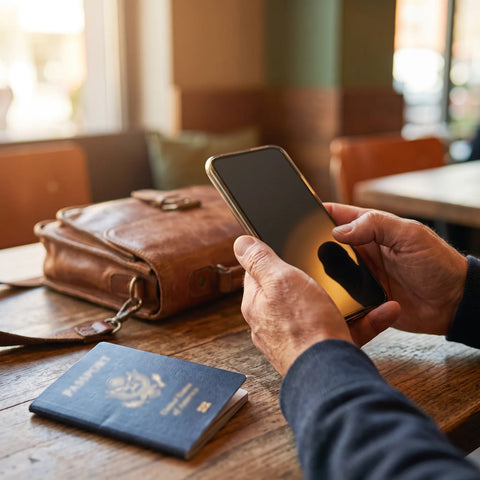
If you've come this far looking for how many GB you need for Germany, I owe you a heads-up before selling you anything: Germany is in the European Union, and if your plan is Spanish or from any EU country, European roaming already covers you at no extra cost. Still, this article makes sense for three things: to know how much data you will actually use, to decide what to buy if your plan includes little to no data outside your home country, and to guide those traveling from outside the EU. Let's get to the number.
How many GB you need for Germany: the number, no beating around the bush
First, a disclaimer: Germany is in the EU, so if your plan is Spanish or European, roaming already covers you and you don't need to buy anything. If you still decide to buy data, for 10 days in Germany, most people will be fine with 5 GB; 2 GB if you only use maps and WhatsApp.
That's the short answer, and the one I use when someone messages me in a hurry. The long answer is that Germany is not a destination that significantly increases data consumption: you don't need a camera translator all day, public transport signs are also in English in large cities, and European maps take up little space. What does significantly increase consumption in Germany is the type of trip, not the country: a week at a trade fair with video calls consumes ten times more than a week of tourism.
My criterion, after seeing hundreds of data bills from travelers, is simple. A normal tourist uses between 150 and 400 MB per day. Someone who lives on social media and uploads videos will go up to 500-800 MB per day. Someone working from the hotel with video calls can exceed 2 GB per day just by themselves. Multiply your range by the number of days and add a 20% margin: you now have your number without tables or calculators.
If you want the general method applied to any country, I elaborate on it in the guide about how much data I need for travel. Here I focus on what changes in Germany, which is more than it seems.
Do you really need to buy data for Germany?
I'm going to be honest, even if it works against me: if you have a mobile plan contracted in Spain or any EU country, you can use your usual gigabytes in Germany. Since January 2026, the "roam like at home" framework covers 33 countries, including the 27 EU members plus Iceland, Liechtenstein, Norway, and the additions of Ukraine and Moldova. You don't have to do anything, there's no surcharge, and your number works the same.
That said, there are very specific situations where it does pay to have separate data. Here they are so you can decide in thirty seconds, without anyone pushing you:
| Your situation | Do you need to buy data? |
|---|---|
| Spanish or EU plan, trip less than 4 months | No. European roaming covers you |
| Plan with a low fair usage limit (typical for plans with many GB) | Yes, as a backup: the limit abroad can be lower than at home |
| Cheap prepaid plan without data included outside the country | Yes |
| Traveler from Latin America, UK, USA, Asia… | Yes, almost always. Outside the EU, roaming is paid separately |
| Long stay: more than 4 months abroad in 12 months | Yes. Your operator may apply surcharges after the fourth month |
| Business trip and you don't want to mix consumption with your personal line | Yes, for billing convenience |
European regulations allow a maximum surcharge of €0.032 per MB when fair use is exceeded, which seems little until you use 3 GB. If your case is in the bottom half of the table, keep reading. If it's in the first row, save your money and just use this article to figure out how much you'll consume. How to connect there step-by-step is covered in internet in Germany, and if you've never used this technology, what an eSIM is explains it in five minutes.
What each activity you'll do there actually consumes
Here's the core of it. People think they use data by "browsing," but what really eats up your plan are three things: video, video calls, and uploading photos. Maps, which is what worries people most, barely consume anything. These are real reference figures, not marketing promises:
| Activity | Approximate consumption | What it means in Germany |
|---|---|---|
| Google Maps navigation (standard map) | 5-10 MB per hour | Walking around Berlin all day: less than 100 MB |
| WhatsApp messages, audio, and photos | 10-25 MB per day | Negligible. Not your problem |
| Social media (feed, stories, reels) | ~700 MB per hour | The big data guzzler. Half an hour a day is already 350 MB |
| Uploading photos from your phone | 3-5 MB per photo | 30 Oktoberfest photos ≈ 120 MB |
| Uploading a short video | 60-100 MB per minute | One daily reel is 2-3 GB in ten days |
| WhatsApp or FaceTime video call | 200-700 MB per hour | Calling home 15 min/day ≈ 1.5 GB in 10 days |
| One-on-one Zoom call | ~540 MB per hour | Business meeting from the hotel |
| Group Zoom or Teams call (active video) | 1.5-2.5 GB per hour | This is what ruins a small data plan |
| Audio-only meeting | ~35 MB per hour | Your best trick on a train |
| Streaming music | 30-120 MB per hour | An ICE Munich-Berlin trip with Spotify: ~250 MB |
| Streaming video in HD | 1-3 GB per hour | Don't do it with mobile data. Ever. |
| Web, email, and searching for a restaurant | 50-100 MB per hour | With heavy attachments, add 5-10 MB per email |
The practical conclusion is almost always the same: if you can watch video only on Wi-Fi, your consumption will be cut by two-thirds. You can find a detailed breakdown in the mobile data usage statistics by activity.
How many GB according to your profile and travel days
This is the table I'm here to give you. Find the row that best matches you, cross-reference it with the number of days you'll be staying, and you'll have your number. These figures are calculated using the data above and include a 20% margin for unforeseen circumstances, because no one travels exactly as planned.
| Traveler profile | 5 days | 10 days | 15 days | 30 days |
|---|---|---|---|---|
| Maps, WhatsApp and little else | 1 GB | 2 GB | 3 GB | 5 GB |
| Tourist with photos and social media | 3 GB | 5 GB | 8 GB | 15 GB |
| Business trip or trade fair (email, some video, occasional hotspot) | 5 GB | 8 GB | 12 GB | 20 GB |
| Digital nomad or remote work with daily video calls | 10 GB | 20 GB | 30 GB | 50 GB |
| Family sharing a phone as a hotspot | 5 GB | 10 GB | 15 GB | 25 GB |
Notice the leap between the first row and the fourth: twenty times more data for the same destination and the same number of days. That's why I'm suspicious of anyone who tells you "for Germany, 10 GB" without asking anything. The destination barely moves the needle; how you use your phone moves it entirely.
If you're torn between two rows, choose the lower one only if you're going to be working. For tourism, sticking to the higher one and topping up if necessary is cheaper than paying for gigabytes you won't use.
A note on the family row: if there are four of you and you're all using the same hotspot, consumption doesn't multiply by four because not everyone looks at their phone at the same time, but it can easily double or triple. And watch out for kids' automatic backups, which upload video without warning.
Business and trade fairs: Berlin, Munich, Frankfurt and Hanover
Germany is probably the European country with the most business travelers, and trade fairs are a world apart. If you're going to the Messe in Frankfurt, Hanover, Munich, or any large venue in Berlin, expect two things: that the venue's Wi-Fi will be saturated during peak hours, and that your phone will become your laptop's modem more than once.
A typical trade fair day with meetings looks quite a bit like this:
| Time of day | What you do | Data |
|---|---|---|
| Morning | Email with heavy presentations and PDFs | 150-300 MB |
| Mid-morning | 45-min group video call with the office | 1-1.8 GB |
| Noon | Share catalog or product video with a client | 100-200 MB |
| Afternoon | Laptop connected to phone for an hour (CRM, cloud, messaging) | 300-600 MB |
| Evening | Upload stand photos, LinkedIn, message home | 200-400 MB |
| Total for the day | — | 2-3 GB |
With that in hand, a week at a trade fair requires between 10 and 15 GB if you're really going to be working from your mobile, and not the 3 GB that seem sufficient on paper. The most expensive item is always group video calls, not email. If you can join meetings with your camera off while at the venue, you go from spending 2 GB per hour to barely 35 MB, and no one will fault you in the middle of a trade fair.
Another practical tip: Wi-Fi in German business hotels is usually decent, so save large uploads, backups, and material downloads for the evening.
ICE trains: on-board Wi-Fi is not a data plan
Here's the part that most people don't expect. Traveling by ICE between Berlin, Hamburg, Munich, or Cologne is comfortable and fast, and all ICE trains have free Wi-Fi, WIFIonICE. The problem is the quality: on paper, it promises up to 50 Mbit/s, but in practice, it usually hovers between 5 and 20 Mbit/s shared with the entire carriage, with cuts in tunnels and rural sections. In an international comparison of railway Wi-Fi published by the German technical press, Deutsche Bahn ranked second to last. It's not a rumor from a frustrated traveler, it's the actual state of affairs.
What this means for your gigabytes:
- Don't count on train Wi-Fi for downloading anything large or for a serious video call. If you have a meeting, join by audio.
- On-board Wi-Fi uses the same mobile network as your phone, so when the train loses signal, both lose it simultaneously.
- A long journey with music, email, and social media can easily reach 300-600 MB if you don't download anything beforehand.
- Download series, podcasts, and music playlists for your trip at the hotel. This is the biggest and easiest saving of all.
I count long journeys as half an extra day's consumption when I do my calculations, because people look at their phones much more on the train than when walking around a city. If you're going to connect several cities by ICE, move up a notch in the profile table. And if you want to see what each plan covers in the country, I detail it in the guide to eSIM for Germany.
Oktoberfest and Christmas markets: photos, stories and saturated networks
Munich's Oktoberfest and the Christmas markets in Nuremberg, Dresden, or Cologne are the two times when a trip to Germany suddenly becomes a high-consumption trip. And not because of what you spend, but how you spend it.
First, volume: at the Wiesn or a Christmas market, people take three or four times more photos and videos than on a normal day, and upload almost everything immediately. Thirty photos are about 120 MB, but three one-minute reels are already 300 MB in a single night.
Second, and this is what almost no one tells you: the network gets saturated. With hundreds of thousands of people in a few hectares, the antennas are pushed to their limit, uploads fail, and the phone retries. Each retry consumes data even if the photo isn't successfully published. It's the same effect as on New Year's Eve in any large city, multiplied by two consecutive weeks.
Rule I always apply at massive events: take photos there, upload them from the hotel. You save data, battery, and headaches, and the upload quality is infinitely better.
If your trip coincides with these dates, add 1-2 GB to the number in the table. Not because Germany consumes more, but because you will be using your phone differently: more camera, more stories, more sharing location with the group so you don't get lost, and more last-minute searches. It's also a good idea to lower the photo upload quality in your social media settings before entering the venue: the visual difference is minimal, and the savings are more than half.
Road trip through the Black Forest or the Romantic Road
If your plan involves a car and the open road—the Black Forest, the Romantic Road from Würzburg to Füssen, the Rhine Valley—I have two pieces of news, both of which affect your gigabytes.
The good news: navigation consumes very little. Google Maps or Waze in standard map mode use 5-10 MB per hour, so eight hours of driving in a day won't even reach 100 MB. You can cross all of Germany guided by your phone and spend less than half an hour on Instagram.
The less good news, and here I must be honest about a country that almost everyone takes for granted: German mobile coverage is worse than you would expect from an economy like theirs. According to measurements by the Bundesnetzagentur published in 2025, 4G from at least one operator covers 97.53% of the territory and 5G covers 93.85%, but there remains 2.10% of the country without 4G or 5G from any operator and about 14% of "gray areas" where there is a network from some operator but not all. The largest gaps appeared precisely in Baden-Württemberg and Rhineland-Palatinate, i.e., the Black Forest and Rhine region.
Translated to your trip: there will be rural stretches and valleys where you'll lose data for a while. That means you'll spend less, yes, but also that you need to be prepared:
- Download offline maps of the regions you'll be traveling through before you leave (about 50-150 MB per area, and on Wi-Fi).
- Save hotel reservations and tickets to your phone, not the cloud.
- If you're sharing your location with someone, let them know there will be gaps: it doesn't mean anything bad has happened to you.
Calculate your own consumption before leaving home
All the tables in the world are worth less than your own data. And you have it in your pocket, free, in two minutes. This is the method I recommend to everyone, and it's the most honest advice in this article because it doesn't depend on you believing me.
On an iPhone: Settings > Mobile Data and scroll down to Current Period usage. It's a good idea to reset statistics at the beginning of a month to have a clean reference. On Android: Settings > Network & Internet > SIM or Data Usage, where you'll see the total for the last 30 days and the breakdown by app.
With that number, the calculation is a simple proportion. Divide your monthly consumption by 30 to find your daily average and multiply it by the number of travel days. Then adjust with these two correctors:
- Subtract if you spend your day at home or in the office on Wi-Fi and will also have Wi-Fi at the hotel during your trip: in practice, data consumption during travel tends to be similar to that of a weekend away, not your monthly average.
- Add 30-50% if you plan to take more photos, use more maps, and do more searches than usual, which is common on a trip.
Real example: if you use 12 GB per month but 9 of them are on home Wi-Fi according to the breakdown, your pure mobile data consumption is about 100 MB per day. For ten days in Germany, that's 1 GB, plus a 50% margin, plus a couple of event days: a good 2 GB. Much less than you would have bought intuitively.
How to stretch your GBs and what to do if you run short
With four adjustments made before leaving, the same trip goes from 5 GB to 2 GB without you noticing anything. These are the ones that really move the needle, in order of impact:
- Downloaded offline maps of Berlin, Munich, or the region you're traveling through. Zero consumption for navigation and they work in ICE tunnels and valleys without coverage.
- Photo backups only via Wi-Fi. This is the number one silent drain: your phone uploads every Oktoberfest photo as soon as you take it if you don't disable it.
- Disabled video autoplay on social media and data saving activated within each app. This alone cuts consumption by a third.
- System data saving mode activated (Android) or Low Data Mode on the eSIM (iPhone): cuts background updates and synchronizations.
- Downloaded series, music, and podcasts at the hotel for train journeys.
And if you still run short, it's not a problem: topping up takes a minute from your phone, and you don't have to go to any store or change anything. That's why my advice is always to underestimate and top up rather than overestimate: unused gigabytes are not refunded, and buying 20 GB "just in case" only to come home with 16 unused is a waste of money. I'd rather you buy little and prove me right halfway through your trip. You can find more refined tips in the guide on how to save data while traveling.
Frequently Asked Questions
The most common questions I get about data in Germany, answered in two lines each.
How many GB do I need for 7 days in Germany?
Between 2 and 4 GB for a normal tourist trip. If you take a lot of photos and stories, 5 GB. If you work with daily video calls, increase to 12-15 GB. And remember: with a European plan, you don't need to buy anything.
If I'm Spanish, do I really not need to buy data for Germany?
Correct, you don't need it. European roaming allows you to use your home gigabytes in Germany without extra charges. It only pays to buy data if your plan has a low fair usage limit abroad, if you're staying for more than four months, or if you want to separate work consumption.
Is mobile coverage reliable in Germany?
In cities, yes; in the countryside, less than you'd expect. Official 2025 measurements show 4G coverage from at least one operator in 97.53% of the territory, but 2.10% still lacks 4G and 5G, and there are many grey areas in the rural south and west.
Can I trust the Wi-Fi on ICE trains?
For checking email and messaging, yes; for serious work, no. WIFIonICE promises up to 50 Mbit/s but in practice provides between 5 and 20 Mbit/s shared, with drops in tunnels and rural sections. Download what you need before boarding the train.
How much data does Google Maps use in a day in Berlin?
Less than 100 MB. The standard map consumes between 5 and 10 MB per hour. Maps are almost never the problem: video, video calls, and uploading photos are the issue.
What if I run out of data in the middle of my trip?
You can top up from your phone in a minute, provided you have some Wi-Fi to complete the purchase. That's why it's better to start with a modest plan and extend it on the fly than to overpay in advance.
How many GB do I need for Oktoberfest or the Christmas markets?
Add 1-2 GB to your normal calculation. Not because of the destination, but because you'll take many more photos and videos, and network saturation causes upload retries that consume data even if the post fails.
Is it worth buying 20 GB for peace of mind?
Almost never. It only makes sense if you work with daily group video calls or if you're going to share the connection with several people. For tourism, 20 GB over two weeks is money you leave unused.
Conclusion
To summarize without embellishment. If you have an EU plan, you don't need to buy data in Germany: European roaming covers you, and that's it. If your plan doesn't include data outside your home country, if you're traveling from outside the EU, or if you want a separate line for work, the benchmark is 2 GB for ten days of relaxed tourism, 5 GB if you live on social media, and between 10 and 20 GB if you're attending fairs or teleworking with video calls.
Add one or two GB if your trip coincides with Oktoberfest or the Christmas markets, and don't count on ICE Wi-Fi or rural German coverage to save you: download maps before you leave. And most importantly, check your phone's actual data usage for the last 30 days before deciding anything. It's the most honest data you'll find.
Once you have your number, choose the smallest plan that fits your needs and extend it on the go if necessary: you can view the available plans for the Germany eSIM and leave home with your phone sorted and without overpaying.