If you've already decided to get a data plan and just need to know how many GB to buy for Egypt, this guide is for you. Egypt has a unique characteristic that almost no other destination shares: within the same country, two types of trips can consume data in radically different ways. The cultural circuit (Cairo, Luxor, Aswan, Nile cruise) significantly increases data usage due to photos, videos, and video calls. A resort week in Hurghada or Sharm el Sheikh decreases it, because the hotel Wi-Fi covers 80% of your day. Buying the same package for both means wasting money in one case and being stranded in the other. Let's look at the numbers.
The short answer, no beating around the bush
For a 10-day circuit trip through Egypt (Cairo, Luxor, Aswan, and a cruise), most people will find 5 GB to be sufficient. If your trip is a Red Sea resort stay with hotel Wi-Fi, 2 or 3 GB will be more than enough. Increase to 10-15 GB only if you work remotely or share data with family.
That's the answer, and I won't hide it at the end of the article. However, if you have three minutes, it's worth understanding where those numbers come from, because Egypt is one of those destinations where the travel profile weighs more heavily than the duration. A fifteen-day resort traveler might consume less than a five-day circuit traveler.
The logic I always follow is the same one I explain in the general guide on how much data you need for travel: start with your actual daily consumption at home, subtract what you'll do over Wi-Fi, and add what you only do while traveling (maps, translator, uploading photos, video calls to show off). In Egypt, that "only while traveling" is surprisingly high on the circuit and almost zero on the beach.
And a starting warning that I'll elaborate on below: don't count on making voice or video calls via WhatsApp normally. Egypt has a long history of restricting VoIP apps, and this changes both how you'll talk to people back home and how much data you'll consume doing it.
Two Egypts that consume differently
When someone writes to me "I'm going to Egypt, how many gigabytes?", my first question is always the same: circuit or beach? Because these are two trips that are completely different from a data consumption perspective.
The cultural circuit is a trip of constant movement: Giza pyramids, Egyptian Museum, flight or overnight train to Luxor, Karnak temples and Valley of the Kings, three or four-night cruise to Aswan, perhaps a getaway to Abu Simbel. You're out of the hotel from sunrise to sunset, taking hundreds of photos and dozens of videos, and spending the day with your phone in hand: maps, translator, looking up the name of the pharaoh the guide just mentioned, sending a video of the temple to the family group. Here, your phone really works hard and consumption soars.
The Red Sea resort trip (Hurghada, Sharm el Sheikh, Marsa Alam, El Gouna) is the opposite: all-inclusive, Wi-Fi in the room and by the pool, and you just relaxing. Mobile data only comes into play during the transfer from the airport, on a diving or quad bike excursion, and during a stroll through the bazaar. You can go entire days without using even 50 MB.
If you're still unsure which connection option suits you best in general — local SIM card, roaming with your carrier, or eSIM — I break that down in the guide on internet in Egypt. Here, we're going straight to the gigabytes.
How much each activity consumes, in real MB
A gigabyte is an abstraction until you translate it into what you do every day. And when you do, most people discover they consume much less than they feared, because they associate "data" with "streaming" when in reality their trip is mostly messages, maps, and photos. These figures are approximate — they vary depending on network quality, screen resolution, and individual app settings — but they are more than sufficient for calculating a package:
| Activity | Approximate Consumption |
|---|---|
| WhatsApp: chats, photos, and voice notes | 5-15 MB per day of normal use |
| Voice call via app (audio) | 30-50 MB per hour |
| 1-on-1 video call, standard quality | 200-300 MB per hour |
| HD or group video call | 500 MB - 2 GB per hour |
| Maps with live navigation | 5-10 MB per hour |
| Social media with video (Instagram, TikTok) | 500 MB - 1 GB per hour |
| Upload 20 photos from phone to cloud | 100-200 MB |
| Upload a 1-minute video | 50-150 MB |
| Translator with camera or voice | 20-40 MB per hour of intense use |
| Music streaming | 40-80 MB per hour |
| Video streaming on mobile | 250 MB (low) to 1 GB (high) per hour |
| Email and web browsing | 10-20 MB per hour |
What's clear at a glance: text uses almost no data, and video consumes it all. Sending 200 messages a day for two weeks costs less than a single long video call from the Giza plateau. If you're curious about the full breakdown by app type, I expand on it in the mobile data usage statistics by activity.
Translated to Egypt: the tourist who uses maps and messages rarely exceeds 150-250 MB per day, while someone who uploads daily stories and makes a long video call easily reaches 600-800 MB per day. Between these two extremes, there's a factor of four, which is why no single recommendation works for everyone. Also note that temples and tombs are places where you'll record a lot of video: if you have automatic cloud upload enabled, that material will be uploaded using data without you consciously deciding it. That's the detail that most often turns a more-than-sufficient package into one that runs out halfway through the trip.
The Nile cruise: coverage comes and goes
This is the point that surprises first-time travelers the most. On the Luxor-Aswan cruise, mobile coverage is not constant: it's good when docked in a city and becomes irregular while sailing. Travelers themselves report this repeatedly in forums, and country coverage guides confirm it: solid signal near urban centers and locks, weak in open stretches of the river.
| Travel Segment | What to Expect |
|---|---|
| Cairo, Giza, and Alexandria | Solid 4G, sometimes congested in tourist areas |
| Luxor and Aswan (city and temples) | Good and stable coverage |
| Docked in Edfu or Kom Ombo | Works, often dropping to 3G |
| Sailing between towns | Intermittent; there are times with no usable data |
| Road to Abu Simbel and desert | Irregular, with long stretches of no signal |
| Red Sea coast | Good 4G in tourist hubs |
What does this mean for your gigabytes? Two things, and they're contradictory. On the one hand, you consume less than expected, because during hours of navigation you simply cannot consume: no streaming, no uploads, no scrolling. On the other hand, when you regain signal upon docking, your phone suddenly downloads everything it had queued — messages with photos, updates, backups — and takes a bite out of several hundred MB in ten minutes.
The practical lesson: on the Nile cruise, don't buy thinking about "what I consume on a normal day," but rather about peaks. Having downloaded maps and disabled automatic backups prevents precisely that data bite.
One more note: the Wi-Fi advertised on boats is not an independent network, but the same mobile link shared among a hundred passengers. When the boat loses coverage, the boat's Wi-Fi also loses it, and when it regains it, it's slow because everyone is using it at once. Count on your own data as your primary plan and the boat's Wi-Fi as a bonus.
Hurghada and Sharm: hotel Wi-Fi changes everything
If your Egypt trip is to the Red Sea, breathe easy: you'll spend very little. Resorts in Hurghada, Sharm el Sheikh, Marsa Alam, and El Gouna offer Wi-Fi practically throughout the entire premises, and although the speed ranges from decent to mediocre depending on the hotel and time, it's more than sufficient for messaging, social media, and video calls.
The actual distribution for a 7-night resort traveler typically looks something like this: 80-85% of consumption goes through hotel Wi-Fi, and only 15-20% through mobile data. And that small portion is concentrated at very specific moments:
- The transfer from the airport to the hotel, looking for the meeting point and notifying of your arrival.
- Excursions: quad safari, diving at Giftun Island, trip to Luxor or Mount Sinai.
- A stroll through the city center or bazaar, using maps and a translator.
- Times when the hotel Wi-Fi goes down or is so slow that you resort to mobile data out of sheer desperation.
That last point justifies carrying data even if you have Wi-Fi included: resort Wi-Fi during peak season gets saturated during afternoon and evening rush hours, exactly when you want to call home. Having a data buffer turns a problem into a minor inconvenience.
My honest recommendation for this profile: 1 GB for 5 days, 2 GB for a week, and 3 GB for two weeks. If you have extra, that's better than paying for 10 GB you won't use. And if you run short, you can top up in two minutes from your phone.
Video calls from the pyramids (and the VoIP warning)
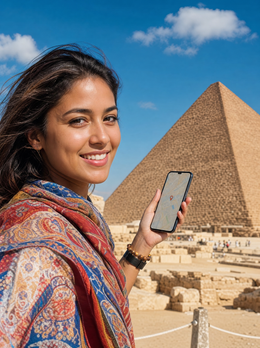
There's a scene that repeats itself in Giza: someone standing in front of the Great Pyramid with their phone held high, showing it live to their mother. It's one of the most exciting parts of the trip, so it's worth budgeting for properly, because a video call is, by far, what consumes the most data of anything you'll do.
| Call Type | Per Hour | 10 Minutes |
|---|---|---|
| Voice-only via app | 30-50 MB | 5-8 MB |
| 1-on-1 Video, standard quality | 200-300 MB | 35-50 MB |
| HD Video | 500 MB - 1 GB | 80-170 MB |
| Group Video (3 or more) | 1-2 GB | 170-330 MB |
With this table, budgeting is easy: ten minutes of video per day for ten days is about 500 MB, half a gigabyte. If you plan to make several long or group calls, add 1 GB to the package and you'll sleep soundly.
Now for the important warning, and I prefer to give it to you before the trip rather than after: Egypt has been restricting voice and video calls from apps like WhatsApp, FaceTime, Skype, or Messenger on its networks for years. Messages, photos, and voice notes work normally; it's the calls that fail. The Egyptian regulator has publicly denied blocking them, and the behavior reported by travelers is intermittent — sometimes it works, sometimes it doesn't even ring, and it changes depending on the network — so I cannot promise it will work for you. Check before traveling if your usual app is operational and have a backup plan: a regular phone call, voice messages, or a VPN, which usually solves it but adds between 10% and 20% extra consumption.
Translator, maps, and transportation: the circuit apps
Beyond video calls, the Egyptian cultural circuit has its own set of apps, and it's useful to know which ones consume a lot of data and which ones don't.
The translator is almost mandatory and is used much more than people expect: in the Khan el Khalili bazaar for bargaining, to read a menu without Latin transcription, to communicate with a taxi driver. It consumes little per query, but camera mode — pointing at an Arabic sign and seeing the superimposed translation — uses more than it seems if you keep it open for a while. The usual solution: download the Arabic language pack in the translator while you're at home, and it will work offline.
Maps consume very little if you download them. Without downloading, each new map load is a few MB, and in Cairo, where traffic constantly forces route recalculations, it adds up.
Transportation is where you really need live data. Uber and Careem work well in Cairo, Alexandria, and Hurghada, and are the most convenient and transparent way to get around without negotiating prices. They require an active connection to request a car and track it: budget about 10-20 MB per day if you use them several times.
Tickets and reservations (domestic flights to Luxor or Aswan, temple entrance tickets, boarding passes) should be downloaded as PDFs before you leave. Relying on opening an email with a bad signal at the gate of Abu Simbel is an unnecessary source of stress. If you're still not sure how the technology you'll carry on your phone works, here's an explanation of what an eSIM is in two minutes.
Master table: GB by profile and duration
This is the table you've been looking for and the heart of the article. The figures are calculated for a cultural circuit trip (Cairo, Luxor, Aswan, and a cruise), which is the scenario that consumes the most, assuming you sleep in hotels with Wi-Fi and upload backups via that connection. Find your profile, cross-reference with your travel days, and you'll have your number:
| Profile | 5 days | 10 days | 15 days | 30 days |
|---|---|---|---|---|
| Tourist using maps and WhatsApp | 1 GB | 2 GB | 3 GB | 5 GB |
| Frequent photo and social media user (uploads daily) | 3 GB | 5 GB | 8 GB | 15 GB |
| Digital nomad / remote worker | 5 GB | 10 GB | 20 GB | Unlimited or 30+ GB |
| Family sharing (2-4 devices) | 5 GB | 8 GB | 12 GB | 20 GB |
And now for the Egyptian adjustment, which makes this article useful:
- Red Sea resort trip: divide by two. With hotel Wi-Fi covering most of the day, a tourist using maps and messages can manage with 1 GB per week.
- Nile cruise included: keep the figure from the table. Don't lower it for segments without coverage, because the data spikes when signal is restored will consume just as much.
- Frequent video calls: add 1 GB for every 30-40 minutes of video calls you plan to make in total.
- If you use a VPN to bypass calling restrictions: add another 10-20% to the total.
With that, you have your number. On the eSIM for Egypt page, you can see what sizes are available and which fits your calculation. Always round down, not up: it's cheaper to top up than to pay too much.
Calculate your real consumption before leaving home
All the tables in the world are worth less than your own data. And you have it in your pocket: your mobile has been recording exactly how much you consume for months.
On Android: Settings → Network & internet → SIM or Data usage, and you'll see current and previous cycle usage, broken down by application. On iPhone: Settings → Mobile Data, and scroll down to the app list; the counter accumulates since the last time you reset it, so if you've never touched it, check your carrier's app, which provides monthly usage.
With that number, the calculation is simple:
- Divide your monthly mobile data consumption by 30. That's your daily average at home.
- Multiply it by your travel days.
- Subtract 40-50% if you sleep in hotels with Wi-Fi (for a Red Sea resort, subtract 70%).
- Add travel extras: maps, translator, photo uploads, and video calls you've already budgeted for above.
A real example: if you use 6 GB per month, your average is 200 MB per day. Ten days on a tour in Egypt would be 2 GB, minus 40% for hotel Wi-Fi is 1.2 GB, plus half a gigabyte for photos and video calls: around 2 GB. This matches the table, and that's why I trust this homemade calculation more than any generic recommendation. Do it once, and you'll know how to gauge all your trips.
Stretching data and what to do if you run short
Five habits that make the difference between 2 GB and 6 GB in Egypt:
- Downloaded offline maps of Cairo, Luxor, Aswan, and Hurghada before you leave. GPS works without data.
- Photo backups only via Wi-Fi. This is the big silent data hog: a day of temples means 300 photos and several videos, and if they upload via data, they'll drain your plan without you even realizing it.
- Disable automatic video playback on Instagram, TikTok, X, and WhatsApp, and set automatic media downloads to Wi-Fi only.
- Activate system Data Saver, which cuts background traffic from apps you're not using.
- Music and series streaming, downloaded from home. The bus rides to Abu Simbel and Nile cruises are long.
I have the complete list of tricks in the guide on how to save data while traveling, but these five alone will cut your consumption by half.
And what if you run short? Well, it's no big deal, and that's why I advocate for running short rather than having too much. To top up takes two minutes from your phone, and you only pay for what you actually need. Buying too much, on the other hand, is money you won't get back: no one refunds unused gigabytes at the end of your trip. That said, do it with some buffer and don't wait until you're at zero in the middle of the desert: when you have 20% of your plan left, top up at the hotel with Wi-Fi and continue without any hiccups.
Frequently asked questions
The most common questions I get about data in Egypt, answered with the number upfront:
How many GB do I need for a week in Egypt?
Between 2 and 3 GB for a 7-day cultural tour, and 1-2 GB if it's a resort trip in the Red Sea. Only if you upload videos daily or make long video calls should you increase to 5 GB.
Does WhatsApp work in Egypt?
Messages, photos, and voice notes work normally; voice and video calls are usually restricted. Egypt has been limiting VoIP traffic on its networks for years, and its behavior is intermittent. Have a backup plan ready.
Is there Wi-Fi on the Nile cruise?
Almost all boats advertise Wi-Fi, but it's slow and unstable, especially while sailing. It relies on the same mobile connection as your phone, so when the boat loses signal, the boat's Wi-Fi does too. Don't rely on it as your primary plan.
How much data does a video call from the pyramids use?
About 200-300 MB per hour at standard quality and up to 1 GB in HD. Ten minutes a day for ten days is roughly half a gigabyte. It's the most expensive activity of the entire trip in terms of data.
Do I need a VPN in Egypt?
It's not mandatory, but many people use it to try to make calls via apps. Keep in mind that encrypting traffic adds between 10% and 20% to consumption, so if you're going to use a VPN, increase your data package a bit.
Will I lose signal in the desert or at Abu Simbel?
Yes, in stretches of road and desert areas, the signal disappears for long periods. This is another reason to have maps, translations, and entertainment downloaded before leaving the hotel.
Is it better to buy a lot of GB at once or top up?
It's almost always better to start with less and top up. Unused gigabytes are not refunded, and a top-up takes two minutes. Buy for the consumption you've calculated, not for the worst-case scenario imaginable.
How many GB for two weeks with family?
About 12 GB for a 15-day tour shared between 2 and 4 devices, or 5-6 GB if it's a beach trip. Sharing data from a single phone works well and avoids buying multiple packages.
Conclusion
In summary, without fluff: 5 GB is more than enough for ten days of a cultural tour in Egypt, including a cruise, and 2 or 3 GB is sufficient for a week at a Red Sea resort. Only increase to 10-15 GB if you work online, share with multiple devices, or plan to make long video calls daily. And remember the two Egyptian peculiarities: on the Nile, coverage comes and goes, so have everything important downloaded, and calls via apps might not work, so have a backup plan for talking to home.
Choose your number with the profile table, round down, and top up if needed. You can activate your data plan for Egypt in a couple of minutes from the Egypt eSIM and arrive in Cairo with your phone already working, no queues or paperwork at the airport.