If you've already decided that you're going to use data and the only thing left is to choose the package size, this guide is all about that: how many GB you need for Georgia. And before we go on, a clarification to avoid trouble: I'm talking about Georgia, the country in the Caucasus, the one with Tbilisi, mountains, and wine, not the state of Georgia in the United States. They are two different destinations, with different coverage and different products.
The short answer: how many GB for Georgia
For 10 days in Georgia, 5 GB is more than enough for most people. Between guesthouse and cafe Wi-Fi and stretches of mountain without coverage, you'll use less than you think. If you only use maps and WhatsApp, 3 GB will be plenty; if you work remotely from Tbilisi, count on 20 GB or more.
That's the figure you'd ask me for if you caught me on the street, and I won't hide it at the end of the article. From here on, all I do is refine it, because Georgia is a destination with two very different faces: that of the traveler who visits Tbilisi, Kakheti, and Kazbegi in ten days, and that of the one who stays three months working from a coworking space in the Vera neighborhood. The first spends very little. The second can easily consume 40 GB.
The good thing is that it's hard to overspend in Georgia if you travel normally. It's a country where accommodation almost always includes Wi-Fi, where cafes offer it for free, and where half of the tourist route runs through valleys where there's simply no signal to use. The trap is the opposite: people buy 20 GB "just in case" and return home with 14 unused. If you want the general framework for calculation before delving into the country's specifics, you can find it in my guide on how much data I need to travel. Here, I'll focus on the specifics: Georgia, your days, your profile.
Georgia country or Georgia state: check before buying
Let's address the most expensive confusion for this destination. There are two "Georgias": the Republic of the Caucasus, between Russia and Turkey, capital Tbilisi, currency the lari, its own alphabet; and the state of Georgia in the United States, capital Atlanta. In Spanish, the coincidence is total, so some people land in Kutaisi with US data, and some arrive in Atlanta with a Caucasus package. In both cases, the phone goes silent, because a data package is tied to the networks of a specific country.
The check takes five seconds and saves you the whole problem: make sure the product description lists the correct country, with its local operators (Magticom, Silknet, or Cellfie are the Georgian ones) and not US operators. If the package mentions Tbilisi, Batumi, or Kutaisi, you're good. If it mentions Atlanta or Savannah, you've got the wrong continent.
The other common oversight is assuming that Georgia is included in European roaming. It's not: it's a European country by vocation and by the Council of Europe, but it's not part of the European Union, so the gigabytes from your Spanish plan don't travel with you for free. All the details on how to connect are in the guide on data for Georgia; here, we'll continue with how much.
How much each activity consumes, in actual MB
Before deciding on a number, you need to know what consumes data. These are the figures I work with, measured in normal mobile usage and rounded up so they don't catch you by surprise. You'll see that what truly eats up data is video, in all its forms: watching video, uploading video, and video calling. Everything else is small change.
| Activity | Approximate consumption | Note for Georgia |
|---|---|---|
| Maps with online navigation | 3-5 MB per hour | Almost 0 if you have the map downloaded |
| WhatsApp, text and audio only | 1-3 MB per day | The cheapest usage there is |
| Voice call via WhatsApp | 25-35 MB per hour | Works well even with 3G in villages |
| Instagram or TikTok, scrolling | 150-350 MB per hour | The big silent data hog |
| Upload 20 photos to chat or cloud | 60-120 MB | Upload on guesthouse Wi-Fi |
| Video call at 720p | 500-900 MB per hour | Key for the nomad profile |
| Video call at 1080p | 1-1.5 GB per hour | Lower quality if you're low on data |
| Music streaming, normal quality | 40-70 MB per hour | Useful on long marshrutkas |
| Video streaming at 480p | 500-700 MB per hour | Enough for a mobile screen |
| Video streaming at 1080p | 2-3 GB per hour | Save this for Wi-Fi |
| Translator with camera | 1-2 MB per query | Download the Georgian package |
| Order a taxi by app | 5-10 MB per trip | Bolt and Yandex Go are used daily |
| Email and web browsing | 10-20 MB per hour | Less than people think |
If you want the long breakdown, with more apps and scenarios, I have it detailed in the mobile data usage statistics by activity. The quick takeaway is this: a day of pure tourism in Tbilisi, with maps, messages, some searches, and photos to the family group, amounts to 150-250 MB. A day of unrestricted social media use can reach 800 MB or 1 GB.
Master table: GB per profile and duration
This is the table I'm giving you. Find your row, find your days, and there's your number. It's calculated with Wi-Fi available at night, which is normal in Georgia, and with a reasonable margin for that one day when you overuse data.
| Travel profile | 5 days | 10 days | 15 days | 30 days |
|---|---|---|---|---|
| Tourist with maps and WhatsApp | 1 GB | 2 GB | 3 GB | 5 GB |
| Photos and social media | 3 GB | 5 GB | 8 GB | 15 GB |
| Trekking in the Caucasus | 1 GB | 2 GB | 3 GB | 5 GB |
| Couple or family sharing | 5 GB | 10 GB | 15 GB | 25 GB |
| Digital nomad or remote work | 10 GB | 20 GB | 30 GB | 50 GB or unlimited |
A couple of honest nuances about the table. The trekking profile consumes the same as the relaxed tourist for a counter-intuitive reason: they spend the day where there's no network, so even if they wanted to consume, they couldn't. The family sharing profile assumes one phone acts as a hotspot for the others; if each person has their own package, apply the individual row to each person, and it will be more accurate.
And the nomad profile is the only one that can truly overflow. If your days include two or three hours of video calls, add 1 GB per hour of meeting and adjust. A month of serious remote work in Tbilisi, with daily meetings and not relying solely on apartment Wi-Fi, can easily reach 40-60 GB.
Why Georgia changes the number
Each destination moves the needle in one direction, and Georgia moves it down for four specific reasons.
The first is Wi-Fi. It's a country where accommodation with included Wi-Fi is the absolute norm, from a Tbilisi hostel to a family guesthouse in Mestia, and where cafes offer it without asking for anything. Much of your heavy consumption (uploading photos, updating apps, watching something before bed) will happen there without touching your gigabytes.
The second is geography. Georgia is a mountainous country with three operators that cover cities, main roads, and tourist towns very well, but they stop at the entrance to high valleys. Every hour you spend on a trail without signal is an hour where your consumption is zero.
The third is the alphabet. Georgian has its own script, and as soon as you leave the tourist areas, there are menus and signs you won't decipher. That means a translator with a camera often, although the consumption is minimal (one or two MB per query) and drops to zero if you download the language for offline use.
The fourth is the local price. Georgian data packages are among the cheapest in Europe; you see offers like 7 GB for about 7 lari. I'm telling you because it's true and because I prefer you to know: the trade-off is going to a store with your passport and registering the line. If you prefer to arrive connected, the complete comparison is in internet in Georgia.
Tbilisi, Batumi, and Kakheti: the city and winery trip
The classic circuit (Tbilisi, a getaway to Kakheti, a few days in Batumi) is the easiest scenario to calculate, and also where consumption is most underestimated, because it's where you really rely on your phone.
In Tbilisi, you'll order taxis by app several times a day: Bolt and Yandex Go are the default transport, and each trip takes between 5 and 10 MB for maps, tracking, and notifications. You'll look for schedules, restaurants, and prices for the Abanotubani sulfur baths, which are booked on the fly. And you'll take photos: the old city, the cable car to Narikala, the rooftops of the bathhouses. With all that, a full day in Tbilisi is around 200-300 MB if you don't get entangled with social media.
Batumi behaves the same or better: it's a coastal city with very good coverage, a promenade, and cafes everywhere. Here, the risk is the beach: two hours of scrolling under the umbrella are worth more gigabytes than three days of museums.
Kakheti is the interesting case. Between Sighnaghi and Telavi, there's coverage without a problem in towns and on roads, but many wineries are on roads between vineyards where the map becomes essential and the signal comes and goes. It's worth having the day's route pre-loaded before leaving the hotel.
Kazbegi, the Military Road, and Svaneti: maps and silence
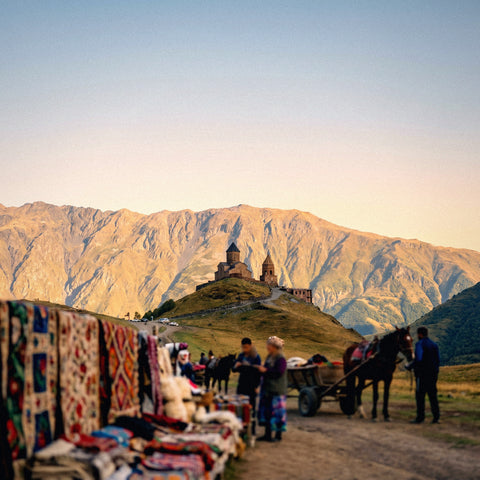
Here is the particularity that most changes the calculation in Georgia. The Georgian Military Road, which connects Tbilisi with Stepantsminda (Kazbegi) passing through Gudauri and the Jvari Pass, is a spectacular mountain road with sections where the phone gets no signal. The same, multiplied, in Svaneti: Mestia and Ushguli are remote, and the trails connecting them pass through valleys without coverage.
| Area | What to expect | What to do with data |
|---|---|---|
| Tbilisi, Batumi, Kutaisi | Fast and stable 4G | Normal use without thinking |
| Kakheti (Sighnaghi, Telavi) | Good in towns and on roads | Pre-load daily route |
| Military Road and Gudauri | Good in towns, gaps in between | Offline map mandatory |
| Stepantsminda (Kazbegi) | Coverage in the village | Upload photos from accommodation |
| Mestia and Ushguli (Svaneti) | Signal in the village, Wi-Fi in guesthouses | Download everything in Mestia |
| High mountain trails and Tusheti | No signal for long stretches | Zero consumption, you'll spend less |
The practical consequence is twofold. On the one hand, you'll consume less than expected in the mountainous part of the trip, because your phone will be without signal for hours. On the other hand, downloaded maps stop being a money-saving trick and become a safety measure: on a foggy mountain road, or on a detour to a Svan tower, you can't rely on the map loading. Download the entire area in Tbilisi or Mestia, with Wi-Fi, before heading up. It costs a few hundred MB of Wi-Fi and saves you cold sweat.
Digital nomad profile: video calls and coworking
Georgia has become a destination for long stays for a very specific reason: citizens from over ninety countries, including Spain, can enter and stay for up to 365 days without a prior visa. This has filled Tbilisi (and to a lesser extent Batumi and Kutaisi) with people working remotely, with coworking spaces, laptop-friendly cafes, and a large community. If that's why you're coming, your calculation will be nothing like that of a tourist. Also, pay attention to the legal aspect: long stays and work permits are different things, and regulations have been changing, so it's advisable to check them before coming with plans for months.
| Work usage | Per hour | 2 hours a day for 10 days |
|---|---|---|
| Audio-only meeting | 30-50 MB | 0.6-1 GB |
| Video call at 720p | 500-900 MB | 10-18 GB |
| Video call at 1080p | 1-1.5 GB | 20-30 GB |
| Screen sharing with slides | 150-300 MB | 3-6 GB |
| Email, chat, and cloud documents | 20-40 MB | 0.4-0.8 GB |
My advice for this profile: rely on coworking or apartment Wi-Fi for long meetings and save mobile data for backup, which in Georgia is exactly what you need, because occasional power or fiber outages do occur. With 20 GB for 10 days or 50 GB for a month, you'll be covered without overpaying. If you literally live on video calls and don't want to think about it, go straight for an unlimited package.
How to know your real consumption before leaving home
Everything above is averages. Your exact number is already in your pocket and can be checked in two minutes, without installing anything.
On Android, go to Settings, Network & Internet, and look for mobile data usage for the month. On iPhone, Settings, Cellular, and scroll down to the app list (it's a good idea to reset statistics occasionally so the data is for the current month and not the last three years). You'll see two things: how much you spend per month outside the home and, most importantly, which three apps consume half of everything.
With that number, the rule is simple: divide your monthly consumption by 30 to get your daily average and multiply it by the number of travel days. Then adjust it with two corrections. Add 20-30% if you use a lot of Wi-Fi at home and will be out and about more in Georgia. And subtract what corresponds to mountain days, where your consumption approaches zero.
A real example of how I do it. If I use 6 GB of mobile data per month at home, my average is 200 MB per day. For twelve days in Georgia, that would be 2.4 GB. I add a margin and subtract the three days in Svaneti, and I comfortably settle on a 3 GB package. That calculation, made with your own data, is worth more than any table, including mine.
Ten tricks to stretch your GB in Georgia
If you want to downgrade and save a few euros, these measures work and won't spoil your trip.
- Offline maps of the whole country downloaded with Wi-Fi: this is the number one trick here, for savings and road safety.
- Offline translator: download the Georgian package and use the camera without spending any data.
- Wi-Fi only backups, on your phone and in your photo app. This is the invisible expense that ruins the most data plans.
- Disable auto-play video on Instagram, TikTok, Facebook, and X.
- Data saver mode activated by default, in the system and in the browser.
- Video at 480p: on a mobile screen, you won't notice the difference and you'll use four times less data.
- Downloaded music before long marshrutka rides; the Tbilisi-Mestia journey is many hours.
- Photos and videos to the group, at night and with Wi-Fi. A 30-second video weighs more than a whole day of maps.
- App updates Wi-Fi only, no exceptions.
- Check the counter every two or three days to correct in time.
The difference between spending 2 GB and spending 8 GB on the same trip is almost never in what you do on purpose, but in what your phone does on its own while you look at the mountains.
With these settings, a normal two-week trip stays below 3 GB effortlessly. I have the extended list, with screenshots and specific settings by operating system, in my tips for saving data while traveling.
What happens if you run out (and why it's okay)
Let me be clear: it's better to run out and top up than to overbuy from the start. If you buy 3 GB and run out on the tenth day, you top up in five minutes from your phone and continue. If you buy 20 GB and use 6, those 14 GB don't come back. The money lost by buying too much is certain; the "problem" of running out is solved with two taps and is usually cheaper even with the top-up included.
Furthermore, in Georgia, running out of data doesn't leave you stranded. You're in a country with Wi-Fi everywhere: accommodation, the corner cafe, restaurants, many buses. You can top up by connecting to your guesthouse's Wi-Fi, or ask your travel companion for a hotspot for ten minutes. It's not an emergency, it's a formality.
What I do recommend is not to wait until the last megabyte if you have a mountain road trip ahead of you. On the Georgian Military Road, with snow or fog, you want your phone to be operational. The rule I follow: top up when you drop below 20%, not when you reach zero.
And if all this sounds like gibberish because you've never used a digital card, I've explained how it works from scratch, including phone requirements, in what an eSIM is. It activates in minutes and top-ups are done from the same account.
Frequently Asked Questions
Is this guide for the country Georgia or for the state of Georgia (USA)?
For Georgia the country, in the Caucasus, with its capital Tbilisi. It has nothing to do with the state of Georgia in the United States, whose capital is Atlanta. Since they have the same name in Spanish, always check that the product you buy mentions Georgian operators or cities like Tbilisi, Batumi, and Kutaisi. A data package only works on the networks of the country for which it was purchased.
How many GB do I need for 7 days in Georgia?
2 GB is more than enough for a seven-day normal tourist trip. This covers maps, messaging, searches, ride-hailing apps, and sending photos to the family group, assuming you use the accommodation's Wi-Fi at night. If you post stories daily and watch videos in bed, increase to 3-5 GB. Only if you work remotely during those seven days will you need 10 GB or more.
Is there Wi-Fi in Georgian accommodations?
Yes, and it's one of the reasons why data consumption is low here. Included Wi-Fi is the norm in hotels, hostels, and family guesthouses, even in mountain villages like Stepantsminda or Mestia. The speed varies quite a bit: in Tbilisi and Batumi it's usually good, and in Svaneti guesthouses it's enough for messaging and uploading photos, but not always for a serious work video call.
Will I have coverage in Kazbegi, Svaneti, and on the Georgian Military Road?
In the villages, yes; on hiking trails and some road sections, no. Stepantsminda, Gudauri, and Mestia have normal mobile coverage. The Georgian Military Road has gaps between settlements, and the trekking routes of the High Caucasus or areas like Tusheti can be completely without signal. Download maps before heading up and assume that in the mountains your data consumption will be almost zero.
Will my Spanish mobile plan work in Georgia?
Not like in the European Union: Georgia is not part of the EU. Although geographically and culturally it is Europe, it is not covered by EU regulations, so your national gigabytes do not travel free and out-of-bundle rates are usually expensive per megabyte. Before you leave, check with your operator for the exact price for Georgia and compare it with a travel data package.
How many GB do I need if I work remotely from Tbilisi for a month?
Between 30 and 50 GB, or directly an unlimited package if you rely on video calls. One hour of 1080p meeting uses more than 1 GB, so two hours daily are 20-30 GB per month just for meetings. Rely on coworking or apartment Wi-Fi for long calls and keep mobile data as a reliable backup when the fixed connection fails.
What happens if I run out of data in the middle of the trip?
You top up from your mobile in a couple of minutes and continue. You need a connection to do it, and in Georgia it's easy: Wi-Fi from your accommodation, a cafe, or a companion's hotspot. That's why I always recommend buying just enough and topping up if necessary, instead of overpaying for gigabytes you won't use.
Is it worth buying a local Georgian SIM?
In terms of pure price, yes, it's one of the cheapest in Europe; in terms of time and convenience, not always. There are local offers for several gigabytes for a few lari, but they involve going to a store with your passport, registering the line, and changing your number. If your trip is short or you arrive at Kutaisi at night, having digital connectivity from landing usually makes up for the price difference.
Conclusion
To summarize so you don't have to scroll back up. For a normal 10-day trip through Georgia, including Tbilisi, Kakheti, and a getaway to Kazbegi, 5 GB is plenty and with 3 GB many people return home without using it all. If your plan is mostly mountains and trekking, go even lower: 2 GB. If you're coming to work remotely, go up to 20 GB for ten days or 50 GB for a month.
The expensive mistake in this destination is not running out, it's overbuying out of fear. Between ubiquitous Wi-Fi and mountains without coverage, Georgia is a country where data goes a long way. Buy just enough, download maps before heading to Svaneti, and top up if necessary – it only takes two minutes.
Once you've decided, choose your size and activate it before you fly with PuraSIM's travel data for Georgia: arrive in Tbilisi with internet from the moment you land, without visiting any stores.