If you're wondering how many GB you need for Kyrgyzstan and can't decide between a small or large package, I understand: it's the country where the "one gigabyte per day" rule simply doesn't apply. Half the route here goes through places where there's no signal and won't be, so the normal calculation doesn't work. Let's look at the number and why.
The short answer: how many GB for Kyrgyzstan
For 10 days in Kyrgyzstan, most people will be fine with 3 GB, and with 5 GB you'll have plenty if you post a lot. The reason is simple: on a classic route, you'll spend between four and six days without coverage —Song-Kul, Ala-Kul, the jailoos— and during that time, you won't use a single megabyte.
That's the number you'd ask for if you sat down with me for ten minutes. Now for the nuance, which is where the value lies: in Kyrgyzstan, you don't buy data for "all the days of your trip," you buy data for the days when there's actually a signal. And those are quite a few fewer than what's on your itinerary.
As a quick reference, depending on your type of traveler:
- Trekking and yurts, basic use (maps, WhatsApp, some audio): 2 GB for two weeks is fine.
- Normal trip with photos, stories, and some video: 5 GB for two weeks.
- Remote work from Bishkek or Karakol: 20 GB and up, because then you'll be connected for full days.
- Family or group sharing a phone as a hotspot: multiply by the number of phones, but only for days with coverage.
If you've read the general guide on how much data you need for travel, forget the "1 GB per day" for a moment: in Central Asia, that calculation will make you buy twice what you'll actually use. And running out here is cheap to fix; overbuying, not so much.
Why the calculation isn't linear here
Kyrgyzstan is mountains everywhere: the Tian Shan covers almost the entire country, and the mobile network follows where people go, meaning cities, main valleys, and roads. Bishkek has perfectly usable 4G, the northern shore of Issyk-Kul and Karakol also, and Naryn, Kochkor, or Osh give you enough signal for normal use. The country's three operators (Beeline, MegaCom, and O!) cover this axis well; 5G is not yet commercially deployed, so we're talking about 4G.
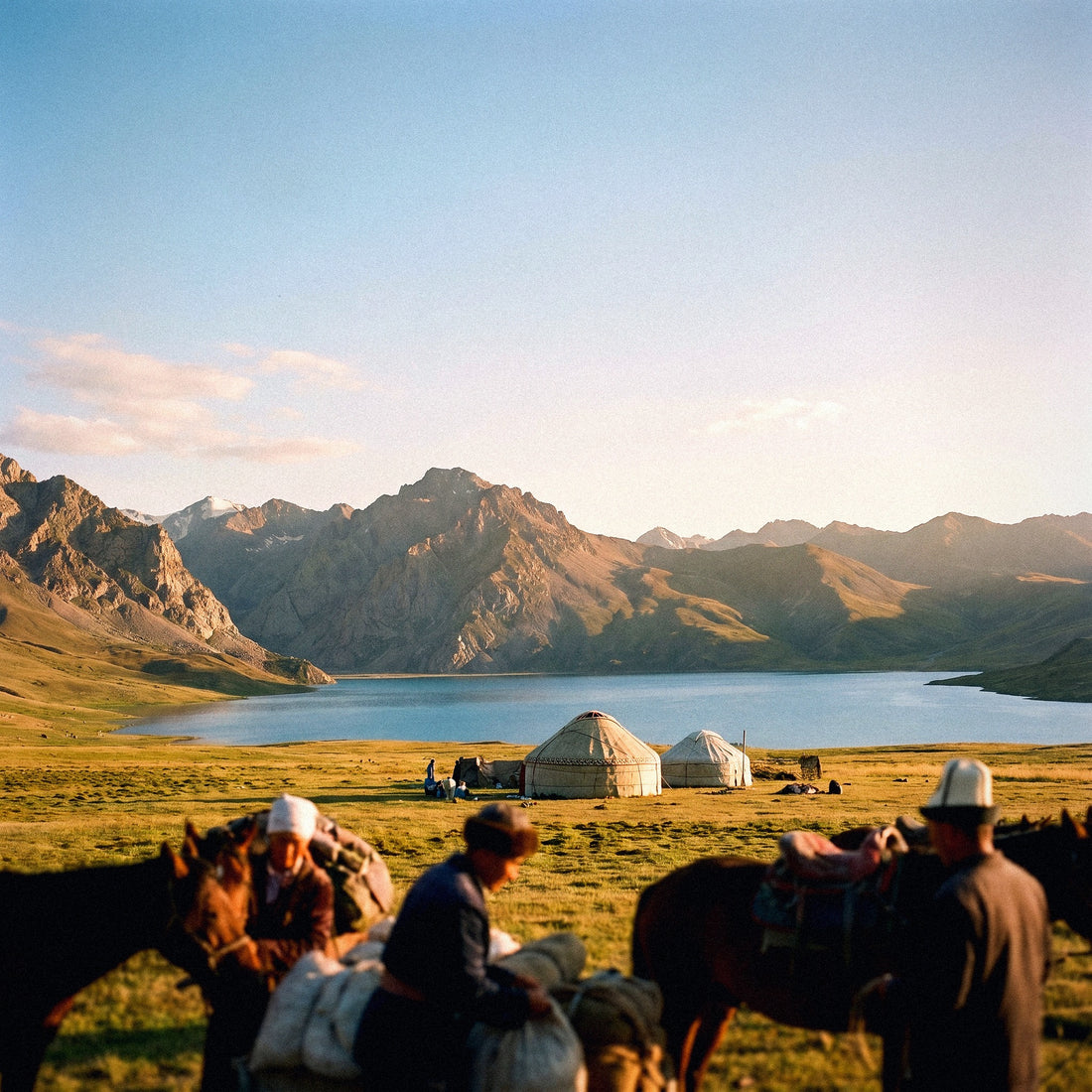
The problem —or the wonder, depending on how you look at it— begins when you leave those areas. The jailoos, the summer pastures where families set up yurts, are precisely where nothing reaches. Song-Kul, at just over 3,000 meters, has no signal, no Wi-Fi, and no electricity in most camps. The Ala-Kul trek, starting from Karakol via Altyn Arashan, is two or three full days where your phone is a camera with GPS and little else.
In Song-Kul there is no antenna, no plug, and no shop. What you don't have downloaded and charged, you simply don't have.
That's why adding days and multiplying by a gigabyte leads you to overbuy. If you want details on which operator works best in each area and how to connect there, you can find it in the guide to internet in Kyrgyzstan. Here we continue with the gigabytes.
How much each app actually consumes
Before deciding on the package, it's worth knowing what consumes data. The usual surprise is that what seems most daunting (maps) is almost free, and what we do without thinking (scrolling Instagram on the marshrutka) is what empties the meter.
| Activity | Approximate Consumption | On a real travel day |
|---|---|---|
| Maps with online navigation | 3-5 MB per hour | 15-30 MB |
| Downloaded offline maps | 0 MB | 0 MB |
| WhatsApp: text, audio, and some photos | 10-30 MB per hour of use | 20-50 MB |
| WhatsApp video call | about 300 MB per hour | 150 MB (half an hour) |
| Scrolling Instagram or TikTok | 600 MB - 1.2 GB per hour | 300-600 MB |
| Uploading photos (about 40, mobile size) | 3-5 MB per photo | 150-200 MB |
| Video in 480p | about 250 MB per hour | 250 MB |
| Video in 1080p | 1.5 GB per hour | avoid on the road |
| Music streaming | 100-150 MB per hour | 300 MB on a long journey |
| Translator with downloaded Russian package | 0 MB | 0 MB |
Notice the leap: a day of maps and messages is less than 100 MB; the same day with half an hour of social media goes up to half a gigabyte. That's your entire data budget right there. If you want the figures broken down by application, I've compiled them in the mobile data usage statistics by activity, but with this table, you can already calculate your entire trip.
How many GB based on your profile and travel days
This is the important table. It already accounts for the days without coverage on a typical Kyrgyz route: I've assumed that around a third of your days will be spent in the mountains or in a yurt, which is typical unless you stay only in Bishkek and Issyk-Kul.
| Profile | 5 days | 10 days | 15 days | 30 days |
|---|---|---|---|---|
| Maps and WhatsApp (trekking, yurts) | 1 GB | 2 GB | 3 GB | 5 GB |
| Photos and social media | 3 GB | 5 GB | 8 GB | 15 GB |
| Digital nomad / remote work | 10 GB | 20 GB | 30 GB | 50 GB |
| Family or group sharing (3-4 phones) | 5 GB | 10 GB | 15 GB | 25 GB |
Two honest caveats about this table. First: if your trip is only Bishkek, Ala Archa, and the shore of Issyk-Kul, with no treks or jailoos, move up one row, because you'll be connected every day and the mountain discount won't apply to you. Second: if you're traveling with an agency and spending four nights in a yurt, you can safely drop to the previous tier.
Digital nomads deserve a separate paragraph. Bishkek has become a comfortable base, and there are cafes and co-working spaces with decent Wi-Fi, but video calls over mobile data consume a gigabyte every long hour. If you're going to truly work, count your accommodation's Wi-Fi as your primary network and data as an emergency backup; with that, 20 GB for ten days is a very reasonable cushion.
Two weeks in Kyrgyzstan, segment by segment
Since the fourteen-day trip is the most common, I'll break it down for you using the classic northern route. You'll see why the total is nothing like "14 days × 1 GB."
| Segment | Days | Coverage | Estimated Data |
|---|---|---|---|
| Bishkek (arrival, formalities, city) | 2 | Good 4G + Wi-Fi | 300-500 MB |
| Excursion to Ala Archa | 1 | Signal in the parking lot, none higher up | 50-100 MB |
| Karakol and Issyk-Kul shore | 2 | Decent 4G in villages | 400-600 MB |
| Trek Altyn Arashan - Ala-Kul - Karakol | 3 | No signal | 0 MB |
| Kochkor and Naryn | 2 | 4G in the village | 200-300 MB |
| Song-Kul, yurt stays | 2 | No signal or electricity | 0 MB |
| Road to Tash Rabat or Osh | 2 | Intermittent, at times | 200-400 MB |
| Total | 14 | - | 1.2-1.9 GB |
There you have it: two full weeks below 2 GB with sensible use. And mind you, it's not that you're depriving yourself of anything; it's that for five of those fourteen days, your phone is in airplane mode because there's no other option.
When does it spike? When you add video. If on long journeys —and there are some: Bishkek to Karakol is about six hours, and to Osh it can take a whole day— you're watching series or story after story, add half a gigabyte daily and your total shoots up to 4-5 GB. That's why what determines your package isn't the country, but what you do on the journeys. Download music and episodes on your accommodation's Wi-Fi and you'll save half.
Offline maps and battery: the real mountain problem
Here's the twist almost no one tells you about. On jailoo and trek days, you don't use data, true. But you do use battery, and there's nowhere to plug in. In the yurt camps of Song-Kul, it's normal not to have electricity beyond a small solar panel for lights, and on a three-day trek, there's absolutely nothing.
Your phone's GPS works without coverage —that's physics, not operator-dependent— so you can track your position on a downloaded map with your phone in airplane mode. And with airplane mode activated, your battery lasts much longer, because your phone stops desperately searching for an antenna that doesn't exist. That's the trick.
What I download before leaving Bishkek, using the hotel's Wi-Fi:
- Offline maps of the entire country in Organic Maps or Maps.me, which include OpenStreetMap trails; Google Maps works well for roads but is weak in the mountains.
- 2GIS for getting around Bishkek and Osh: it's the street map locals use and works offline.
- The offline Russian language pack for the translator. With Russian, you can get by almost anywhere.
- The trek tracks in your hiking app, plus a screenshot of the itinerary and contact phone numbers.
- Music, podcasts, and a few episodes for journeys.
And bring an external battery of at least 10,000 mAh; if you're sleeping two nights in a yurt, 20,000 is better. The cold at high altitudes, moreover, drains the battery much faster than you'd expect: put your phone in your sleeping bag at night and you'll see the difference in the morning.
Cheap data and the combined package with Kazakhstan and Uzbekistan
Kyrgyzstan is one of the cheapest countries in the world for mobile data. To give you an idea, as of mid-2026, local operators sell things like 20 GB for about 240 som or packages of tens of gigabytes for similar figures: we're talking about the equivalent of a few euros, far from what it costs in Europe. Check upon arrival, as rates often change.
Now, let's be honest about what that means. If your entire trip uses 2 GB, the difference between paying two euros and paying eight is six euros. What you're deciding isn't the price per gigabyte, it's whether it's worth queuing at Manas airport, leaving your passport to register the line, and being without connection from the moment you land until you buy it. If you're going to be working from Bishkek for a month, a local card pays off. For two weeks on the road, convenience wins; the complete comparison is in the guide to eSIM for Kyrgyzstan.
The other factor is that almost no one goes to Kyrgyzstan alone. Combining it with Kazakhstan—Almaty is four hours from Bishkek—and with Uzbekistan via the Silk Road is common. Crossing the border with a Kyrgyz card means paying roaming prices or buying another card in each country. That's why, if you're visiting more than one country, a regional Central Asia plan is better than three different cards even if the single gigabyte is slightly more expensive.
How to know your own data consumption
Everything above is an average. Your actual consumption is in your pocket and can be checked in two minutes, which is the most useful advice in this article.
On an iPhone: Settings, Mobile Data, and scroll down to Current Period Usage (it's a good idea to reset the statistics on the 1st of the month for a clean reference). On Android: Settings, Network & Internet, Data Usage, and there you'll see the current month and the breakdown by application. Write down your total for a normal month at home.
With that number, the calculation is easy:
- Divide your monthly consumption by 30 to find your real daily usage.
- Multiply it by the number of travel days when you'll have coverage, not all of them.
- Subtract what you'll do via Wi-Fi: in Bishkek, Karakol, and guesthouses, there's Wi-Fi, weak but sufficient for messages and uploading photos at night.
- Add a 20% buffer and that's it.
An important detail: at home, you consume more than you will there, because at home you watch video on your phone without thinking. When traveling, you tend to have your phone in hand less often. So that calculation usually errs on the side of generosity, which is good. If it turns out you use 8 GB a month in Spain, your daily usage is about 270 MB; for ten days with seven days of coverage, less than 2 GB. It matches the table, and now the number is yours, not mine.
How to make your GB last and what to do if you run out
Stretching data in Kyrgyzstan is simple because the country itself forces you into economy mode for half the trip. Even so, here are four adjustments I always make as soon as I land:
- Backups only over Wi-Fi. This is the number one data thief: a vacation full of photos and videos can be 1-2 GB daily uploading to the cloud without you even realizing it.
- Data saver mode activated in the system and within social media apps.
- No auto-play for videos on Instagram, TikTok, and the browser.
- Video at 480p and music/series downloads done over the accommodation's Wi-Fi.
I have more tricks compiled in the guide on how to save data while traveling, but with these four, you'll already cut almost half your consumption.
What if you run out? Just top up. And precisely for that reason, my advice is to buy less and top up if necessary, rather than overbuying out of fear. Unused gigabytes aren't refunded, and in a country where you'll spend five days in airplane mode, the risk of overbuying is much greater than running out.
The only operational nuance: top up when you have a signal, not in the middle of a mountain pass. Before heading to Song-Kul or Ala-Kul, check your balance in Kochkor or Karakol; if you're low, you can extend it there in a minute. Getting coverage again after three days is a small luxury, and it's better if it comes with available data.
Frequently Asked Questions
Common questions I receive about this destination, answered directly without inflating numbers to sell larger packages.
How many GB do I need for 10 days in Kyrgyzstan?
Most people are fine with 3 GB. If your plan includes trekking and yurt stays, 2 GB might be enough; if you post stories every day and watch videos on journeys, aim for 5 GB. Anything above that only makes sense if you're teleworking.
Is there coverage in Song-Kul and on the Ala-Kul trek?
No, practically none. In Song-Kul, you might get a stray bar if you climb a nearby hill to the camps, but it's not reliable and shouldn't be planned around. At the Ala-Kul pass and in the high mountain passes, there's no signal from any operator. Consider those days disconnected and go without worries.
Can I use the maps without data in the mountains?
Yes: GPS works without coverage and without data. All you need to do is download the map beforehand. With Organic Maps or Maps.me and the entire country downloaded, you can see your position on the trail with your phone in airplane mode, which also significantly extends your battery life.
Can the same plan be used for Kazakhstan and Uzbekistan?
Only if you purchase a Central Asia regional plan. A package just for Kyrgyzstan will not work across the border. If your route includes Almaty, Bishkek, and Samarkand, choose regional coverage from the start: it saves you from buying and activating a new plan in each country. If you don't know how switching countries works, here I explain what an eSIM is and how it's managed.
Is it worth buying a local SIM card in Bishkek?
It's worth it if you're staying for weeks; for two weeks, not really. Local data is very cheap, but you need a passport to register the line, time at the airport or a store, and you arrive without connectivity. If you're only going to use 2 or 3 GB for the entire trip, the savings are just a few euros.
Is there Wi-Fi in accommodations?
In cities, yes; in the mountains, no. Hotels and guesthouses in Bishkek, Karakol, Naryn, or Osh have Wi-Fi, sometimes slow but sufficient for messages, uploading photos, and downloading maps or music. In the yurt camps of the jailoo, there is no Wi-Fi or electricity, so plan your downloads before heading up.
Do I need a VPN in Kyrgyzstan?
For normal use, no. Common services — messaging, maps, email, banking — work normally. That said, some specific applications have been blocked in the country in the past, so don't assume everything works the same as at home. And keep in mind that an active VPN always adds some extra battery consumption.
What happens if I run out of data halfway through the trip?
You top up in two minutes and continue. That's why it's worth starting with the small package. The only thing: do it where there is coverage. Check the counter in Karakol or Kochkor before heading towards the high-altitude lakes, because once you're up there, you won't be able to extend anything for days.
Conclusion
Kyrgyzstan is the destination where most people overbuy, and now you know why: you plan a fourteen-day trip, but the data only lasts nine. With 2 GB, you can do two weeks of travel with maps, messages, and photos; with 5 GB, you'll have plenty even if you post daily; and only if you're going to work from Bishkek does it make sense to go for 20 GB or more. Anything above that, for a trekking trip, is wasted money.
The important things are done before you leave: downloaded maps, Russian translator downloaded, music for the journeys, and your power bank charged. That's worth more than any gigabyte package when you're at 3,000 meters looking at Lake Song-Kul without a single bar of signal, which is exactly the moment you went there for.
If you're already clear, choose your size for the eSIM for Kyrgyzstan, activate it before you fly, and land in Manas with internet working. Start with the small package: topping up is always easy, and here it's much more likely you'll have too much than too little.