If you've made it this far, you've already decided to get a data plan, and you just need to know the package size: how many GB you need for Romania. I'll answer that with facts, not fluff, and with a heads-up that might save you the entire expense. Romania is a country where data goes a lot further than people imagine, and that pushes the number down, not up.
The short answer (and the honest heads-up that Romania is in the EU)
For 10 days in Romania, 3 GB is more than enough for most people: maps, WhatsApp, and a bit of social media use less than 250 MB per day, and Romanian Wi-Fi handles almost all heavy data use. If you upload video daily or work remotely, count on 10 GB.
Now for the heads-up, because I'd rather you read it here than after you've already paid: Romania is a member state of the European Union. Since June 2017, the "roam like at home" rule applies: if your plan is Spanish (or from any EU country), your home data works in Bucharest just like in Badajoz, at the same price. There's no surcharge. For many readers of this article, the correct answer to "how many GB should I buy" is zero.
That said, there are specific cases where it does make sense to get separate data:
- Cheap or prepaid plans with a very low roaming cap (some plans offer 30 GB in Spain but only 5 or 7 GB abroad): the fair use policy exists and bites.
- Travelers from outside the EU (United Kingdom after Brexit, Latin America, Switzerland), where roaming is charged at punitive rates.
- Those traveling for work who want to separate their personal line from their travel data line.
- Those who will share their connection with family and don't want to exhaust their primary plan.
If you're still debating between using your current plan, buying a local SIM, or getting digital data, I break that down in the internet in Romania guide. Here, we'll continue with what you came for: the number.
What really consumes data: usage by activity
The classic mistake is to think that "using your mobile" consumes the same amount no matter what you do. Not so. There's a 100-fold difference between browsing with Maps and watching an HD series. These are the figures I work with, measured under normal travel conditions (mobile screen, not tablet, and without obsessing over maximum quality):
| Activity | Approximate consumption | Translation to a day of travel |
|---|---|---|
| Maps with GPS navigation (route loaded) | 3-7 MB per hour | 4 h driving ≈ 20-30 MB |
| Maps with satellite view or live traffic | 15-20 MB per hour | 4 h ≈ 60-80 MB |
| Text and photo WhatsApp | 5-15 MB per day | almost negligible |
| Voice call on WhatsApp | 20-30 MB per hour | 30 min ≈ 15 MB |
| Video call | 200-300 MB per hour | 15 min daily ≈ 60 MB |
| Social media with video (Reels, TikTok) | 500 MB - 1 GB per hour | 30 min ≈ 250-500 MB |
| Uploading photos from mobile | 3-5 MB per photo | 30 photos ≈ 120 MB |
| Uploading a 1-minute video | 60-150 MB | one long story consumes the day's data |
| Music streaming (normal quality) | 40-70 MB per hour | 2 h driving ≈ 100 MB |
| Video streaming SD / HD | 0.3 GB / 1.5-3 GB per hour | one HD movie ≈ 3 GB |
| Email, news, and web browsing | 10-20 MB per hour | 1 h ≈ 15 MB |
Notice the pattern: everything that is text, maps, and voice is small change; everything that is video eats up the entire budget. In the data usage statistics by activity, you have the extended details. With this table, the calculation stops being a guess: you just have to add up your typical day.
Why Romania consumes less: excellent Wi-Fi and super-fast network
Here's the counterintuitive, yet real and verifiable, fact: Romania has some of the best connections in Europe. This isn't tourism marketing. Bucharest has been among the top ten cities in the world for the fastest fixed broadband for years, with average download speeds over 200 Mbps, and the country leads the Central and Eastern European region in fiber speed. Furthermore, the price of a mobile gigabyte in Romania is around half a euro, among the cheapest on the continent.
And why does that matter to you if you're only going for ten days? A lot, because it translates into three practical things:
- The accommodation's Wi-Fi isn't just a comfort, it's a highway. In a pensiune in a village in Maramureș or Bucovina, you might find better fiber than at your own home.
- Cafes, restaurants, and even many city buses in Bucharest and Cluj have open and decent Wi-Fi.
- Because Romanians consume data without fear, the mobile network is well-dimensioned: 4G and 5G really work in cities and on main roads.
Romania is one of the few places in Europe where you have more data plan than you need precisely because the connection is so good: you end up downloading everything via Wi-Fi without even trying.
The consequence for your GB budget is direct: if you sleep with Wi-Fi every night, large downloads (maps, series, backups, updates) don't touch your data. That's why I recommend lower figures than for a trip to Morocco or South America. If you still want your own connection from the moment you land, the eSIM for Romania guide has the options and coverage.
Transylvania by car: the hours of maps you underestimate
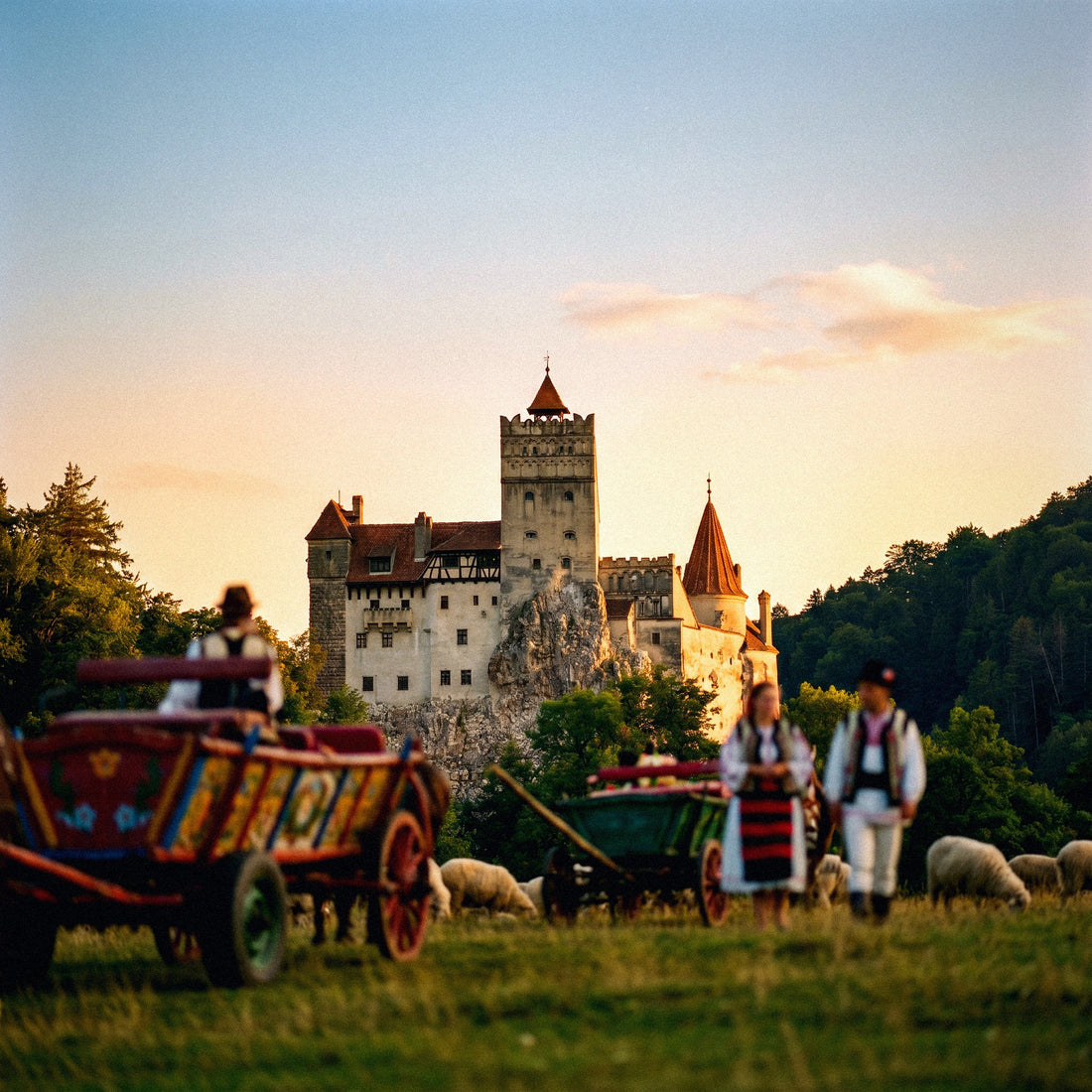
The typical trip to Romania is not a city trip; it's a road trip. Bucharest, Peleș Castle in Sinaia, Brașov, Bran Castle, Sighișoara, Sibiu, and back. That's easily between 900 and 1,200 km and many hours of driving, because Romanian roads are beautiful but slow: national roads with one lane per direction, trucks, villages with a 50 km/h limit, and mountain curves. A 120 km stretch can take two and a half hours.
The good news is that navigation is very cheap. Google Maps or Waze with the route already calculated consume around 5 MB per hour; even driving six hours in a day, you won't reach 50 MB. What really increases consumption are three things:
- Recalculating the route many times (each detour redownloads the map).
- Satellite view, which multiplies consumption by three or four.
- Searching on the go: photos of restaurants, reviews, castle opening hours. You can easily use 100-200 MB in an afternoon without realizing it.
My practical advice: download the offline map of all Transylvania the night before, using the hotel's Wi-Fi. That's about 300-500 MB you don't pay for with your data, and it saves you in bad sections. With the offline map, your phone only uses data for live traffic, which is just a few MB. Count on 150-250 MB per day for a day of driving with stops, searches, and photos to the WhatsApp group. Nothing more.
The Transfăgărășan: sections with no coverage
The Transfăgărășan (DN7C) is 151 km of mountain road that crosses the Carpathians from south to north and peaks at 2,042 meters, next to Lake Bâlea. It is one of Europe's most spectacular roads and, due to its altitude and snow, it is only open from late June or early July until late October, depending on the year. If you go in May, don't count on it.
For our purposes, there are two warnings, and one is good news:
- There are sections without coverage. Between the Vidraru reservoir and the Bâlea tunnel, with rock walls and tunnels, your phone goes silent at times. This is normal and not a fault of your connection.
- That means you won't use data there. A full day on the Transfăgărășan can end with less than 50 MB consumed, because you spend half the day without signal and the other half taking photos, which don't consume anything until you upload them.
What's important isn't the cost, it's the preparation. Have the map downloaded and the route saved before you start climbing, and let anyone waiting for you know that you'll be unreachable for a few hours. If you're going to upload videos of the mountain pass, do it at night from your accommodation: a single two-minute clip in high quality can easily be 200-300 MB, more than the rest of the day combined. Coverage returns strongly once you descend towards Cârțișoara and connect with the DN1.
Bucharest and the monasteries of Bucovina: two opposite consumption patterns
Within the same trip, some days consume ten times more data than others, and it's good to see this to avoid overbuying.
Bucharest is an expensive data day. There's 5G in almost the entire city, you'll use the subway and taxi apps (Bolt and Uber work great and are ridiculously cheap), you'll look for restaurants, check Parliament Palace hours, upload photos. An intense urban day can easily consume 300-600 MB, and if you're into Reels, it could reach a gigabyte. The compensation: Wi-Fi is everywhere, so you can connect at every cafe.
Bucovina is a cheap data day. The painted monasteries (Voroneț, Sucevița, Moldovița, Humor) are in rural valleys, the route between them is short and slow, and what you do there is admire 16th-century frescoes, not scroll. Plus, the signal is decent but doesn't invite heavy data use. Count on 100-150 MB per day, mostly for maps and messaging.
| Type of day | What you do | Estimated consumption |
|---|---|---|
| Urban Bucharest | Taxis, subway, searches, photos, social media | 300-600 MB |
| Transylvania road trip | Maps, stops, castles, WhatsApp | 150-250 MB |
| Transfăgărășan or mountains | Half day without coverage, offline photos | 30-80 MB |
| Bucovina monasteries | Maps, little mobile use, many frescoes | 100-150 MB |
| Work-from-accommodation day | Email, video calls, cloud | 0.5-2 GB (better with Wi-Fi) |
With this mix, a classic ten-day trip comes out to about 2 GB in real terms. That's why I recommend 3 GB: a margin without overspending.
Master table: GB by profile and duration
This is the table you came to see. It's calculated for Romania, meaning assuming you sleep in places with decent Wi-Fi (which is almost always the case in this country). If you're camping or moving without fixed accommodation, go up a level.
| Profile | 5 days | 10 days | 15 days | 30 days |
|---|---|---|---|---|
| Tourist using maps and WhatsApp | 1 GB | 2 GB | 3 GB | 5 GB |
| Transylvania road trip (2 mobiles, lots of driving) | 2 GB | 4 GB | 6 GB | 10 GB |
| Photos and social media (daily stories) | 3 GB | 5 GB | 8 GB | 15 GB |
| Family sharing (2 adults + 2 children with video) | 5 GB | 10 GB | 15 GB | 25-30 GB |
| Digital nomad / remote work with video calls | 5 GB | 10 GB | 20 GB | 30 GB or unlimited |
Three honest interpretations of this table:
- If you fit the first profile and are going for a week, 1 or 2 GB is more than enough. I'm telling you this even though we sell larger packages: buying 20 GB to stroll around Brașov is a waste of money.
- The real jump in consumption is caused by video, not by the number of days. A weekend of uploading Reels consumes more than two weeks of maps.
- If you're sharing your connection (hotspot) with another mobile, double your profile's figure, don't just add a little.
And if you want the general framework for any destination, not just this one, the complete calculation method is in the main guide: how much data do I need for travel.
How to know your actual consumption before leaving home
All the tables in the world are worth less than your own history. You already know how much you spend, you just haven't looked at it. It takes a minute:
- On Android: Settings > Network & internet > SIM / Data usage. You'll see the current cycle's consumption and, by tapping on the graph, the breakdown by application.
- On iPhone: Settings > Mobile Data. Note: this counter is accumulated since the last time you reset it, so if you've never reset it, the number is from years ago. Reset it, wait a normal week, and multiply by four.
With your monthly average in hand, the rule I use is simple: divide by 30 to get your daily consumption and multiply by 1.5. That 50% extra covers the fact that you use more maps and search for more things when traveling. Then multiply by the number of travel days.
| Your monthly home consumption | Daily | GB for 10 days in Romania |
|---|---|---|
| Less than 5 GB | ~150 MB | 2 GB |
| 5-15 GB | 0.2-0.5 GB | 3-5 GB |
| 15-40 GB | 0.5-1.3 GB | 8-15 GB |
| More than 40 GB or unlimited plan | 1.3 GB or more | 20 GB or unlimited |
An important nuance: at home, many people are constantly connected to office and home Wi-Fi, so their mobile consumption is artificially low. If this is your case, it's better to look at a weekend away from home and use that day as a reference. It's the closest data to a travel day you'll find.
How to stretch your GB in Romania without suffering
If you're running low on gigabytes or simply want to buy the small package with peace of mind, these adjustments will save you between 40% and 70% of consumption. None of them force you to give up anything important:
- Offline maps of Romania downloaded via Wi-Fi before you leave. The most cost-effective of all.
- Backups and photos to the cloud, only via Wi-Fi. iCloud and Google Photos are, by far, the biggest silent data thieves while traveling.
- Disable automatic video playback on Instagram, Facebook, X, and TikTok. This alone cuts hundreds of MB daily.
- Activate Data Saver (Android) or Low Data Mode (iPhone, within Mobile Data Options).
- Download music and podcasts the night before; driving in Romania can be long, and streaming Spotify adds up.
- App updates only via Wi-Fi: a batch of updates can eat 1 GB at once.
- Check consumption every two or three days, not just at the end. Correcting mid-trip is easy; finding out on the last day is not.
The golden rule: let large data travel via Wi-Fi and small data via mobile data. Maps, messages, and browsing on mobile data; video, backups, and updates at your accommodation.
I have an entire guide dedicated to this with all the step-by-step settings, system by system: tricks to save data while traveling. By applying half a dozen of them, a two-week trip through Transylvania easily fits within 3 GB, even if you spend a lot of time on your phone.
What happens if you run out (and why it's better than overspending)
Let's address the question that really worries you: what if I run out of data in the middle of the Transfăgărășan? Reassuring answer: nothing serious happens. When you exhaust your plan, you simply lose your data connection; there are no surprise bills or excess charges, because a prepaid package does not allow you to spend more than what you bought. You still have your downloaded map, you still have Wi-Fi at the hotel, and you can top up from there in two minutes.
That's why my advice is always the same: underbuy and top up. The math is clear:
- If you buy too much, you pay for gigabytes that expire unused. It's simply wasted money.
- If you buy too little, the cost of topping up is that of another small package, and you only pay for it if you truly need it.
- The real risk of running out of data in an EU country with excellent Wi-Fi is very low. You're not in the desert: you're ten minutes from a cafe with fiber optic internet.
The only situation where it's worth having plenty of data is for remote work with video calls: running out in the middle of a meeting can cost money, and the price difference between 10 and 20 GB is small. For everything else, start small. If it's your first time with a digital connection and you want to understand how it works before buying, I'll explain it to you without technical jargon in what is an eSIM.
Frequently asked questions
The most common questions I get about gigabytes in Romania, answered with the numbers first.
How many GB do I need for a week in Romania?
Between 1 and 3 GB for most people. A tourist who uses maps, messaging, and takes some photos won't reach 2 GB in seven days. If you upload stories daily or share your connection with another phone, budget 5 GB and don't worry about it anymore.
Do I need data if my plan is Spanish?
No, not in principle. Romania is in the European Union and since 2017, your plan applies just as it does in Spain. The only thing you should check is the roaming data cap of your specific plan, as many cheap plans significantly limit data outside the country.
How much data does Google Maps consume on a day trip through Transylvania?
Less than 50 MB. With the route loaded, navigation consumes around 5 MB per hour. Even if you drive six hours between Bran, Sighișoara, and Brașov, the consumption is minimal. What increases the figure are searches for places, photos, and reviews, not the map itself.
Is there coverage on the Transfăgărășan road?
Not at times, and that's normal. In the mountain sections, tunnels, and around Lake Bâlea, at 2,042 meters, the signal disappears. Have your map downloaded and your route saved. Remember that the road is only open approximately from late June to late October.
Is it true that the internet in Romania is so good?
Yes, and it's among the best in Europe. Bucharest ranks year after year among the cities in the world with the fastest fixed broadband, and the country leads Central and Eastern Europe in speed. You'll find excellent Wi-Fi even in village guesthouses, and that greatly reduces the gigabytes you need to buy.
How many GB for two weeks of remote work from Romania?
Around 20 GB if you rely on mobile data. However, with the fiber optic internet available in Romanian accommodations, many digital nomads end up using less than 5 GB of mobile data and working via Wi-Fi. Take 10 GB with the option to top up, and you'll probably have plenty.
What happens if I run out of gigabytes in the middle of my trip?
Nothing: you run out of data, you're not charged extra. You top up from the accommodation's Wi-Fi in a couple of minutes and continue. That's why it's better to buy the right package instead of inflating it out of fear: whatever is left over expires and is not refunded.
Is it worth buying more GB because data is cheap there?
No, the local price doesn't affect you. The fact that a gigabyte in Romania costs around half a euro is a good sign about the quality and dimensioning of the network, but you pay the rate of your travel package. Buy according to your consumption, not according to how cheap it is.
Conclusion
Let me summarize plainly. Romania is in the European Union: if your Spanish plan has ample roaming, don't buy anything and enjoy your trip. If your plan limits data outside of Spain, or you're coming from outside the EU, or you want to reserve your main line, then yes, and with modest figures: 2 GB for a week, 3 GB for ten days, 5 GB for two weeks if you're into photos and social media, and 10 GB only if you work remotely or share your connection with the whole family.
Everything that makes this destination special works in your favor for consumption: hours on the road that spend pennies, half a day without coverage on the Transfăgărășan, monasteries in Bucovina where your phone can rest, and Wi-Fi that in many villages is better than at home. It's one of the few countries where I can tell you with a clear conscience to buy the small package and top up if needed.
Once you've decided, choose your data package for Romania here: eSIM for Romania. Activate it before leaving home, download the Transylvania maps with your living room Wi-Fi, and only worry about not getting caught by snow on the mountain road.