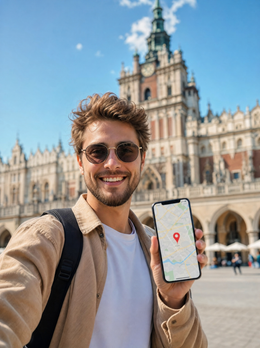
If you're looking at how many GB you need for Poland, chances are you've already booked your flights to Krakow or Warsaw and just need to decide on the size of your data plan. I'll spare you the suspense: Poland is one of the destinations in Europe where you'll use the least data, thanks to excellent Wi-Fi, long train journeys, and several hours of sightseeing where your phone won't even leave your pocket. Here, you won't find an excuse to sell you 20 GB: you'll find a well-reasoned figure and the reasons why it's that one and not another.
The number, straight up
For a 5-day trip to Poland, most people will be fine with 3 GB: between hotel, cafe, and train Wi-Fi, and the hours underground in Wieliczka or in Auschwitz with your phone stowed away, the actual consumption of a tourist using maps, WhatsApp, and photos is around 300-500 MB per day.
That's the short answer, and it's the one I use when asked via message. If your trip is the classic Krakow + Auschwitz + Wieliczka for three or four days, 2 GB will suffice. If you extend to Warsaw and stay for 7-8 days, I'd take 5 GB to be safe. And if you're going to telework from an apartment in Kazimierz for two weeks, then we're talking 20 GB or more, but that's a different story.
What almost no one tells you is that Poland works in your favor. It's not Morocco or Japan, where you end up using a camera translator every other minute; it's not the United States, where you spend your life in the car with the map running. It's a destination with compact cities that you can explore on foot, with Wi-Fi in almost every place you sit down, and distances covered by train. The result is that most people return home with unused data.
Before you buy anything, however, I have an obligation to give you a warning that takes up the entire next section. Read it, even if it's only for thirty seconds: you might not need to buy anything at all.
Honest warning: Poland is in the EU, and your plan already covers you
Poland is a member of the European Union. This means that if you have a Spanish data plan or one from any other EU country, you can use your home data in Poland without paying extra, just as if you were in Cuenca. There's no surcharge, no activation, nothing to do: you land, your phone connects to Orange Polska, Play, Plus, or T-Mobile, and you're good to go. I'd rather tell you this myself before selling you something you might not need.
That said, there are three real situations where it makes sense to have separate data:
- Plans with roaming limits. European regulations allow operators to apply a "fair use policy," so many unlimited plans offer significantly fewer gigabytes abroad than at home. Check the fine print of yours before assuming anything.
- You're not from the EU. If you're traveling from Latin America, post-Brexit UK, Switzerland (depending on the plan), or anywhere else, roaming in Poland can be very expensive.
- Prepaid and basic plans. Some don't even include data outside of Spain, or they charge extra for it.
If you're in the first group and your plan gives you enough leeway, save your money. If not, keep reading. I've laid out all the options (roaming, local Polish SIM, Wi-Fi) in Internet in Poland, because here I want to focus on the number of gigabytes rather than comparing methods.
What consumes what on your phone
Most people overestimate their consumption because they think of "internet" as a block. In reality, 90% of a trip's data usage comes from a handful of very specific actions, and maps — which are what most people worry about — consume the least. These are the figures I use, rounded up so that you run short, not me:
| Activity | Approximate Consumption | Note for Poland |
|---|---|---|
| Google Maps navigating | ~5 MB per hour | Almost 0 if you have the map downloaded |
| WhatsApp text and photos | 10-25 MB per day | The family group chat is the cheap part of the trip |
| WhatsApp voice call | ~30 MB per hour | Perfect for checking in with family |
| Video call | 300-360 MB per hour | By far the most expensive: do it over Wi-Fi |
| Instagram or TikTok scrolling | 700-840 MB per hour | This is where your gigabytes disappear |
| Uploading a photo instantly | 3-5 MB per photo | 50 photos of the medieval old town ≈ 200 MB |
| Uploading a short video | 15-40 MB | Stories add up more than they seem |
| Spotify at normal quality | ~70 MB per hour | 150 MB/h if you set it to high quality |
| YouTube at 480p | 250-300 MB per hour | At 1080p, it skyrockets to over 1.5 GB |
| Browsing websites, checking schedules | ~50 MB per hour | Tickets, museums, restaurants |
| Translator with camera | 1-2 MB per query | Useful for Polish menus |
Notice the contrast: you can navigate with the map for eight hours straight for less than the cost of three minutes of scrolling on TikTok. If you want a detailed breakdown by application, I've covered it in mobile data usage statistics by activity.
Why you spend less than you think in Poland
Each destination has its own consumption physics, and Poland's is particularly gentle. Here are the specific, not generic, reasons:
- Wi-Fi is excellent and everywhere. Cafes, restaurants, shopping centers, museums, accommodations: it's rare to sit somewhere and not have a decent connection. Plus, Poland is inexpensive, so you stop for meals or coffee much more frequently than in Norway or Switzerland, and each stop is a free recharge.
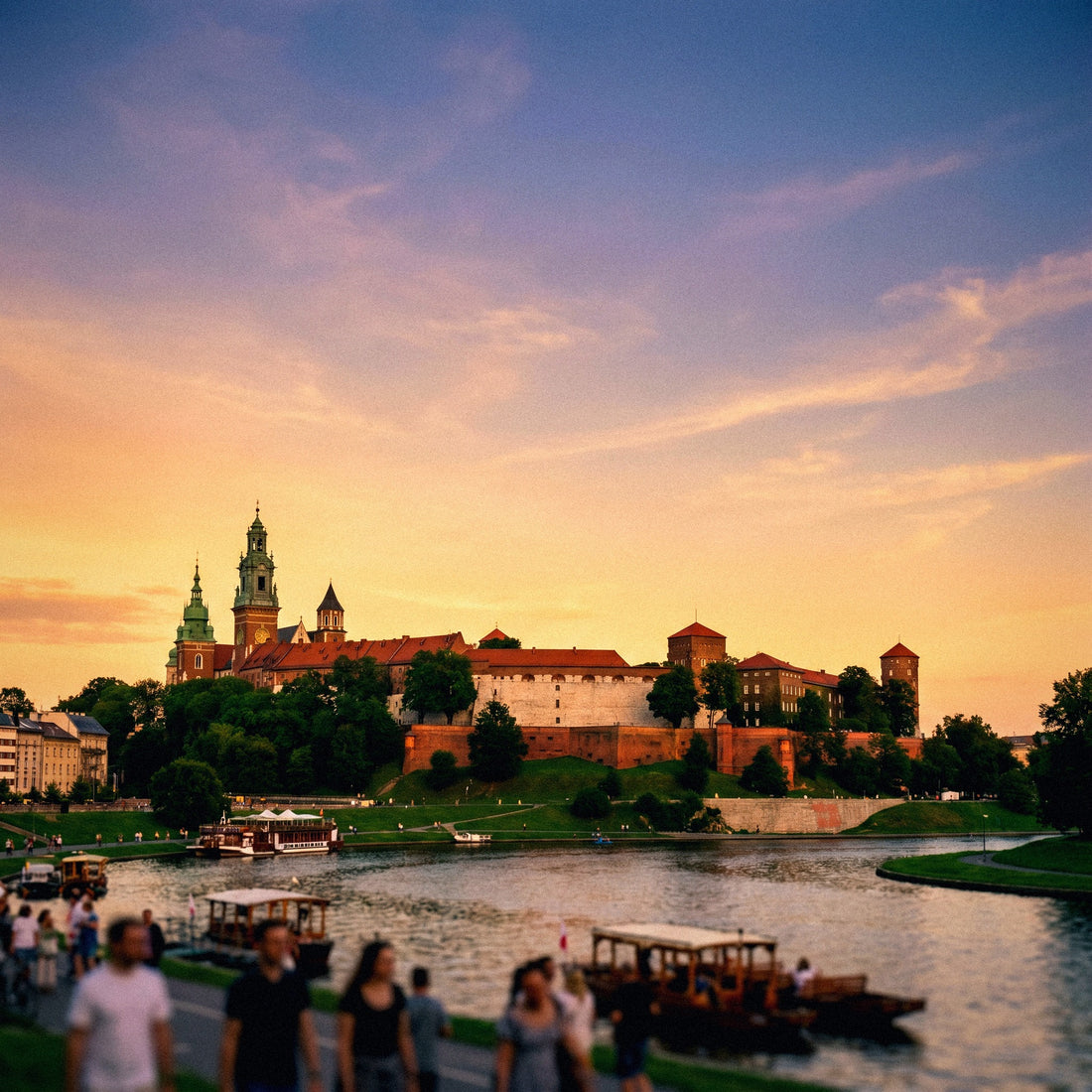
- Krakow and Warsaw are walkable. Krakow's Old Town can be entirely explored on foot in a short time: Rynek Główny, the Cloth Hall, Wawel, Kazimierz. You don't need the map constantly running; just check it occasionally.
- Long journeys are by train. Warsaw-Krakow is a direct train ride, and many PKP Intercity services offer onboard Wi-Fi, in addition to power outlets. A two-and-a-half-hour journey can cost you zero personal data.
- There are entire hours without your phone. Auschwitz-Birkenau and the Wieliczka Salt Mines each take up half a day, and in both, data consumption is almost nil, for different reasons that I explain below.
- It's a short break destination. The average is 3-5 days. Fewer days, fewer gigabytes: the math is simple.
The only thing that drives consumption up in Poland is the sheer number of photos you'll take. Krakow's medieval Old Town with snow, the Christmas markets in the Rynek with lights, Warsaw's reconstructed Old Town... if you're one to upload everything live, add 200 to 400 MB per day just for that.
How many GB depending on your profile and days
This is the table that truly matters. Find your profile, cross-reference it with the number of days you're staying, and you'll have your number. These are calculated with a margin, assuming you'll use Wi-Fi at night in your accommodation:
| Profile | 5 days | 10 days | 15 days | 30 days |
|---|---|---|---|---|
| Map and WhatsApp Tourist | 1 GB | 2 GB | 3 GB | 5 GB |
| Photo and Social Media (uploads daily) | 3 GB | 5 GB | 8 GB | 15 GB |
| Family Sharing (2-4 phones) | 5 GB | 10 GB | 15 GB | 25 GB |
| Digital Nomad / Remote Work | 10 GB | 20 GB | 30 GB | 50 GB |
A couple of nuances that are worth more than the entire table. The "map and WhatsApp tourist" profile is much more common than people think: if your usage is for navigation, answering messages, finding places to eat, and sending some photos at night, that's you. And the "family sharing" profile assumes you're sharing data from a single phone acting as a hotspot; if each person has their own data, divide accordingly.
The remote work profile is the only one that needs large numbers, because video calls are the big data guzzler: a daily hour-long meeting alone is over 2 GB per week just for that. If you're going to work from Poland, the real advice is to book accommodation with good Wi-Fi and use data only as a backup when the apartment's Wi-Fi fails. If you want to see how these figures compare in other destinations, I've covered it in how much data do I need for travel.
A real day in Krakow, hour by hour
Tables are great, but what really convinces is seeing an entire day broken down. Here's a typical day of intense tourism in Krakow, starting at nine in the morning and returning at eleven at night:
| Time of Day | What you do | Data Used |
|---|---|---|
| Breakfast at accommodation | Messages, planning the day | 0 MB (Wi-Fi) |
| Morning in the Old Town | Map, 40 photos, checking schedules | ~120 MB |
| Lunch at a bar mleczny | Uploading photos, replying to the group | 0 MB (Wi-Fi) |
| Afternoon in Kazimierz and Wawel | Map, photos, streaming audio | ~180 MB |
| Return to accommodation | Music during commute | ~60 MB |
| Dinner and evening | Social media, videos, video call home | 0 MB (Wi-Fi) |
| Daily Total | — | ~360 MB |
Three hundred sixty megabytes. And that's an intense day, one where you walk ten kilometers and take photos non-stop. Multiply that by five days and you get 1.8 GB for a complete getaway. That's why my recommendation of 3 GB for five days already includes almost a 70% safety margin.
If you're into live stories from every corner, that day's usage will climb to 600-700 MB, so recalculate. And if you watch series on your phone at night, do it over Wi-Fi and save yourself the trouble: high-quality video is the only habit capable of blowing any prediction we make here.
Auschwitz, Wieliczka, and the train: blank hours
This is where Poland differs from other European destinations and where the numbers truly drop. There are three blocks of time, very common in any itinerary, where your consumption approaches zero.
Auschwitz-Birkenau. It's a long day: the transfer from Krakow, the guided tour with headphones through both camps, the return trip. Easily six or seven hours. The museum asks you to silence your phone before starting, and there are areas where photography is expressly forbidden. Beyond the rules, the reality is that many people put their phone away out of respect and don't take it out for the entire visit. This isn't moral advice; it's a fact that lowers consumption: these are entire hours of your trip where you spend nothing.
The Wieliczka Salt Mines. You're more than a hundred meters underground, exploring chambers and chapels carved out of salt. Down there, mobile coverage is practically non-existent. Another three or four hours, including travel, where your phone is only useful for taking photos—which don't consume data until you upload them.
A typical five-day trip to Krakow includes two full days where your phone is barely used. This isn't theory: it's 10 fewer hours of consumption on paper.
Trains. Warsaw-Krakow, Krakow-Wrocław, Warsaw-Gdańsk: long journeys are spent seated, and many services offer onboard Wi-Fi. If you're traveling in winter for the Christmas markets, add in the fact that you'll spend more time indoors with a connection than outside.
Calculate your consumption before leaving home
All of the above are averages, and you are not an average. The honest way to get it right is to look at your own numbers, and it's just a couple of taps away. No fancy apps needed.
- On Android: Settings → Network & internet → SIMs or Data usage. You'll see this month's megabytes and the breakdown by app.
- On iPhone: Settings → Mobile Data. Scroll down to the app list; note that this counter accumulates since the last time you reset it, so reset it and wait a week for a clean reading.
With your actual monthly consumption in hand, this conversion gives you a fairly reliable forecast for Poland, already accounting for Wi-Fi hours and visits without coverage:
| Your monthly home consumption | Estimated daily consumption in Poland | For 5 days |
|---|---|---|
| Less than 5 GB | 150-250 MB | 1 GB more than enough |
| 5-15 GB | 300-500 MB | 2-3 GB |
| 15-40 GB | 600-900 MB | 3-5 GB |
| More than 40 GB or "unlimited" | 1-1.5 GB | 5-8 GB |
The trick is that at home, you consume with your phone in hand all day, while traveling, you're looking at a medieval square, not a screen. That's why I divide your domestic consumption and don't multiply it. If you get a strange number, stick with half of what you spend on a normal office day: that's the approximation that has worked best for me with real people.
Tips for extending data in Poland
If you want to lower the number even further—or buy the small package with complete peace of mind—these five things can be done in ten minutes the night before you fly and will save you more than half your consumption:
- Download offline maps. In Google Maps, search for "Krakow," tap the name, and select Download. Repeat for Warsaw. That's about 100 MB per city you download via home Wi-Fi, and then you navigate almost at zero cost.
- Download music and episodes. Spotify, podcasts, whatever you listen to on the train. A Warsaw-Krakow journey streaming music is 200 MB wasted.
- Backups only via Wi-Fi. Google Photos and iCloud can upload every photo you take instantly. With the 300 photos you'll bring back from the medieval old town, that's a disaster. Set it to "Wi-Fi only" and sleep peacefully.
- Disable auto-play for videos on Instagram, TikTok, X, and Facebook. This setting saves the most gigabytes of all.
- Activate system data saver and lower video quality to 480p. On a phone screen, walking down the street, you won't notice the difference.
With this applied, a pure tourism day can drop from 360 to less than 150 MB. I have the complete list with screenshots and some finer tricks in tips to save data while traveling, including how to detect the app that's draining your plan without you realizing it.
What happens if you run out
I'm telling you clearly: it's better to underestimate and recharge than to overpay for gigabytes you won't use. Unused data is not refunded, and on a five-day trip, the difference between getting it right and overspending is usually more money than a recharge costs.
If you run out of data in Poland, it's not like you'll be stranded in the middle of nowhere. You're in a country with Wi-Fi everywhere: just walk into the first cafe, connect, and recharge in a couple of minutes. With an eSIM, recharging is immediate, and you don't have to go to a physical store or change anything on your phone.
My foolproof rules:
- Buy the package shown in the table, not the next one up. If you're debating between 3 and 5 GB for five days, go for 3.
- Check your usage on the second day. After 48 hours of travel, you'll know your actual pace and can accurately project the rest.
- Keep a companion's phone as a backup. If two of you are traveling, one should buy a plan and the other should keep their European backup rate.
- Don't buy "just in case" for the flight or airport. Both Chopin and Balice have Wi-Fi.
And if you want to see what packages are available for the country, how they are activated, and what coverage they offer, you can find everything in the eSIM guide for Poland, including step-by-step installation instructions before you leave home.
Frequently asked questions
How many GB do I need for 5 days in Krakow?
2-3 GB will be more than enough. An intense day of sightseeing in Krakow uses around 360 MB, so five days would come out to about 1.8 GB. If you're constantly uploading stories, get 3 GB and you'll have plenty of wiggle room.
If Poland is in the EU, why would I buy data?
If your plan is European and has enough roaming gigabytes, don't buy anything. It only makes sense if you're traveling from outside the EU, if your plan has a low usage cap abroad, or if you're on a prepaid plan with no data outside of Spain. Check beforehand.
Is there coverage in the Wieliczka Salt Mine?
Virtually none: you're over a hundred meters underground. Download your ticket and any audio guides before going down. The good news is that it's three or four hours during which your data consumption is zero.
Can I use my phone at Auschwitz-Birkenau?
Yes, but you are asked to silence it and there are areas where photography is prohibited. It's a long visit with audio guides, and many people prefer to keep their phones put away for the entire tour. In terms of gigabytes, count that day as almost zero consumption.
Is there Wi-Fi on trains between Warsaw and Krakow?
On many PKP Intercity services, yes, as well as power outlets. It doesn't always work perfectly for the entire journey, so have your music and podcasts downloaded. Even so, a long journey will usually cost you very little of your own data.
Do I need more gigabytes if I go to the Christmas markets?
Only a little more, and for photos. Add 200-300 MB per day if you're going to upload live photos and videos of the lights. The markets are in the city center, surrounded by establishments with Wi-Fi, so it balances out.
How much data does Google Maps use if I keep it open all day?
About 5 MB per hour navigating, and almost nothing if you download the map beforehand. It's one of the cheapest things you can do. The fear of the map is unfounded: what eats up your gigabytes is video and social media scrolling, not navigation.
What do I do if I run out of data in the middle of my trip?
You connect to the Wi-Fi of any cafe and recharge in two minutes. In Poland, Wi-Fi is everywhere and it's fast. That's why I recommend buying less: recharging is trivial, and overpaying cannot be recovered.
Conclusion
To sum it up for you: 3-5 day trip to Krakow: 2-3 GB. Long week including Warsaw: 5 GB. Fifteen days of photos and social media: 8 GB. And if you're going to telework, 20 GB or more, but with good Wi-Fi at your accommodation as a base. Poland is also a cheap destination for data: walkable cities, excellent Wi-Fi, trains with connection, and two entire visits—Auschwitz and Wieliczka—where your phone stays put.
And I repeat myself because it's important: if you have a European plan with enough roaming gigabytes, don't spend a single euro. If that's not your case, choose the package shown in the table and not the next one up, which is where people waste money.
Once you've decided, here's the eSIM for Poland with the sizes we've discussed: you install it from home, it activates when you land, and you can recharge in two minutes if you run short. Have a good trip and enjoy the Rynek.