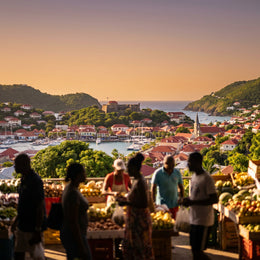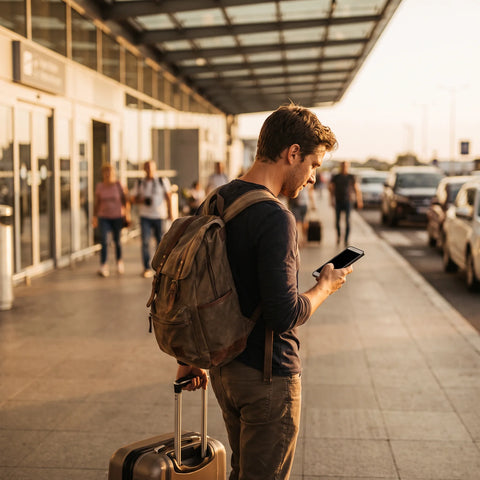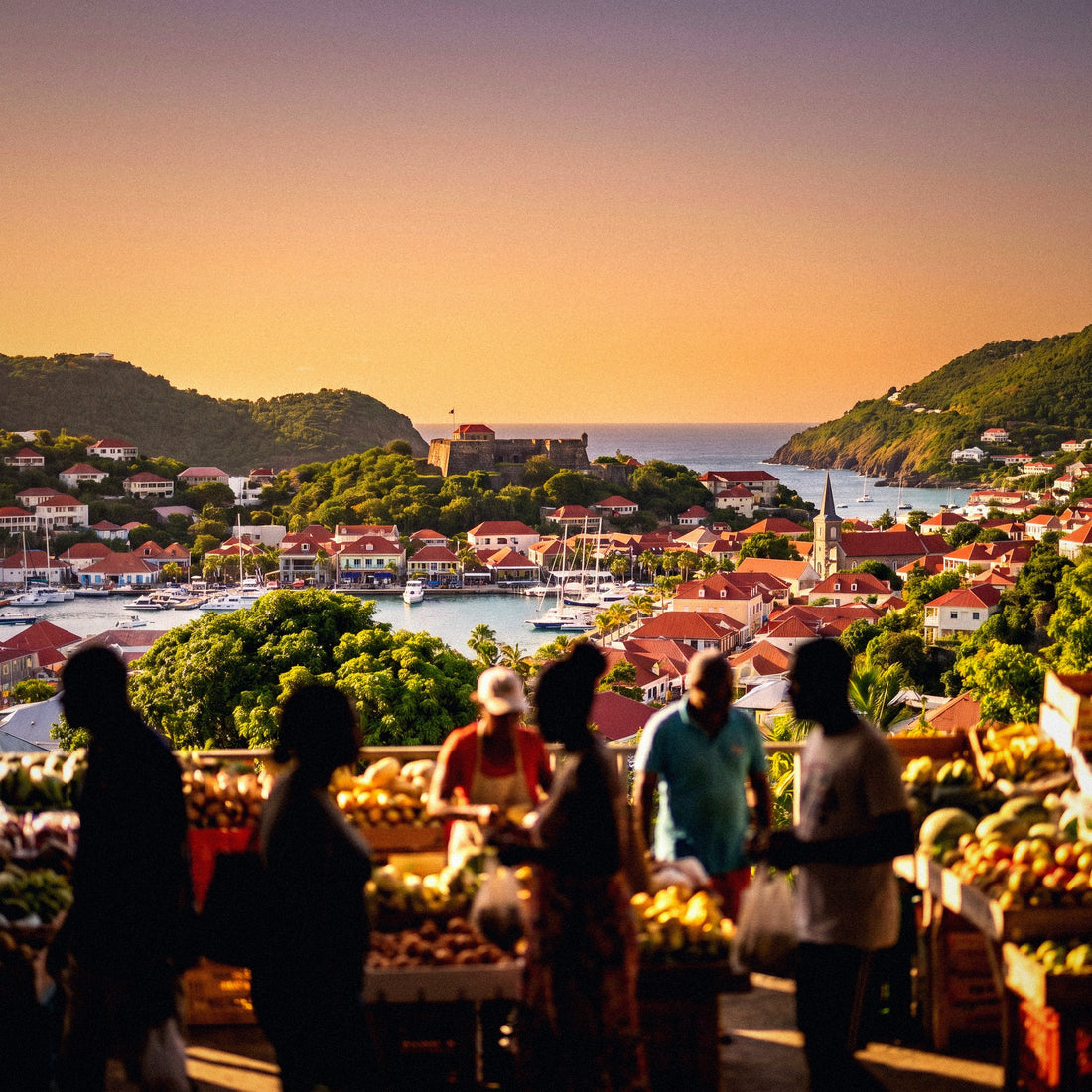
Saint Barthélemy (St Barths to almost everyone) is one of those places where the trip is expensive, and if you're not careful, your phone bill will be too. I'm not here to convince you of anything; I'm here to tell you how many GB you need for St Barths and explain why this island, despite being French territory, is the expensive surprise of the French Caribbean the moment you pull out your phone. If you already know you want data and are only debating the package size, this guide is about that and nothing else.
The short answer: how many GB for St Barths
For a week in St Barths, most people will be fine with 3 GB. It's a short-trip destination, with good Wi-Fi in hotels and restaurants and fifteen-minute journeys: maps barely use any data. If you're going to upload daily videos of landings and yachts, go for 5 GB.
I'm telling you this with a calculator in hand, not based on intuition. St Barths is 21 km²: it's a fifteen-minute drive from Gustavia to Saline beach. There's no Uber or transport app you need to keep open, no subway to consult, no long bus rides where you end up watching two hours of video. Your day will be spent between the beach, meals, and driving, and your phone will be in your pocket more than in your hand.
The other half of the equation is that the Wi-Fi here is genuinely good. It's a destination of expensive villas and hotels, and Wi-Fi is one of the services that is well-maintained: at your accommodation, in Gustavia's restaurants, and at most beach clubs, you'll be connected without using data. All heavy usage—backups, uploading your entire camera roll, watching series at night—happens there.
If you're coming from the general exercise of how much data you need for travel, you can lower the bar here compared to a big city destination or backpacking through Asia. What increases the figure in St Barths isn't moving around: it's recording.
The "it's France" trap: St Barths is not an outermost region
This is the part almost no one tells you about, and it's why many people come back with a bill shock. St Barths is a French overseas collectivity, yes. But since January 1, 2012, it ceased to be an outermost region of the European Union and became an overseas country and territory (OCT). It sounds like Brussels paperwork, but it's actually the difference between paying zero and paying euros per megabyte.
The European roaming regulation, which allows you to use your gigabytes as at home, applies to the territory of the Union, and that includes the outermost regions. Guadeloupe and Martinique are outermost regions: there, your Spanish tariff works as it would in Madrid, by legal obligation. St Barths is not. And it's counterintuitive because they are a short flight from each other, speak the same language, and pay in euros.
| Destination | EU status | European roaming guaranteed by law? |
|---|---|---|
| Guadeloupe | Outermost region | Yes |
| Martinique | Outermost region | Yes |
| Saint Martin (French side) | Outermost region | Yes |
| St Barths | OCT | No |
| Sint Maarten (Dutch side) | OCT | No |
An honest caveat: some Spanish operators still include the island in their European zone as a commercial decision, and France extended the same treatment to its own operators. But that is a courtesy, not an obligation, and it varies from one tariff to another. If your operator doesn't state it in writing in their list of countries, assume that St Barths will charge you as "rest of the world." In the internet guide for St Barths, I break down the options for connecting; here, we're sticking to gigabytes.
How much data each app actually uses, in megabytes
Before deciding on a package, it's helpful to have an idea of the real order of magnitude, because almost everyone makes the same mistake: they think maps use a lot of data and social media uses little. It's exactly the opposite. These are approximate consumption figures per hour of continuous use, which is how they should be viewed.
| Activity | Approximate Consumption | Comment |
|---|---|---|
| GPS Navigation (Google Maps, Waze) | 3-5 MB/hour | With route loaded; satellite view uses much more |
| WhatsApp (text only) | 1-2 MB/hour | Practically irrelevant |
| WhatsApp with photos and audio | 10-20 MB/hour | Depends on how many groups you have |
| Video call (WhatsApp, FaceTime) | 400-450 MB/hour | The biggest silent data hog |
| Instagram or TikTok, continuous scrolling | 600-850 MB/hour | Auto-playing video is what weighs it down |
| Uploading photos from phone | 3-5 MB per photo | 20 photos ≈ 80 MB |
| Uploading a 1-minute video in high quality | 150-350 MB | 4K goes even higher |
| Streaming video, medium quality | 700 MB/hour | From 300 MB in data-saving mode to 7 GB in 4K |
| Streaming music | 50-150 MB/hour | Less if you lower the quality |
| Web, email, and news | 10-20 MB/hour | Increases if there are many embedded videos |
Notice the jump: an hour of maps uses the same as one second of a video call. You can have GPS on the entire trip and not notice it. If you want the long detail, I have it broken down in the mobile data usage statistics by activity. For St Barths, keep one idea in mind: here, video is the enemy, not maps.
Why you use less data than you think in St Barths
Some destinations inflate consumption for structural reasons: languages where you need a camera translator all day, countries that require a VPN, cities with two hours of public transport daily. St Barths is none of these, which is why your data package will last longer than usual.
- Ridiculous distances. You can cross the island in twenty minutes. Navigation stretches are 10-15 minutes: Gustavia to Saline, Saint-Jean to Gouverneur, little more. Maps barely use any data.
- No transport apps. There's no Uber or equivalents. You either rent a car—a Mini Moke or a Jimny, the island classic—or call a taxi. Zero data consumption from booking apps running in a loop.
- French won't force you to translate constantly. English is widely spoken in hotels, restaurants, and shops. You'll use a translator for a menu or a supermarket label, not as a permanent crutch.
- Decent and widespread Wi-Fi. It's an expensive destination, and Wi-Fi is one of the services that actually works. Accommodation, Gustavia restaurants, and a good portion of beach clubs.
- Short trips. The typical stay is 4-7 days. Very few people spend a month here, partly because their wallets won't allow it.
And there's a less obvious factor: on the most beautiful beaches of the island, Saline and Gouverneur, there are no beach bars or services. They are wild beaches, with parking and a small path. People go there precisely to disconnect, and the phone stays on the towel. There is coverage—the island is small and well-served by local operators, with reasonable 4G almost everywhere—but real consumption during those hours tends to zero.
And why it can skyrocket: Saint-Jean, Gustavia, and video
Now for the other side. St Barths is probably the Caribbean destination that generates the most video per tourist, and that does change the numbers. There are three moments that explain it.
The first is the landing at Gustaf III Airport, in Saint-Jean. The approach skims over the Tourmente hill and the runway ends literally on the beach. I don't know anyone who doesn't record it. And then, on Saint-Jean beach itself, people spend the afternoon recording planes passing just meters above their heads. Add to that the fact that all this is uploaded instantly and you have the problem: a one-minute video in good quality is 150-350 MB, and five such videos in a day is over 1 GB.
The second is Gustavia and its yachts. The harbor in high season is a parade, and the entire island functions as an aspirational backdrop: sunset at Shell Beach, terrace in Gouverneur, convertible car. Many more photos and stories are taken than on a normal trip, and video stories are among the heaviest.
The third is the peak season of Christmas and New Year, when the island fills up and prices go sky-high. Be careful with one nuance: network saturation doesn't make you use more gigabytes, but it does make everything slower, uploads retry, and you end up relying on data where you would normally use the site's Wi-Fi, because the Wi-Fi is also saturated.
Practical rule for St Barths: calculate your normal travel consumption and add 150 MB for every video you know you're going to upload. If you're someone who uploads three a day, your package will double.
Recommendation by profile and duration
This is the table you've been looking for. It's designed for one phone and assumes you use the accommodation's Wi-Fi at night, which is a realistic assumption in St Barths. If you don't plan to connect to Wi-Fi even once, go up a level.
| Profile | 5 days | 10 days | 15 days | 30 days |
|---|---|---|---|---|
| Tourist using maps and WhatsApp | 1 GB | 2 GB | 3 GB | 5 GB |
| Photos and social media user | 3 GB | 5 GB | 8 GB | 15 GB |
| Uploads daily video (landing, yachts, stories) | 5 GB | 10 GB | 15 GB | 30 GB |
| Digital nomad or remote worker with video calls | 5 GB | 10 GB | 15 GB | 25-30 GB |
| Family sharing one line (2 adults + 2 children) | 5 GB | 8 GB | 12 GB | 20 GB |
Read it with two caveats. The first: the top row is more common than people admit. If your usage is checking maps, sending audio messages, and looking up the weather, 1 GB for five days is more than enough, no matter how many 20 GB packages are offered. I say this knowing that we sell larger packages: inflating the number does me no good if you come back with half of it unused.
The second: the typical stay in St Barths is 4-7 days. The 15- and 30-day columns are there for completeness, but if you're looking at that part of the table, you're probably combining the island with Saint-Martin, Anguilla, or Antigua, and then what you need isn't a larger St Barths package, but coverage for all islands.
A typical day on the island, in megabytes
So that the previous table isn't just a number out of thin air, here's a breakdown of a normal vacation day in St Barths, for the average user: someone who takes photos, uploads a few stories, and calls home at night.
| Time of Day | What you do | Mobile Data |
|---|---|---|
| Morning at the villa | Email, news, social media with coffee | 0 MB (Wi-Fi) |
| Drive to Gouverneur | 15 minutes of navigation | ~2 MB |
| Two hours at the beach | Photos, some scrolling, WhatsApp | ~120 MB |
| Lunch in Gustavia | Finding a place, looking at the menu | ~20 MB |
| Return and nap | Sending 15 photos to the family group | ~50 MB |
| Sunset at Shell Beach | Three video stories | ~90 MB |
| Dinner | Maps, reservations, messages | ~25 MB |
| Evening | 20-minute video call | ~150 MB |
| Total for the day | ~450 MB |
Multiply: 450 MB per day for seven days is a little over 3 GB. That's where the weekly recommendation comes from. And notice where the money is: almost half the day's data goes to video calls and stories. If you have dinner at the hotel that night and make your call from Wi-Fi, your daily usage drops to 300 MB and your weekly usage to just over 2 GB.
This is the exercise I recommend you do for your own trip before buying anything. You don't need to be precise: just identify the two or three heavy moments of the day and see if they'll use data or Wi-Fi. In St Barths, they can almost always use Wi-Fi, which is why it's a destination where buying less is the right decision.
How to calculate your real consumption before leaving home
All the above are averages, and you are not an average. The honest way to get it right is to look at your own data, which you already have on your phone and costs nothing to check.
- On Android: Settings → Network & internet → SIM or Data usage. You'll see your current month's usage and breakdown by application.
- On iPhone: Settings → Mobile Data. Below, you'll find the breakdown by app; note, the counter is cumulative since you reset it, so check the "Last Reset" date before drawing conclusions.
Take your entire month's usage, divide it by 30, and you'll have your average daily usage at home. Now adjust it for your trip with two simple corrections. Downward, because at home and in the office you're on Wi-Fi almost all day, and on vacation you'll also be on Wi-Fi at the hotel. Upward, because during your trip you'll take more photos, videos, and make more video calls than you do on any given Tuesday.
With that corrected daily average, multiply by the number of travel days and compare it with the profile table. If it's similar, go ahead. If it's double, trust yourself and not my table: you know yourself better. And if it's much less, don't panic: some people travel for a whole week with 800 MB because they do almost everything on Wi-Fi, and that's perfectly normal.
An extra tip: reset your phone's data counter on the day you leave for your trip. That way, halfway through your stay, you'll know exactly how fast you're going and can make an informed decision about whether you need to top up or if you have plenty.
How to make your data last (and what to do at Christmas)
If your calculations show you're cutting it close, don't buy more: use it smarter. These adjustments can be made in five minutes and in a destination like this, they make a huge difference, because the bulk of consumption is in two or three very identifiable things.
- Download the island map before you go. In Google Maps, search for "Saint-Barthélemy" → menu → Download offline map. It's a tiny island, takes up very little space, and keeps your GPS working without data.
- Backups, Wi-Fi only. This is the most expensive mistake: your phone decides to upload a 400-photo camera roll using data, and your plan is emptied in an afternoon. Google Photos and iCloud have the option; disable it before you fly.
- Turn off automatic video playback on Instagram, TikTok, Facebook, and X. This alone can cut your social media consumption by half.
- Activate Data Saver Mode on your system and in the apps that have it.
- Upload the landing video from the hotel Wi-Fi, not from the beach. The video will be just as good two hours later.
- Lower the music quality or download playlists before you go.
Regarding high season: if you travel between December 20th and January 5th, the island is packed, and both mobile network and local Wi-Fi are slower than usual. My advice is to have your map and music already downloaded before landing and not to rely on being able to upload a heavy video on your first try. You'll find more ideas in the guide on tips for saving data while traveling.
If you run short and the layover in Sint Maarten
Running short is not a drama: it's normal when you buy wisely. Topping up takes a couple of minutes from your phone, and you only pay for what you truly need. Overbuying, on the other hand, is money that doesn't come back. That's why my recommendation is always to buy the right tier and top up if needed, rather than buying the large tier "just in case."
Now, the most useful practical warning in the entire article, and it has to do with how to get to St. Barth. Almost no one flies direct: the vast majority arrive via Sint Maarten, at Princess Juliana Airport, and from there hop on a small plane to Saint-Jean or take the ferry to Gustavia. And Sint Maarten is the Dutch side of the island: another country and a different territory. A data package for St. Barth will not work there, not during your three-hour layover, nor on the ferry while you're crossing.
That means two things. One: don't buy extra GB for St. Barth thinking of covering your layover, because you won't be able to use them. And two: if you're going to spend actual time in Sint Maarten or Saint-Martin — an overnight stay before your flight, for example — consider a regional Caribbean plan instead of one just for the island. If managing several destinations on one trip sounds complicated, here I explain what an eSIM is and why it allows you to have multiple profiles saved on the same phone and activate each one when needed.
Frequently asked questions
How many GB do I need for a week in St. Barth?
3 GB is sufficient for most people for seven days. If you only use maps and WhatsApp, 1-2 GB will be plenty. If you upload videos daily, expect to use 5 GB. The island's short distances and good Wi-Fi mean consumption is lower than in other destinations.
Does my Spanish plan work in St. Barth like in Guadeloupe or Martinique?
It's not guaranteed, and that's the big difference. Guadeloupe and Martinique are outermost regions of the EU, so European roaming applies by law. St. Barth has been an overseas country and territory since 2012 and is outside of it. Some operators include it anyway by their own decision, but you need to check your list of countries before flying.
Is there good coverage throughout the island?
Yes, the island is small and well covered with 4G. Local operators provide service in Gustavia, Saint-Jean, Lorient, and the main beaches. In ravine areas or narrow roads, it might weaken for a moment, but it recovers quickly. 5G is not yet widespread.
Do I need a lot of data for a translator if I don't speak French?
No, hardly any. English is well understood in hotels, restaurants, and shops, so you'll only use a translator occasionally for menus or supermarket labels. Plus, if you download the French language pack before you go, text and camera translation works offline and consumes no data.
Do I use more data if I go at Christmas?
You use about the same, but you'll notice it more. During the high season of Christmas and New Year, the island gets crowded, and both mobile networks and Wi-Fi in restaurants and hotels are slower. The risk is ending up relying on mobile data where you would normally use Wi-Fi. Have maps and music downloaded in advance.
Does the St. Barth package work for my layover in Sint Maarten?
No. Sint Maarten is the Dutch side and counts as a different destination, just like Saint-Martin on the French side. If you're going to spend hours at Princess Juliana Airport or stay overnight there, you need coverage for that territory or a regional Caribbean option.
What do I do if I run out of data halfway through my trip?
Top up from your phone, in a couple of minutes. It's cheaper than buying too much at the beginning. Meanwhile, your accommodation's Wi-Fi covers the essentials. If you want to fine-tune the size from the start, in the St. Barth eSIM guide you'll find the packages with their duration.
Is it worth buying the biggest package just in case?
Almost never, and less so here. St. Barth is a short trip to a small island with abundant Wi-Fi: most people who buy 10 GB come back with 6 unused. Buy the right tier according to the table by profile and top up if you run short.
Conclusion
To summarize without embellishment: for a week in St. Barth, 3 GB covers most people; 1-2 GB if you're mainly using maps and messages; 5 GB if you're going to upload videos of the Saint-Jean landing and Gustavia yachts every day. It's a destination where little data is used because distances are minimal and Wi-Fi is good, and where what drives up the figure is recording, not moving around.
What I do ask you not to take for granted is the "it's France, it's included in my plan" idea. Guadeloupe and Martinique yes; St. Barth, unless your operator states it in writing, no. Checking it takes two minutes and saves you the disappointment of coming back with a bill that costs more than a dinner in Gustavia.
If you prefer not to take chances, here is our eSIM for St. Barth: choose the size using the table above, install it before leaving home, and land connected, with no surprises on your bill and no need to look for a store in Gustavia on your first day of vacation.