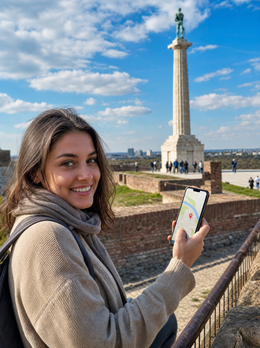
If you've already decided that you're going to use data and all that's left is to choose the package size, this guide is exactly about that: how many GB I need for Serbia without running out halfway through the trip or paying for gigabytes that will go untouched. Here I'm not going to repeat the comparison of options for connecting, just the number, where it comes from, and what changes it in this specific country.
The number, straight up
For 10 days in Serbia, 3 GB is usually enough: maps, WhatsApp, some Instagram, and looking for places on the go. If you upload videos daily or are on a Balkan road trip, go up to 5 GB. With remote work involved, 20 GB or an unlimited plan.
I'm telling you this right away because it's what I'd want to read if I were about to buy. Serbia is a destination where Wi-Fi works well in cities, where Belgrade's urban transport doesn't require a ticketing app, and where a good part of your trip will be spent on the road, looking out the window. All of this works in favor of needing less data than you imagine.
The catch is on the other side: it's a country where you will truly need your own data, because your Spanish plan won't work for free as it does in Croatia or Hungary. That means the number matters, and running short isn't "a shame" but being left with nothing.
If you want the general framework for any destination and not just this one, I have a parent guide on how much data I need for travel with the complete method. What follows from here is that method applied to Belgrade, Novi Sad, the monasteries, and the Balkan roads, which is where the number truly fluctuates.
Warning: Serbia is not included in European roaming
This is the mistake I see most often, and it's the most expensive. Serbia is not a member of the European Union, so the "Roam Like at Home" that lets you use your Spanish plan as is in France, Croatia, or Greece does not apply here. Your operator will charge you international roaming outside the zone, with prices per megabyte that are completely different from what you pay at home.
The confusion comes from the typical route: if you do Budapest, Belgrade, and then down to Montenegro, you cross in and out of the EU several times in the same week. Hungary, Croatia, Romania, and Bulgaria are EU; Serbia, Bosnia and Herzegovina, Montenegro, North Macedonia, and Albania are not. Your phone won't warn you with a sign: it will simply start billing differently.
There is a regional agreement in the Western Balkans, in force since July 2021, that eliminates surcharges between these six countries, but it's an agreement among them, not with the European Union: it works if you travel with a local card from the region, not with your Spanish line. There has also been talk of aligning tariffs between the EU and the Balkans, but until your bill says otherwise, assume that Serbia is a paying zone.
If you want the details of all the ways to connect there (local SIM card, your operator's plan, or eSIM), you can find it broken down in internet in Serbia. Here, we continue with gigabytes.
How much data the apps you'll use actually consume
Before choosing a package, it's good to see where the gigabytes come from. These are approximate figures with a range, as they depend on video quality, each app's settings, and whether you're on 5G (which usually serves higher bitrate video and thus consumes more). Even so, they serve for honest calculations.
| Activity | Approximate consumption | Translated to one day of travel |
|---|---|---|
| WhatsApp text and occasional photos | 10-20 MB per day | Almost nothing |
| WhatsApp video call | 300-500 MB per hour | 20 min per day: 100-170 MB |
| Google Maps navigating | 5-15 MB per hour | 2 h driving: 10-30 MB |
| Searching for places, photos, and reviews on Maps | Up to 100 MB per hour | 30 min: up to 50 MB |
| Scrolling Instagram or TikTok | 600 MB - 1.2 GB per hour | 30 min per day: 300-600 MB |
| Uploading a photo to social media | 4-5 MB per photo | 20 photos: 80-100 MB |
| Uploading a short video (1 min) | 60-100 MB | 3 videos: 200-300 MB |
| High-quality music streaming | 150-160 MB per hour | 2 h on the road: about 320 MB |
| Video in 1080p | 1.5-3 GB per hour | One episode: more than 1 GB |
| Video in 480p | 250-500 MB per hour | One episode: about 250 MB |
| Browsing, email, and translator | 20-60 MB per hour | Normal use: 50-100 MB |
Notice the pattern: what consumes data is not maps or WhatsApp, it's video. A single day of uploading Reels from a Belgrade terrace will eat more data than five days of navigating on the road. That's why the traveler's profile weighs more than the number of days. If you want more detailed data per activity, I have it compiled in mobile data usage statistics per activity.
Master table: GB by profile and by days
This is the table I'm here to give you. Choose the row that most resembles you, look at the column for your number of days, and you'll have the number. It's calculated with the figures above, assuming that in Serbia you'll have good Wi-Fi at your accommodation and in cafes almost every night, so you don't need to cover 100% of your consumption with mobile data.
| Profile | 5 days | 10 days | 15 days | 30 days |
|---|---|---|---|---|
| Tourist (maps and WhatsApp) | 1-2 GB | 3 GB | 5 GB | 10 GB |
| Photos and social media (daily stories) | 3 GB | 5 GB | 10 GB | 20 GB |
| Digital nomad / remote work | 10 GB | 20 GB | 30 GB | 50 GB or unlimited |
| Family sharing one phone as a router | 5 GB | 10 GB | 15 GB | 30 GB |
| Balkan road trip (lots of driving and music) | 3 GB | 5 GB | 10 GB | 20 GB |
A couple of nuances that don't fit in a single cell. The "family" profile assumes that one phone acts as a hotspot for two or three devices, and what really spikes there is the background consumption of kids' tablets: block automatic updates before leaving home and you'll save half of it.
The remote work profile depends heavily on whether you make video calls. One hour of daily meetings is about 500 MB, or 15 GB in a month just for meetings. If you work with text, code, or documents, 10 GB a month is more than enough. Be honest with yourself before paying for 50 GB that you won't touch. And if you're torn between two rows, only choose the lower one if the trip is long: for 5 days, it's cheaper to be slightly wrong.
What drives consumption up in Serbia
This is where this destination deviates from the average. There are three things that increase the number and are worth noting.
- Cyrillic script. Serbia uses the Cyrillic alphabet on signs, restaurant menus, bus schedules, and museum placards. Many travelers end up using a camera translator several times a day. It's not a huge expense, but it adds up: add 50-100 MB per day if you rely heavily on online translators.
- Belgrade at night. The long nights at the Sava and Danube splavovi are where most data is spent: stories, videos, looking for the next place, ordering a car by app at four in the morning. A night like that can easily cost you 500 MB.
- Mass events. When 50,000 people gather in a venue, the network gets saturated, and uploads fail and are retried. That retry consumes data even if the video isn't published.
Regarding the latter, a useful note if you had EXIT in mind: Petrovaradin Fortress in Novi Sad hosted the festival until the 2025 edition, and from then on the project was reorganized into a tour format in other countries. Before calculating gigabytes "for EXIT," check where and when it will be held the year you travel, because it's no longer a fixed event in Novi Sad. The underlying advice still applies to any large festival or concert: upload the good video later, from the accommodation's Wi-Fi, and at the venue, stick to messaging.
What brings it down: Wi-Fi, cities, and mountain silence
Now for the good part, which also needs to be mentioned even though we sell data packages. Serbia is a country where you'll spend less than you think, for three reasons.
The first is Wi-Fi. In Belgrade and Novi Sad, there's free Wi-Fi in almost any cafe, in shopping centers, hotels and hostels, and in many eating establishments. Coffee culture is very strong, and no one looks at you sideways for sitting for two hours. If you upload photos and backup there, your mobile data consumption will be limited to maps and messaging.
The second is transport. Belgrade eliminated tickets on urban public transport in 2025, so you don't need a ticketing app or to buy anything online to get around by bus, tram, or trolleybus. This is a data expense you would have in other capitals, but here you save it entirely.
The third is geography. In the monasteries of Fruška Gora, in Studenica, in the Đavolja Varoš area, or in the Tara and Đerdap National Parks, coverage is spotty: there are stretches where you simply won't have stable 4G. You won't spend data there, but you also can't improvise, so download your maps. The Serbian network is operated by three national companies (mts, Yettel, and A1) with widespread 4G and 5G in large cities, but the 5G in central Belgrade is useless on a mountain road.
Balkan route: borders and network jumps
If Serbia is just one stop on a longer route, this will change your purchase more than any gigabyte calculation. In the Balkans, borders are very close, and your phone will connect to networks in the neighboring country without asking permission, especially in border areas and in queues at crossings.
| Country on the route | Included in EU roaming? | Covered by a Serbia-only plan? |
|---|---|---|
| Serbia | No | Yes |
| Hungary | Yes | No |
| Croatia | Yes | No |
| Romania and Bulgaria | Yes | No |
| Bosnia and Herzegovina | No | No |
| Montenegro | No | No |
| North Macedonia | No | No |
| Albania | No | No |
Practical conclusion: if you're crossing into Bosnia or Montenegro, a Serbia-exclusive plan will leave you without data as soon as you pass customs. In that case, a regional plan that covers the Balkans, or directly a broad European one if the route starts or ends in Hungary or Croatia, is more suitable. And a field tip: in border areas, force manual network selection in your phone settings so it doesn't hook onto a neighboring country's antenna and leave you without connection unnecessarily.
For the gigabytes for the Serbian part of the route, the figures in the master table are still valid, and details on coverage and plans can be found in eSIM Serbia.
How to calculate your real consumption before you leave
Everything above is averages. You have better data than any average: your own history. And you have it for free on your phone.
- On Android, go to Settings, Network & internet, Mobile data usage and check the total for the last full month. On iPhone, Settings, Mobile Data: you'll find the breakdown by app there, although it accumulates since the last time you reset it (note the date before trusting it).
- Divide that total by 30 to get your daily consumption at home.
- Subtract what you do at home using Wi-Fi and what you'll also do using Wi-Fi while traveling (streaming, backups, downloads).
- Multiply by the number of travel days and add a 20-30% buffer for the unexpected: the translator, last-minute searches, the map that recalculates.
Real-world example for daily life: if you spend 6 GB a month in Spain, that's 200 MB a day, and a good part of that is video you'll watch less of while traveling. For 10 days, that comes out to over 2 GB, and with 3 GB you'll be comfortable. If your phone says 25 GB a month, forget about 3 GB: you're a video profile and you need 10 GB or more.
This calculation is much more reliable than any table, including mine, because it measures your habits, not those of an average traveler. If this is also your first trip with this type of digital card and you want to understand how it works before buying, I explain it in simple terms in what an eSIM is.
How to stretch your data and what happens if you run short
With four adjustments made before leaving home, the same trip can fit into half the gigabytes. These aren't strange tricks: it's about turning off what consumes data without you seeing it.
| Setting | What it saves you |
|---|---|
| Offline downloaded map of Serbia | Almost all navigation data consumption |
| Downloaded Serbian language pack for translator | The 50-100 MB daily for translating signs and menus |
| Video at 480p instead of 1080p | From 1.5-3 GB per hour to 250-500 MB |
| Autoplay disabled on social media | 300-600 MB for every hour of scrolling |
| Backups only over Wi-Fi | 4-5 MB per photo and 60-100 MB per video |
| Data saver mode activated | Background app data drip |
I'd much rather you buy 3 GB and top up halfway through your trip, than buy 20 GB and return home with 16 unused. Running short in Serbia can be fixed in two minutes from your phone; overbuying isn't refunded.
And if you run out of data, it's not a drama: you lose mobile connection, but you still have Wi-Fi at your accommodation and in any cafe to top up your plan or ask for help. That's why the sensible strategy is to start with just enough and expand if your usage spikes in the first couple of days. The long list of tricks, with screenshots and specific settings, is in how to save data on a trip.
Frequently asked questions
How many GB do I need for a week in Serbia?
2-3 GB is fine for 7 days if you use maps, messaging, and some social media, relying on your accommodation's Wi-Fi. If you upload videos daily or share the connection with another person, count on 5 GB for the same week.
Will my Spanish plan work in Serbia without extra charges?
No, unless your plan explicitly includes Serbia. Serbia is not part of the European Union, so EU roaming conditions do not apply, and your operator will bill it as an international destination. Check your zone before you leave.
Will the data I buy in Serbia work in Bosnia or Montenegro?
No, if the plan is only for Serbia. The Balkan surcharge-free agreement works between local lines of those countries, not with a traveler plan contracted for Serbia. If your route crosses borders, buy regional coverage from the beginning.
How much data does a normal day in Belgrade consume?
Between 200 and 400 MB on a standard tourist day: maps for getting around, WhatsApp, some searches, and a bit of social media. A long night out with videos and stories can add another 300-500 MB by itself.
Is a VPN necessary in Serbia and does it consume extra data?
There are no internet blocks that force you to use a VPN in Serbia. If you use it out of habit or for work, keep in mind that encrypting traffic adds around 5-15% to consumption, so add that margin to your calculation.
Will I have coverage in monasteries and in Đavolja Varoš?
On main roads, yes; in mountain corners, not always. 4G is widespread and 5G reaches large cities, but there are gaps in valleys and rural areas. Download the map and route before you go.
Is it better to buy a lot of gigabytes at once or recharge?
Recharge, almost always. The cost per gigabyte decreases when buying large packages, but it only pays off if you use them all. Start with the figure in the table and expand if you've used half of it after three days.
Can I share data with my partner's phone?
Yes, by sharing the connection from your phone. It works the same as at home, but keep in mind that two people consume more than double what one person does: the second device syncs photos, emails, and updates without anyone asking for it.
Conclusion
To sum up without embellishments: for a normal 10-day trip to Serbia, 3 GB will be more than enough; if you upload photos and videos every day, aim for 5 GB; and if you're going to telework from Belgrade, look into 20 GB. The only thing you can't assume is that your home plan will work for free, because Serbia is outside the European agreement, and that's where people get a shock on their bill.
My final advice is the same one I follow: download maps and the Serbian language pack for your translator before you leave, save backups for the hotel Wi-Fi, and start with just the right package—it only takes a minute to top up. If you're clear on that, choose your data plan for Serbia here: data for Serbia, activation in minutes, and no need to change your SIM card.