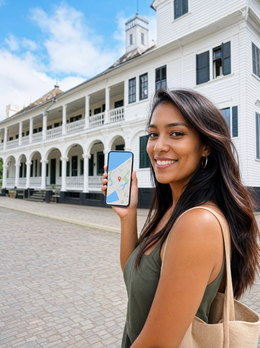
You've decided to buy data for your trip to Suriname, and you have just one question left: how many GB to buy so you don't run out or waste money. Good news: Suriname is one of those destinations where you'll need the least data, and I'll give you a well-reasoned number here, without confusing you with comparisons.
How many GB do I need for Suriname?
For 10 days in Suriname, most people will have more than enough with 3 GB. The jungle—which covers almost the entire country—has no coverage, so you'll only use data in Paramaribo and along the coast. If you work remotely from the capital or upload many photos daily, increase it to 5-7 GB.
I'm being direct because Suriname is a rare case. In most destinations, you calculate your gigabytes based on the number of days you're away. Not here: you calculate based on the days you will be truly connected. And on a typical trip to Suriname, you'll spend a good part of your time in the Amazonian interior, in Brownsberg, or navigating rivers, where your phone won't get any signal at all. Those days won't use a single megabyte.
So the mental exercise is this: from your travel days, subtract the days you'll spend in the jungle or on long river journeys. The remaining days—those in Paramaribo, the coast, and excursions based in the capital—are the ones that will consume data. You calculate your package based on this reduced figure, not on the total duration of your trip.
That's why I'll recommend lower amounts than for other South American countries. It's not stinginess: it's that in Suriname, if you buy 15 GB for ten days, you'll most likely return home with more than half untouched. I prefer you buy just enough and top up if necessary, which is very easy.
Why Suriname uses less data than almost any other destination
Suriname is the smallest country in South America and, at the same time, one of the least populated: the Amazon rainforest covers about 90% of the territory, and almost no one lives there. All life—and all coverage—is concentrated in a narrow strip to the north: Paramaribo, the capital, and the coastal corridor from Nieuw Nickerie in the west to Albina on the eastern border.
Outside this strip, your phone is a paperweight. The Central Suriname Nature Reserve, Brownsberg, Brokopondo Lake, or any jungle camp deep inland have no cell towers for many kilometers around. You reach these places by boat or small plane, and once there, you are completely disconnected. It's not a temporary signal glitch: there simply isn't a network to connect to.
This completely changes the calculation. On an adventure trip to Suriname—which is why almost everyone goes—you can spend three, four, or five consecutive days without coverage. These days don't count towards your data allowance. If you're considering local operators, Telesur offers the widest coverage, and Digicel is usually cheaper for city data bundles, but neither works miracles in the jungle.
The practical consequence is good for your wallet: you use data in bursts—when you return to Paramaribo and suddenly all your accumulated photos upload and messages arrive—and not continuously. Before deciding on the size, it's a good idea to review how to connect in the country, which I cover in depth in my guide to internet in Suriname.
How much data each mobile activity consumes
To put numbers to it, you need to know how much each activity consumes. These are real, average figures for normal use; they apply in Suriname as much as anywhere else, although here you'll only use them in the capital and on the coast. What almost always drives up the bill is the same thing: video, whether watching it or on a video call.
| Activity | Approximate Consumption | Note |
|---|---|---|
| Maps and GPS navigation | 5-10 MB/hour | Almost nothing if you have the map downloaded |
| WhatsApp (messages and voice notes) | 2-5 MB/hour | What you'll use most; barely any data |
| WhatsApp voice call | ~5 MB/hour | Ridiculously little |
| Video call | 300-480 MB/hour | The expensive one; use hotel Wi-Fi for these |
| Social media (scrolling) | 120-600 MB/hour | Automatic video playback multiplies consumption |
| Upload 20 photos (backup) | ~100 MB | Schedule this for Wi-Fi only |
| Music streaming | 40-70 MB/hour | Download playlists before you go |
| Video (YouTube/Netflix in SD) | 250-600 MB/hour | In HD, it goes up to 1-3 GB/hour |
The quick takeaway from the table: maps, messages, and voice calls won't bankrupt your data package by a long shot. The black hole is video and social media with auto-playback. If you control those two things, 3 GB will last you a very long time. You can find the full breakdown, activity by activity, in my guide to mobile data usage statistics by activity.
GB recommendation by profile and travel days
This is the table you've come to see. I've deliberately erred on the side of conservatism, assuming that in Suriname you'll spend days without coverage and that long video calls and binge-watching will be done over Wi-Fi. Find your profile, cross-reference it with your number of days, and there you have your starting figure.
| Travel Profile | 5 days | 10 days | 15 days | 30 days |
|---|---|---|---|---|
| Tourist using maps and WhatsApp | 1 GB | 2 GB | 3 GB | 5 GB |
| Photo and social media user | 2 GB | 3 GB | 5 GB | 8 GB |
| Digital nomad / remote worker | 5 GB | 8 GB | 12 GB | 20 GB |
| Family sharing one phone | 3 GB | 5 GB | 8 GB | 15 GB |
A couple of important nuances for Suriname. The digital nomad profile only makes sense if your plan is to stay in Paramaribo or on the coast: if you're going into the jungle, there will be no network for remote work, no matter what you do, so don't buy data for days you'll spend without coverage. And a family sharing a phone uses less than it seems, because almost all children's digital entertainment—videos, games—ends up being done over the hotel's Wi-Fi.
If you're hesitating between two rows, only choose the lower one if you know you'll be watching video or uploading content daily. For all other cases, the upper row will suffice. And if you want the general method for any country, you can find it in my main guide on how much data I need for travel.
Where you'll have coverage in Suriname (and where you won't)
Knowing where there is and isn't a network is what truly determines your data package in this country. You're not buying gigabytes for your trip: you're buying them for areas with cell towers. This table gives you an overview at a glance.
| Area | Coverage | What to do |
|---|---|---|
| Paramaribo (capital) | Good 4G | Work, upload photos, browse freely |
| Coastal corridor (Nickerie–Albina) | Decent 3G/4G | Enough for maps, messages, and social media |
| Rivers and boat trips | Intermittent | Signal occasionally, only near settlements |
| Brownsberg and interior jungle | None | Airplane mode; download everything before entering |
| Border with French Guiana | French network (EU) | Your European plan might roam here |
In Suriname, the best data-saving trick isn't a phone setting: it's the geography itself. Four days in the jungle mean four days of zero data consumption.
Look at the last row, which is tricky. If your route touches French Guiana—very common—you're no longer in Suriname for network purposes, but in French territory and therefore part of the European Union. With a normal Spanish plan, EU roaming allows you to use your home data at no extra cost in that section. That means fewer gigabytes to spend from your Surinamese allowance. I'll elaborate on this in the combined trip section, a little further down.
Will you use data translating from Dutch?
Suriname is the only country in South America where Dutch is the official language, and this scares some people who worry about data usage for translation. Don't worry: it's a non-issue. In practice, in Paramaribo and with tourists, many people get by in English, and with Sranan Tongo, the local Creole language, you can manage with a few words.
For everything else, the trick is to download the offline language pack for your translator before you leave. Google Translate lets you download the entire Dutch pack—text and camera—and then translate signs, menus, or conversations without using a single megabyte. Do it from home, with Wi-Fi, and you won't have to worry about it. Real-time camera translation, which would be the heaviest data user, works just as well offline.
So don't inflate your data package because of language fears: the translator isn't a real data consumer if you prepare it beforehand. The same advice applies to maps, PDF travel guides, and anything else you can download. Downloading what you'll use on the street from your hotel Wi-Fi is the habit that saves you the most gigabytes in a destination like this.
By the way, if this is your first trip with digital data and you're not quite sure how this virtual card thing works, I'll explain it from scratch in what is an eSIM.
Suriname in a combined trip: the three Guianas
Almost no one goes to Suriname alone. It's common to combine it with its neighbors on a trip through the three Guianas, and that changes your data plan more than you think. Each border is a different world in terms of network and price:
- French Guiana: It's France, which means the European Union. With your Spanish plan, EU roaming is included, so you use your home plan's data without extra cost. You don't need Surinamese data for that leg.
- Guyana (the English one): A separate country, with its own operators. Here you will need a specific data solution, different from Suriname's.
- Suriname: In the middle, with the limited coverage we've already seen, concentrated in the capital and on the coast.
The implication for your calculation is clear: don't buy a huge Surinamese data package thinking it will cover your entire trip. Buy only for the days you're in Suriname with coverage, and sort out Guyana separately. French Guiana is covered by your European operator by default, without you needing to do anything.
If you finally decide to go with dedicated digital data for the Surinamese leg—the most convenient option, because you activate it before flying and land connected—you'll find the specific plans and prices for the country in the Suriname eSIM guide. There you choose the size that comes out of this guide and you're all set.
How to know how much data you really use
Tables provide an average, but you are not the average. The honest way to get your number right is to look at yourself before traveling, and it takes two minutes from your phone settings. No one consumes data the same way, and your own history is the best forecast there is.
On an iPhone, go to Settings, Mobile Data, and scroll down to see period usage. On Android, go to Settings, Connections or Network, Data usage. See how many GB you've used in the last month of normal life at home and divide it by 30: that's your real daily consumption with your specific phone usage habits.
Now adjust it for your trip with two corrections. First: on vacation, you tend to use maps, photos, and social media more, so add a margin. Second, and this is key in Suriname: subtract the days you'll spend without coverage in the jungle or on long river journeys, because on those days your usage will be zero, no matter how much you normally consume.
With these two adjustments, you'll get a personalized number that's worth a thousand times more than any generic table. If, for example, it tells you 250 MB per day and you'll be connected for six out of ten days, that's about 1.5 GB; round up to 2 GB and you'll be fine. This homemade calculation is, by far, the best way to avoid buying too much or too little.
Tips to make your data last twice as long
With Suriname on your side—so much forced disconnection—and these habits, your package will go a long way. None of them are life-changing on their own, but together they make 3 GB feel like 6:
- Offline maps: download Paramaribo and your routes in Google Maps before you leave. You'll navigate with GPS without using data, and it's essential for the interior.
- Backups only on Wi-Fi: go into Google Photos or iCloud settings and set it to upload only with Wi-Fi. This is the number one silent data drain.
- Disable video auto-playback: on Instagram, TikTok, and YouTube, turn off automatic video playback. That's where your megabytes disappear without you noticing.
- Lower video quality: watching in SD instead of HD divides data usage by three or four.
- Data Saver mode: activate it in your system; it cuts background consumption for all apps at once.
Downloading music, series, and guides from your accommodation's Wi-Fi, to consume them later outside, is the most effective habit in a country where heavy digital entertainment can always wait until night. You can find the complete list of tips, with screenshots, in my guide on how to save data while traveling.
What if I run out? Better that than buying too much
I'll be clear about this, even if it goes against my own commercial interest: it's better to run out and top up than to buy too much. If you're debating between two sizes, choose the smaller one. Running out of data in Suriname isn't the drama it would be elsewhere, and you'll definitely save money.
Why is it okay to run out? Because topping up is immediate. With digital data, when you see your allowance getting low, you can extend it from your phone in a couple of taps and continue seamlessly. You don't have to go to a store or look for a physical card. Buy just enough, and if you happen to run out of data halfway through your trip, add what you need, and you're good to go.
On the other hand, buying too much has no going back: no one will refund the gigabytes you don't use on a trip, and they expire. In a destination like Suriname, where we've already seen you can spend entire days without using any data, overbuying is almost the norm if you let fear guide you. I've seen people return with more than half of their package untouched.
My rule for Suriname: buy for your connected days, not for your travel days, and leave the option open to top up. You'll be right more often this way than by inflating your package just in case. Topping up is your safety net, and it's inexpensive.
Frequently asked questions
How many GB do I need for 7 days in Suriname?
For a week, 2 GB is sufficient for most profiles. If you plan to spend two or three of those seven days in the jungle without coverage, even 1.5 GB might be enough. Only increase to 3-4 GB if you work remotely from Paramaribo or upload photos daily.
Will my eSIM work in Brownsberg or the jungle?
No, and it's not the card's fault: there's no network coverage from any operator in inland Suriname. Brownsberg, the Central Nature Reserve, and jungle camps are out of range. Download maps and anything else you need before entering and expect a complete disconnection on those days.
Do I need Surinamese data for French Guiana?
No: French Guiana is European Union territory. With your standard Spanish plan, EU roaming is included, and you can use your home plan's data without extra cost. Reserve your Suriname package only for the Surinamese leg of your trip.
Can I top up if I run out of data halfway through my trip?
Yes, and instantly from your phone. With digital data, you can extend your allowance without visiting a store or changing cards. That's why it's better to buy just enough: if you run short, you top up; if you overbuy, the gigabytes expire without a refund.
Does translating from Dutch use a lot of data?
Almost zero, if you download the offline language before traveling. Google Translate downloads the complete Dutch language, including the camera, and translates signs and menus without using data. Don't inflate your plan for the language: it's an expense that can be eliminated by preparing it from home with Wi-Fi.
Will one solution cover Suriname, Guyana, and French Guiana?
Normally no: these are three different network realities. French Guiana is covered by your European operator; Suriname and Guyana are separate countries, each with its own operators. It's practical to have dedicated data for Suriname and resolve Guyana separately.
What about a whole month in Suriname?
5 GB is more than enough for a normal tourist for 30 days. It sounds like a little, but remember that a good part of a long month in Suriname is spent on excursions without coverage. A digital nomad based in Paramaribo would want 15-20 GB to telework comfortably.
Conclusion
In summary, without exaggeration: Suriname is a low data consumption destination, because almost the entire country is jungle without coverage and you only really spend data in Paramaribo and on the coast. For a typical ten-day trip, 3 GB is more than enough for almost everyone; go up to 5-7 GB only if you telework from the capital or upload a lot of content, and go down to 2 GB if you're on a pure adventure with many days deep in the jungle.
Buy for your connected days, not for your travel days, prepare offline maps and translator from the hotel Wi-Fi, and leave the door open to recharge instead of inflating your package out of fear. With that, you're sure to get it right. When you have your number, get your data already activated before flying with the Suriname eSIM and land connected without looking for stores or cards.