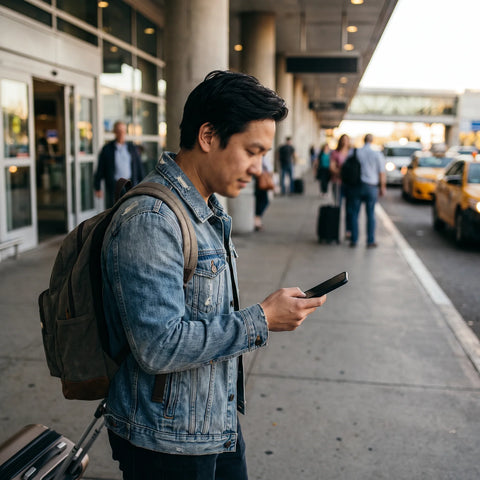
In short: an eSIM for Brunei gives you internet as soon as you land at Bandar Seri Begawan (BWN) airport, with no store, no passport registration, and no touching your physical card. It's installed before you leave home, activated upon arrival, and you keep your Spanish number for SMS and calls while browsing with data from the sultanate.
Brunei is not a three-week backpacking destination: it's a short stop, almost always part of a Borneo or Southeast Asia itinerary, and that changes how you should approach your connection. You don't need a huge plan or to complicate your life; you need reliable data from the minute you leave the terminal, for the taxi, for the map of the floating village, and to book the ferry without relying on hotel Wi-Fi that you might not even have booked in advance.
The sultanate is small, orderly, and has surprisingly good telecommunications infrastructure for its size. The question isn't whether there's coverage, there is, but how to organize yourself so you don't waste time at the airport or overpay for something that can be sorted out on your phone before you board the plane.
Real coverage in the sultanate, area by area
Brunei has three mobile operators: DST (Datastream Digital), imagine (formerly Progresif), and the shared infrastructure of Unified National Networks (UNN), which supports a good part of the country's networks. An eSIM automatically connects to the best available signal from these networks, so you don't manually choose an operator or need to know which is better: the profile itself connects to the strongest one at each point.
Where the difference is really noticeable is on the ground. Bandar Seri Begawan has stable 4G throughout the city center and much of the outskirts, with 5G already present in some areas of the capital. Outside the city, in Muara, Seria, and Kuala Belait, coverage remains strong because these are population centers with oil and industrial activity. Where the signal naturally drops is in the Ulu Temburong rainforest reserve: there are hardly any antennas there, and even the local SIMs of guides don't work well once you delve into the forest canopy.
| Area | Typical Coverage | What you'll need there |
|---|---|---|
| Bandar Seri Begawan (city center) | Stable 4G/5G | Maps, payment apps, video calls |
| BWN Airport and surroundings | Good 4G upon arrival | Taxi, transport, initial searches |
| Kampong Ayer (Water Village) | Sufficient 4G | Photos, translation, messaging |
| Muara, Seria, Kuala Belait | Good 4G in urban core | Road navigation |
| Ulu Temburong (jungle) | Weak or non-existent | Offline map downloaded before entering |
An easily overlooked detail: the journey to Ulu Temburong first passes through Sarawak (Malaysia) territory before re-entering Brunei via the Temburong enclave. During that stretch, your Brunei eSIM may lose local signal for a while, so don't be alarmed if your phone searches for a network for a few minutes; it's the border crossing, not an eSIM failure.
eSIM, roaming, or local SIM: what suits you (and when not to buy anything)
You have three ways to get connected in Brunei, and they are not equivalent. Your Spanish operator's roaming outside the European Union can get expensive easily: check the exact rate with your company before you leave, because in countries outside the European area, the cost per megabyte usually multiplies several times compared to what you pay at home. A local physical SIM is cheap for data once you have it, but it requires finding a store, showing your passport, filling out a registration, and losing your WhatsApp line while using it if you don't have dual SIM.
The eSIM solves the problem from the start: you buy and activate it before leaving Spain, you keep your number for banking SMS and calls, and you arrive in Brunei with data already ready without visiting a counter. If you want the full breakdown of why it pays off compared to roaming, we have the comparison of eSIM versus roaming and, if you're unsure between a physical chip and a digital profile, the guide to international chip versus eSIM.
That said, be honest with yourself about the length of your trip. If your stop in Brunei is a technical layover of a couple of hours without leaving the BWN airport terminal, don't activate anything: use the Wi-Fi in the boarding lounge and save your data for when you really need it. And if you're going to be less than a full day without leaving the hotel and the city center, with the accommodation's Wi-Fi and downloading the offline map beforehand, that's probably enough. The eSIM makes sense as soon as you go out on your own: taxis, ferries, markets, walking tours in areas without Wi-Fi.
Tip: On a two or three-day Borneo layover, buying a local SIM for such a short use rarely justifies the hassle. A small-gigabyte eSIM solves the same problem without queues.
How many GB to bring based on your itinerary
Brunei can be covered quickly, so the common mistake is to buy too much "just in case." Think about what you're actually going to do with your phone: maps for getting around the capital and Kampong Ayer, messaging, looking up mosque schedules, and uploading photos when you have a moment. With that, a few gigabytes go a long way.
| Type of Trip | Intended Use | Estimated GB |
|---|---|---|
| Layover or 2-3 days | Maps, messaging, some photos | 1-2 GB |
| 4-6 days combined with Borneo | Daily navigation, social media, bookings | 3 GB |
| Remote work or long video calls | Intensive use, shared hotspot | 5 GB or more |
A trick that saves more gigabytes than it seems: download the offline map of Bandar Seri Begawan and the Kampong Ayer area before leaving home. This way, you only use mobile data for real-time routing, not for loading the entire map from scratch every time you open the app. If you want more tips like this, the guide on how to save eSIM data on a trip has several that apply just as well here as in any other destination.
How to activate the eSIM before flying
The process doesn't change from other destinations, and that's precisely its advantage: you do it once, at home, calmly and with stable Wi-Fi, and you forget about it until you land.
- Purchase the eSIM for Brunei and receive the QR code or installation link by email, usually instantly.
- At home, connected to Wi-Fi, install the profile from your phone settings by scanning the QR (if you've never done it, the guide on how to install an eSIM will walk you through it step-by-step).
- Configure it as your secondary data line and leave your Spanish SIM active for calls and SMS.
- Upon landing at BWN airport, activate data roaming only on the eSIM line.
- Check in the settings that your phone has connected to a local operator and that you have data before leaving the airport.
If you're not clear on exactly what an eSIM is or how it differs from a traditional SIM, the guide on what a virtual eSIM is addresses basic questions before you buy.
A connected weekend in Bandar Seri Begawan
Most trips to Brunei are short, so it's worth thinking about your connection based on what you'll be doing day-to-day, not just in the abstract.
The first challenge right after leaving the terminal is arranging transport: there isn't as much taxi availability here as in other Asian capitals, so having active data to order transport or at least confirm the exact hotel address with the driver saves you the classic back-and-forth with a paper reservation in hand. The Omar Ali Saifuddien Mosque, illuminated at sunset, is easy to visit on foot from the center, but it's advisable to check public opening hours beforehand: it closes during prayers and varies by day, and there's no reliable public Wi-Fi in the square.
To get to Kampong Ayer, the floating village, it's common to take a small ferry or water taxi from the downtown pier. Prices are often negotiated verbally with the boatman, and having a translator and map handy helps confirm the route and return pickup point without relying on memory. At night, the Gadong Night Market is one of the capital's liveliest spots: food stalls, human warmth, and again, payments that are sometimes cash-only, so having your banking app handy to withdraw money beforehand avoids surprises.
If you add a day trip to Ulu Temburong, mentally prepare to truly disconnect: it's primary rainforest, and as we saw in the coverage table, the signal drops as soon as you enter the park. Download the area map before you leave and don't count on mobile data during the excursion, whether with an eSIM, local SIM, or roaming. That day, neither an eSIM nor a local SIM will help you if something goes wrong.
What almost no one tells you before you go
Brunei is a Muslim country with prohibition: alcohol is not sold in shops or restaurants, which surprises those coming from Malaysia or Singapore without having checked beforehand. This doesn't affect the eSIM itself, but it does affect how you plan your trip: if you search for "bar" or "wine shop" on the map, you'll be disappointed, so adjust your searches to cafes and juice bars, which have much more to offer here than one might expect.
Friday is the religious day of rest, and many businesses close at midday for Jumu'ah prayer, reopening afterward. If your only day in the capital falls on a Friday, having data to check in real time what's still open saves you pointless walks to a closed restaurant that would otherwise be bustling.
Another overlooked detail: power outlets in Brunei are Type G, the same three-flat-pin type as in the UK. If you're coming from another part of Southeast Asia where you used a different adapter, double-check that you have the correct one before your battery dies on the day you'll be relying most on maps.
And about privacy: if you're going to connect to cafe or hotel Wi-Fi to save data, a VPN adds an extra layer of peace of mind on public networks you don't control. If you've never set one up on your phone, the guide on eSIM, VPN, and privacy on your trip explains it without technical jargon.
Finally, if your itinerary continues beyond Borneo to other parts of Asia-Pacific, it's worth checking the coverage for your next country in advance instead of leaving it until the last minute at the departure airport; for example, if your next destination is South Korea, the guide on eSIM for South Korea will prepare your connection for Seoul or Busan before you even land there.
Frequently Asked Questions
What do I need to travel to Brunei with an eSIM?
For the trip itself, a passport with at least six months of validity; most Spanish travelers can enter without a visa for short tourist stays, although conditions change over time and it's advisable to confirm them with an official source before departing. For the eSIM, no additional procedures are required: no registration or documentation, just a compatible and factory-unlocked mobile phone.
Is my phone compatible with eSIM?
Most iPhones from XS onwards, Google Pixels from 3, and a good number of mid-to-high-end Samsung Galaxy phones support eSIM. If you're unsure, check the guide on how to install an eSIM, which also explains how to check compatibility from your phone's settings before buying anything.
Does the eSIM work as soon as I land at BWN airport?
Yes. If you installed it at home with Wi-Fi, upon landing, you only need to activate data roaming on the eSIM line, and your phone will connect to the local network in a matter of seconds, usually before you even reach the baggage claim.
Can I make regular calls with the eSIM?
The data eSIM is designed for internet, not traditional voice calls. To talk, you use WhatsApp, Telegram, or FaceTime with your data connection, while your Spanish number remains active on your main line for SMS and incoming calls at no additional cost for having it in standby.
How many GB do I need for a short layover?
For two or three days with maps, messaging, and some social media, 1 or 2 GB should be plenty. If you know you'll be uploading a lot of photos or making video calls, upgrade to 3 GB. Downloading offline maps of the capital before you leave significantly reduces actual consumption on the ground.
Is there free Wi-Fi at Brunei airport?
International airports usually offer free Wi-Fi in boarding and arrivals areas, and Brunei's is no exception. If your stop is just a layover without leaving the terminal, you can rely on that Wi-Fi and save your eSIM data for when you go out.
What happens to the signal if I go to Ulu Temburong?
The Ulu Temburong jungle has weak or no coverage because there are hardly any antennas in the reserve, and the journey also briefly crosses Sarawak territory. Download the map of the area before you go and do not count on mobile data during the excursion, whether with eSIM, local SIM, or roaming.
Conclusion
Brunei is best enjoyed when you're not wasting time figuring out how to connect: maps for Kampong Ayer, real-time mosque schedules, and the ability to upload photos without waiting for hotel Wi-Fi. An eSIM for Brunei gives you that from minute one, with no in-destination hassles and no reliance on expensive roaming from your operator. Install it before you leave home, activate it upon landing at BWN airport, and dedicate your brief visit to the sultanate to seeing the city, not staring at your phone screen searching for a signal.