Guyana is a rare and precious corner of the world: South America's only English-speaking country, with an Atlantic coast where almost everyone lives, and an Amazon rainforest and savanna interior that covers the rest of the map. And that geography dictates your mobile experience like few other places. Planning your internet in Guyana before you leave isn't a geeky obsession: it's what separates a smooth trip from being stuck without Google Maps on the way to Kaieteur Falls. Here, I honestly compare all the real options and tell you where you'll have data and where you won't.
Connectivity in Guyana in 2026
Quick answer: In Guyana, you have four ways to connect: your carrier's roaming (convenient but expensive), hotel Wi-Fi (free, but ties you to the building), a local GTT or Digicel SIM (cheap, bought with a passport), or a travel eSIM, which activates before you leave and works as soon as you land.
It's worth understanding the terrain, because it explains everything else. Guyana has only about 800,000 inhabitants and close to 90% live on the narrow coastal strip of the Atlantic. That's where the antennas, fiber, and decent 4G are. The rest of the country — over 80% Amazon rainforest — is practically empty of people and, therefore, of coverage.
There are two mobile operators, and you should remember this fact now, because it will be important several times:
- GTT: the historical telco, rebranded as ONE Communications in 2024. Offers the most reliable 4G on the coast and data plans with the best value for money.
- Digicel: the Caribbean operator, very competitive in Georgetown and with a counter at the international airport to buy SIMs upon arrival.
Translated into travel decisions: on the coastal strip you'll be fine with either; as soon as you head inland, whoever has an antenna rules, and antennas are scarce.
Roaming with your carrier: convenient and very expensive
The option of doing nothing: you turn on your mobile and let your Spanish carrier connect to the Guyanese network. It works, but it's the most expensive of all and the one that causes the most surprises upon return.
Guyana is outside the European Union, so your "roaming included" rate does not apply here. You enter the most expensive international zone for almost all companies, and that's where three-figure bills are born. Browsing without a contracted bundle can cost you several euros per megabyte —some operators publish rates of around €6 per MB outside of bundles— so watching two minutes of video at Georgetown airport can cost you the price of a dinner.
That's why they sell international bundles: a few gigabytes for between €5 and €15 per day. The problem is not only the price, it's the fine print: they expire, renew automatically, and limit speed when they run out. If you want the numbers under a magnifying glass, I break them down in how much international roaming costs and in the comparison eSIM vs roaming.
When does it make sense? Only in two cases: if your company pays the bill, or if you have a 24-hour layover and don't want to complicate things.

Hotel Wi-Fi: useful, but limited
Wi-Fi is free and usually works well in Georgetown. Most hotels, guesthouses, and cafes in the capital offer decent connection, and as a backup network, it's perfect: uploading daily photos, making a long video call, or downloading offline maps before an excursion.
The problem is that Wi-Fi only exists where there are walls, and traveling in Guyana means almost always being outside of them: in a minibus along the coast, on a boat along the Essequibo River, or on the small plane that takes you to the jungle. That's exactly when you need Google Maps, your guide's number, or a message from your accommodation.
Also, there are three reasons not to rely on it:
- Security: open networks in airports and terminals are fertile ground for credential theft.
- Real speed: Wi-Fi in a crowded guesthouse at nine at night is a lottery that rarely pays off.
- Zero coverage outside the premises: it won't help you call a taxi or notify someone you're running late.
If you're considering a portable router as an alternative, I compare it in depth in eSIM vs pocket Wi-Fi: quick summary, it's another gadget to carry, watch over, and return, and it doesn't create coverage where there isn't any in the interior either.
Local Guyanese SIM: GTT (ONE) and Digicel
The classic option for backpackers. It's cheap, works well on the coast, and gives you a Guyanese number, useful if you're booking tours by phone. The chip costs little —a Digicel SIM is around 2,000 GYD (about $9-10) and a GTT/ONE SIM ranges from 1,500 to 2,000 GYD— and data packages are affordable: Digicel starts at about 485 GYD for 2 GB for one day, and ONE offers up to 35 GB monthly for 3,500 GYD (about $17).
Now, the part almost no one tells you: in Guyana, the passport registration process is mandatory. To activate any SIM, you have to register it with your document, and the seller records your data and the serial number as per regulations. Nothing strange, but count on showing your passport no matter what.
Where you buy it makes a difference:
- Digicel: has a counter at Cheddi Jagan International Airport, so you can leave the terminal already connected.
- GTT / ONE Communications: better coverage and plans, but does not sell at the airport; you'll have to go to a store in Georgetown.
The real cost isn't the money; it's the time and the process. I compare it calmly in eSIM vs local SIM.
eSIM: my recommendation for most people
It's a digital card that downloads to your mobile and coexists with your Spanish line without removing anything. You buy it from home, install it with your Wi-Fi, and when you land in Georgetown, it connects automatically to the Guyanese network. No queues, no passport at the counter, and no searching for a store on the first day.
If you've never used one, start with what an eSIM is. The only requirement is a compatible mobile (iPhone XS or later, Samsung Galaxy S20 onwards, Pixel 3 and higher) and unlocked by the carrier.
The specific advantages for Guyana are three:
- Connection upon landing: you leave the plane with Google Maps and the translator working, which is exactly when you need them most.
- Fixed price: you pay before traveling and forget about surprise bills upon return.
- Your number stays active: you receive bank SMS —that verification code that always arrives at the worst moment— without spending data or skipping any local registration.
The honest downside: it doesn't give you a Guyanese number for local calls, and if you exceed your data, you'll have to top up. For a normal tourist trip, neither of these is a problem. You can find the plans and step-by-step instructions in the eSIM guide for Guyana.
Comparison: which option is right for you
I'll summarize what we've seen in a table so you can decide in thirty seconds. Prices are approximate for a ten-day trip and depend heavily on your home operator and the data you contract:
| Option | Approximate Cost (10 days) | Ready upon landing | Best for |
|---|---|---|---|
| Roaming with your carrier | €50-150 (or much more without a bundle) | Yes | Business trips and short layovers |
| Hotel Wi-Fi | €0 | No | Support, never a sole solution |
| Local Guyanese SIM | €10-20 | No (passport registration required) | Long stays and local number |
| Travel eSIM | €10-25 | Yes | Most tourists |
My criteria, after many trips: if you're going for less than a month and want zero friction, the digital card wins hands down. If you're staying for weeks working from Georgetown, it's worth going through the process and getting a Guyanese line with its own number. And hotel Wi-Fi is always there, but as a supplement.
The right question isn't "which is the cheapest option?", but "what happens if I run out of internet at the worst possible moment?". In Guyana, that moment usually comes while flying over the jungle, an hour's flight from the nearest town.

Coverage in Georgetown and the coast
Here's the good news: all life in the country is concentrated in a narrow strip along the Atlantic, and that strip is well connected. In Georgetown, you have stable 4G for all tourist purposes —maps, messaging, social media, and video calls run smoothly— with both GTT/ONE and Digicel.
Other coastal towns work similarly:
- New Amsterdam: the second city, to the east, with decent 4G coverage in the urban area.
- Linden: inland by road, still within the area well-served by antennas.
- Coastal corridor: the route connecting the towns along the sea maintains reasonable signal almost the entire journey.
A useful technical note: Guyanese 4G started on band 28 (700 MHz) and later added band 3 (1800 MHz) to provide more capacity. These bands are fully compatible with any recent European mobile, so your device will work without problems.
On the coast, any option in this guide will work for you. The antenna density is high where people live, and that's the comfortable scenario. The problem begins as soon as you leave the asphalt and enter the jungle. And in Guyana, that happens very quickly: just cross the first line of trees.
Kaieteur Falls: the great warning of the jungle
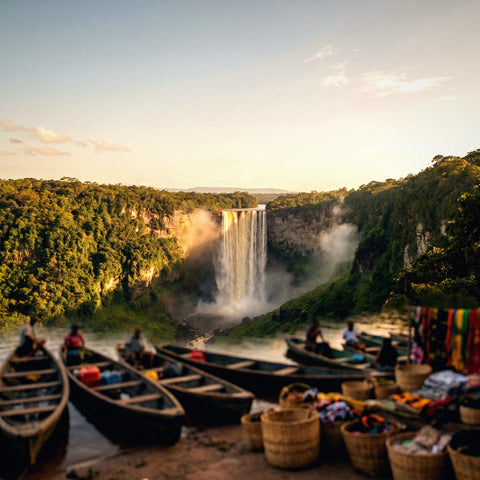
If you take away only one piece of information from this guide, let it be this: there is no coverage at Kaieteur Falls. They are the country's jewel, a single-drop waterfall of 226 meters in the heart of Kaieteur National Park, and they are so deep in the Amazon jungle that there are no roads, no towns, and hardly any facilities around.
You get there by 12-seater plane from Georgetown, on a charter flight of approximately one hour; there are no regular flights because there is no constant demand. And there, over the infinite canopy of the Amazon, your mobile enters total disconnection: it's not a fault of your card, it's that there isn't a single antenna for hundreds of kilometers around.
How to prepare so it's not a problem:
- Download offline maps and tour information before boarding the plane.
- Notify your people that you will be unreachable during those hours; don't panic if you don't respond.
- Bring your camera and battery fully charged: it's the most photogenic spot on the trip and there will be nowhere to recharge.
- Embrace the silence: being alone at the edge of a waterfall in the middle of the jungle, without notifications, is part of the experience.
You'll have a good connection before and after, in Georgetown. During Kaieteur, your phone is a spectacular camera and little else.
Amazon interior and Rupununi savannas
Outside the coast, Guyanese coverage is a map of holes, and it's good to know what to expect in each area to avoid surprises:
| Area | Actual Coverage | What to Expect |
|---|---|---|
| Georgetown and coast | Good (4G) | Stable signal for all tourist use |
| Iwokrama Reserve (jungle) | Very weak or none | Some signal in lodges; nothing between trees |
| Lethem (border with Brazil) | Basic in town | Enough to notify; sometimes Brazilian network is caught |
| Rupununi savannas | Practically non-existent | Ranches and villages communicate by radio |
The Rupununi, the great southern savanna, is the extreme case. It is so remote that many villages communicate by radio and much of the trade is done with Brazil, to the point that Portuguese is heard more than English. Its capital, Lethem, next to the Takutu River, has basic connection, but as soon as you go out into the plains, radio silence is the norm.
The advice that never fails in the interior: sort out everything important while you have a signal in Georgetown or Lethem —reservations, maps, guide contacts— because in the jungle and savanna there will be no way. And if you really need to stay connected in the middle of nowhere, the only realistic alternative today is Starlink, which arrived in the country in 2025 and is used by some lodges.
How much data you need and key tips
The million-dollar question. The short answer: less than you think, and in Guyana even less, precisely because you'll be spending hours—or days—in the jungle and savanna without a signal, where you won't use a single megabyte.
My practical rule is to estimate between 500 MB and 1 GB per day for normal tourist use on the coast: maps, WhatsApp, looking for places to eat, uploading some photos, and a bit of social media at night. That should be plenty. Only if you make long video calls daily or work from your mobile should you consider 2 GB per day.
| Type of trip | Duration | Recommended Data |
|---|---|---|
| Layover or city break in Georgetown | 3-4 days | 3 GB |
| Coast + Kaieteur excursion | 10 days | 5-8 GB |
| Grand tour with Iwokrama and Rupununi | 3 weeks | 10-15 GB |
| Digital nomad on the coast | 1 month | 20 GB or more |
And some habits that truly make a difference: download Google Maps offline for each region before you leave, always carry a power bank (searching for signal consumes the most battery), and save emergency numbers in your contacts —in Guyana, 911 for police, 912 for fire, and 913 for ambulance, although medical service only operates reliably in Georgetown. Also, beware of ghost signal: in the interior, you might see a 3G bar but have no usable data, so don't count on it for anything critical.
Frequently asked questions
Is there coverage at Kaieteur Falls?
No. Kaieteur is deep in the Amazon rainforest, with no roads or nearby towns, and is reached by small plane from Georgetown. There are no antennas there, so you will be in total disconnection. Download maps before boarding the plane and enjoy the site without looking for bars.
Do I need my passport to buy a SIM card in Guyana?
Yes. Registering the SIM with your ID is mandatory, and the vendor records your data as per regulations. Carry your passport. Digicel has a counter at Cheddi Jagan Airport; GTT/ONE does not sell there, so for their card, you will have to go to a store in Georgetown.
Which Guyanese operator has the best coverage?
GTT, now called ONE Communications, offers the most reliable 4G on the coast and the best data plans. Digicel is very competitive in Georgetown and has the advantage of a counter at the airport. Outside the coast, neither guarantees continuous signal.
Is there internet in the interior and in the Rupununi savannah?
Very little. In towns like Lethem, there is a basic connection, but in the Iwokrama reserve and the Rupununi savannahs, the signal is almost non-existent, and many villages communicate by radio. Get everything sorted before heading inland and don't count on data.
How many GB do I need for 10 days in Guyana?
Between 5 and 8 GB is more than enough for a 10-day trip along the coast with a getaway to Kaieteur. You consume less than it seems because hours in the jungle and savannah pass without signal, without spending data.
Does my Spanish mobile work in Guyana?
Yes. Guyanese 4G uses bands 28 (700 MHz) and 3 (1800 MHz), compatible with any recent, unlocked European handset. If you use a digital card, you only need your mobile to be eSIM compatible.
Does my operator's roaming work in Guyana?
It works technically, but Guyana is outside the EU, so it falls into the more expensive international zone. Without a contracted bundle, data is paid at a premium price. Contract a bundle, use a digital card, or a local SIM to avoid a shock on your bill.
Conclusion
Guyana will offer you two opposing experiences: a well-connected coast, with Georgetown and its towns enjoying 4G, and a wild interior—Kaieteur, Iwokrama, the Rupununi—where your mobile becomes a very expensive camera. Accepting this duality is key to traveling peacefully through South America's only English-speaking country.
My recommendation is simple: arrange your connection from home for everything that has coverage (the capital, the coast, the airports) and prepare for offline mode in the jungle and savannah, where you won't have it.
If you want the simplest option, activate the PuraSIM eSIM for Guyana before boarding the plane: it installs in two minutes, connects automatically upon landing in Georgetown, and gives you a fixed price with no surprises upon your return. The rest—the waterfalls, the caimans, and the endless savannah—is up to you.