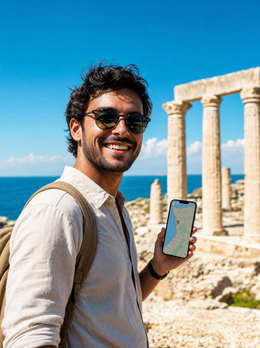
If you've already decided to get data and the only thing left is to decide how many GB to buy for Cyprus, this article is for you. Cyprus is a small island, with very good Wi-Fi in hotels and short driving distances, so almost no one needs as much as they think. But it has a catch that no other European Union destination has: the northern half of the island does not operate under the same rules, and there your mobile phone can start costing you money without you realizing it. Let's get to the number, and then the warning.
The short answer: how many GB for Cyprus
For 10 days in Cyprus, most people will be fine with 5 GB: maps, WhatsApp, social media, and some browsing. If you mainly use maps and messaging, 3 GB will be plenty; if you upload photos and videos daily without waiting for hotel Wi-Fi, aim for 8 GB.
That's the number, and I'm not going to hide it at the end of the article. Cyprus plays in the traveler's favor in this regard: the country has good 4G coverage almost everywhere on the island and 5G in urban areas (Nicosia, Larnaca, Limassol, Paphos), and hotel, apartment, cafe, and restaurant Wi-Fi is abundant and usually works well. This means that everything that truly devours gigabytes—photo backups, series, phone updates, uploading 4K beach videos—can be offloaded onto Wi-Fi while you're eating dinner or sleeping.
What you spend with mobile data outdoors is another matter: maps, messages, checking schedules, looking for a restaurant, sharing a photo on WhatsApp. That, on a normal week-long or ten-day trip, ranges between 200 and 600 MB per day. Multiply that and you'll see why the numbers above seem so modest compared to the 20 GB packages advertised.
If you want the general criteria for any destination and not just Cyprus, you can find it detailed in the parent guide on how much data I need for travel. Here I focus on what changes the number on this specific island.
Why you'll spend less in Cyprus than you think
Some destinations inflate data consumption for structural reasons: huge countries with very long journeys, places where you need the camera translator on all the time, or locations where a VPN is required to use your usual apps. Cyprus is none of these, and that directly saves you gigabytes.
First, language. Cyprus was a British colony until 1960, and English is everywhere: restaurant menus, road signs, museums, car rentals, hotel staff. You won't be glued to a camera translator, which is one of the most data-consuming activities per minute in destinations with a different alphabet. The Greek alphabet appears, yes, but almost always accompanied by its Latin transcription.
Second, distances. The island measures about 240 km from end to end, and the part you'll be exploring is even smaller. From Paphos to Ayia Napa is just over a two-hour drive on the highway; from Larnaca to Nicosia, forty minutes. There are no six-hour journeys where you end up watching videos out of boredom, which is where gigabytes really go.
Third, Wi-Fi. It's easy to find free networks in cafes, organized beaches, shopping centers, and practically any accommodation. With that, the heavy data consumption shifts away from your data plan. If you're still deciding how to connect and not just how much to buy, I compare everything in internet in Cyprus; here we're only talking about the size of the package.
Important warning: the north of the island does not count as EU
This is the part almost no one tells you about, and it's what can turn a cheap trip into an unpleasant bill. The Republic of Cyprus is a member of the European Union, so in the south, your European plan works normally. But the northern third of the island is under Turkish Cypriot administration, and EU legislation is de facto suspended in areas where the Government of the Republic of Cyprus does not exercise effective control. Translated for mobile: European roaming does not apply there.
As soon as you cross the Green Line towards Kyrenia, Famagusta, North Nicosia, or the Karpas Peninsula, your phone stops seeing Cypriot networks and connects to Turkish Cypriot operators: KKTCELL (the Turkcell of the north) and KKTC Telsim. For your plan, that's a non-European country, with the price of a non-European country.
| Where you are | Which network your phone connects to | What happens with your European plan |
|---|---|---|
| South: Larnaca, Limassol, Paphos, Ayia Napa, Troodos, South Nicosia | Cyta, Epic, PrimeTel, Cablenet | EU Zone: works with your usual conditions |
| North: Kyrenia, Famagusta, North Nicosia, Karpas | KKTCELL (Turkcell), KKTC Telsim | Outside European roaming: non-EU country rates apply |
| Near the Green Line or the northern coast | Northern signal may intrude without crossing | Risk of charges even if you haven't left the south |
How much does it hurt? Cypriot operators themselves charge their customers between €0.20 and €0.25 per MB for data usage in the north. That's more than €200 per gigabyte. With your Spanish plan, the price will depend on your contract, but the mechanism is identical: you leave the European bubble.
If you're going to cross to the north, the rule is simple: deactivate mobile data before passing through customs and don't turn it back on until you return to the south. In the north, use hotel or cafe Wi-Fi.
And be careful with one detail: most data plans sold "for Cyprus" cover the networks of the Republic of Cyprus, not those of the north. Before buying, check the declared coverage on the plan's specification sheet; in our eSIM guide for Cyprus, I explain which networks are used and how to check.
How much data each activity actually consumes
Before choosing a number, it's good to know where gigabytes come from. These are real consumption figures per hour of active use. These are not feelings: they are the orders of magnitude you'll see if you check the details by app in your phone's settings.
| Activity | Approximate Consumption | On a typical travel day |
|---|---|---|
| Maps with navigation (Google Maps, Waze) | 3-5 MB/hour | 15-30 MB |
| WhatsApp: text, audio messages, individual photos | 5-15 MB/hour of active use | 30-80 MB |
| WhatsApp voice call | ~60 MB/hour (1 MB per minute) | 20-60 MB |
| WhatsApp video call | ~440 MB/hour | 150-400 MB if calling home |
| Work video call in HD (Zoom, Meet) | up to 1.6 GB/hour | 1-3 GB if teleworking |
| Instagram and TikTok (feed, stories, reels) | ~700 MB/hour | 350-1,000 MB |
| Music streaming (normal quality) | ~150 MB/hour | 150-450 MB |
| YouTube or Netflix video (480-720p) | 500 MB - 1 GB/hour | as much as you decide |
| Browsing, searching for places, checking email | 30-60 MB/hour | 50-150 MB |
Note the contrast: maps, which is what worries us most, are practically free in terms of data. Ten days of navigating two hours daily in Cyprus won't even reach 100 MB. Video is expensive, in any of its forms: reels, video calls, and streaming. If you're curious about the full breakdown by application, I have it expanded in the mobile data usage statistics by activity.
How many GB depending on your profile and how many days you're staying
This is the table you've been looking for. It's calculated for Cyprus with a realistic assumption: you sleep in a place with Wi-Fi and use it for backups and watching videos at night. If you're going to be without Wi-Fi the whole trip, go up one tier.
| Travel Profile | 5 days | 10 days | 15 days | 30 days |
|---|---|---|---|---|
| Map and WhatsApp Tourist (basic, no social media) | 1-2 GB | 3 GB | 5 GB | 8-10 GB |
| Photos and Social Media (daily stories, Instagram, TikTok) | 3 GB | 5 GB | 8 GB | 15 GB |
| Digital Nomad / Remote Work (video calls, files) | 10 GB | 20 GB | 30 GB | 50 GB or unlimited |
| Family Sharing (2 adults + kids with video) | 5 GB | 10 GB | 15-20 GB | 30 GB |
A couple of nuances worth more than the table:
- If the trip is a beach holiday in Ayia Napa or Paphos, consumption drops: many hours are spent on the towel without looking at the phone, and beach bars usually have Wi-Fi.
- If the trip is for driving and visiting villages (Troodos, Lefkara, Omodos), it doesn't increase much either: it's maps and photos, and photos can wait.
- If you're going to make daily video calls home, add between 1 and 3 GB to the total. It's the only thing that truly skyrockets on a leisure trip.
- If you share your connection with your partner's phone or a laptop, count both consumptions as if they were two different travelers.
And an honest note: if 3 GB works for you, buy 3 GB. We sell larger packages here, but a plan that you only use half of doesn't make you a better traveler, it just makes it more expensive for you.
What will definitely use up your data in Cyprus
Every destination has its own data sinks. These are Cyprus', in case any apply to you.
The rental car and driving on the left. In Cyprus, you drive on the left, a British legacy, and roundabouts go the opposite way your brain expects. Most people end up with their phone in the holder and the navigation on for the entire journey, not just to know the route but to avoid taking the wrong lane at exits. Good news: navigation consumes very little. What is advisable, however, is to download the offline map of the entire island before leaving, because in the mountain roads, coverage can have gaps, and a half-loaded map is worse than having none at all.
The Troodos Mountains. In the valleys and on some winding roads towards Mount Olympus, the signal drops. This, paradoxically, is a saving: you don't spend what you can't use. But it means that the photos you take there will be uploaded in bulk when you regain coverage, with the corresponding consumption peak if you have automatic backups activated with mobile data.
Divided Nicosia. Walking through Europe's last divided capital is full of moments where you check your phone: which border crossing is open, what's on the other side, where the market is. It's navigation and searches, which means pocket change in data. The important thing in Nicosia is not how much you spend, but which network you connect to depending on which side of the city you're on.
Beaches and sunny days. Ayia Napa, Fig Tree Bay, or Coral Bay are for lounging, and you use your phone less there. Beach days are usually the lowest consumption days of the trip.
Photos: the real data sink for your plan
Cyprus is a very photogenic destination —turquoise water, stone villages, monasteries, Aphrodite's Rock— and that's where most people's data plans go. Not from looking at photos, but from uploading them without realizing it. Automatic backups from Google Photos or iCloud, if activated with mobile data, can burn through a gigabyte in an afternoon.
| What you upload | Approximate size |
|---|---|
| Normal phone photo (12 MP) | 3-5 MB |
| High-resolution or HDR mode photo (48 MP) | 8-12 MB |
| One minute of 1080p video | 60-130 MB |
| One minute of 4K video | ~350 MB |
| Automatic backup of 100 photos from one day | 400-500 MB |
| A 15-second Instagram story | 5-10 MB |
The practical conclusion is a single line: limit backups to Wi-Fi only. On iPhone, in Photos Settings, disable mobile data for iCloud; on Android, in Google Photos, set backups to "Wi-Fi only." With that, a traveler who takes many photos goes from needing 15 GB to needing 5 GB.
And if you want to share immediately, share wisely: sending a photo via WhatsApp compresses it to less than 1 MB, while sending it "as a document" sends the full original. Ten photos via WhatsApp are less than 10 MB; the same ten photos in original quality can be 50 MB. It's the same gesture with ten times the cost.
How to check your data usage before leaving home
All the above are averages. You are not an average, so there's a much better way to get it right: check what you actually consume. Your phone already keeps track.
- On iPhone: Settings > Mobile Data. You'll see the total for the period and the breakdown by application. The counter is cumulative since the last time you reset it, so check the date at the end of the list.
- On Android: Settings > Network & Internet > SIM or Data Usage. There you'll find monthly cycle usage and also the breakdown by app.
Take your normal monthly consumption, divide it by 30, and you'll have your daily average. Now apply two travel corrections. The first: at home, you spend much more time on Wi-Fi (work, couch), so when traveling, your mobile data proportion goes up. The second: in Cyprus, you'll be out and about more hours, but also more hours doing things that don't use data, like driving, swimming, or dining.
In practice, for most people, it works out to almost the same: if you use 4 GB a month at home, in Cyprus you'll use about 130-150 MB a day, meaning less than 2 GB in ten days. That's the baseline. Add the margin for photos and some video calls, and you'll have your real number, calculated with your own data and no one else's.
If you've never used this type of connection and are wondering how the underlying technology works, it's explained without technical jargon in what is an eSIM.
How to make your GB last without giving anything up
Stretching your data isn't about suffering through your trip with your phone off. It's about eliminating consumption that doesn't benefit you. These five adjustments, made in five minutes before flying, can easily cut your data usage by half.
- Offline maps of the entire island. In Google Maps, search > your profile picture > Offline maps > Select your own map. All of Cyprus fits easily and it also helps in areas without coverage in Troodos.
- Backups only via Wi-Fi. Photos, videos, iCloud, Drive, Dropbox. This is by far the biggest data saver.
- Disable auto-play video on Instagram, TikTok, Facebook, and X. Videos that start automatically as you scroll are pure, unrequested consumption.
- Activate System Data Saver Mode (Android) or Low Data Mode (iPhone, in Mobile Data Settings). This curbs background updates and lowers download quality.
- Download music, podcasts, and series before you leave. A car trip to Paphos with Spotify streaming is 300 MB; with the list downloaded, it's zero.
A specific extra for Cyprus: if you're crossing to the north, in addition to turning off data, make sure network selection is set to manual while you're near the Green Line, so your phone doesn't automatically connect to a Turkish Cypriot network. I have the long list of tricks in the guide on how to save data on a trip.
What happens if you run out (and why it's not a big deal)
The question that stops many people is, "What if I run out of data in the middle of my trip?" Honest answer: nothing serious happens, and running out of data is almost always cheaper than having too much.
When you run out of data, your phone simply stops browsing. There are no surprise charges or strange bills: it just ends. You top up from any Wi-Fi — at the hotel, a café, the airport — in a couple of minutes, and you're good to go. In a country like Cyprus, where there's Wi-Fi everywhere, finding somewhere to top up is not a problem at all.
Buying too little can be fixed in two minutes from your hotel's Wi-Fi. Buying too much has no fix: the gigabytes you don't use don't come back.
That's why my advice is always the same: buy the tier you calculate you need, not the next one out of fear. If the table says 5 GB, get 5 GB. If halfway through your trip you see you're cutting it close, top up. And if you see you have extra, you know next time you can go even lighter.
What is advisable is to monitor the counter from day one, not day five. Check your consumption at the end of the first full day and multiply it by the remaining days: in 30 seconds you'll know if you're doing well, if you have too much, or if you need to adjust something. It's the same calculation made by those who never get stranded, and there's nothing more to it than that.
Frequently asked questions
How many GB do I need for a week in Cyprus?
3 GB is good for 7 days. It's enough for browsing, WhatsApp, searches, and uploading photos in moderation, provided you use the accommodation's Wi-Fi for backups and video streaming. If you post daily stories, go up to 5 GB.
Will my Spanish plan work in Cyprus?
Yes, in the Republic of Cyprus (the south), your European plan works normally. Cyprus is an EU member state and applies the same rules as the rest. Note: this only applies to the south, and many plans have a lower international data limit than at home, so check before you go.
Does European roaming work in Kyrenia or Famagusta?
No. Although the north of the island is de jure territory of the Republic of Cyprus, EU legislation is de facto suspended in areas outside the effective control of the Cypriot government. Your mobile will connect to KKTCELL or KKTC Telsim and you will be billed as a non-European country.
How do I prevent my phone from connecting to a northern network by mistake?
Turn off mobile data before crossing the Green Line and set network selection to manual. Near the border and on the coast, the northern signal can bleed through even if you are technically in the south. In Settings, look for "Network selection" and manually choose a Cypriot operator (Cyta, Epic, or PrimeTel).
Does a data plan for Cyprus also cover the north?
Usually not. Most plans sold for Cyprus use the networks of the Republic of Cyprus and do not include Turkish Cypriot networks. If your trip spends several days in the north, check the declared coverage on the product sheet or consider a plan that includes Turkey for those days.
Do I use more data by driving on the left?
A little, but very little. You'll have the navigator on longer than usual to avoid getting in the wrong lane at roundabouts, and navigation only consumes 3-5 MB per hour. Ten days of driving two hours daily won't even reach 100 MB. Download the offline map and not even that.
What if I run out of data halfway through my trip?
You top up from any Wi-Fi in a couple of minutes. There are no excess charges: the connection simply stops. In Cyprus, there's free Wi-Fi in hotels, cafes, organized beaches, and shopping centers, so getting back online is just a matter of sitting down for a drink.
Is it worth buying 20 GB "just in case"?
For a leisure trip to Cyprus, almost never. It only makes sense if you telecommute with daily video calls, if you share the connection with multiple devices, or if you're staying for a month. For everything else, between 3 and 8 GB cover the trip with room to spare, and topping up is trivial.
Conclusion
In summary, to be straightforward: for ten days in Cyprus, 5 GB is suitable for almost everyone; 3 GB if you're mostly using maps and messaging, and 8 GB if you like to upload photos and videos without waiting for Wi-Fi. Cyprus is a small island with good coverage and Wi-Fi everywhere, which works in your favor. Download maps, save backups for the night, and you've already won the game.
And the only thing you really need to remember from this article: in the south, you are in the European Union; in the north, you are not. If you cross the Green Line into Kyrenia or Famagusta, turn off your data and use Wi-Fi. It's a two-second action that prevents the only unpleasant bill this trip might bring.
Once you're clear on your number, PuraSIM's eSIM for Cyprus activates it in minutes from your mobile, without needing to find a store upon landing in Larnaca or change your SIM card. Choose the size you calculate you need, not out of fear, and spend your trip looking at the sea instead of the data counter.