If you're packing your bags and wondering how many GB you'll need for Slovenia, I'm going to give you the number before you read any further: less than you think. Slovenia is a small country with good Wi-Fi, and half of your itinerary will be spent in caves and mountains where your phone won't even get a signal. Here are the figures by travel profile, the actual consumption table per activity, and, most importantly, an honest warning that almost no one gives you before selling you a data package.
The short answer: the number for Slovenia
For 10 days in Slovenia, most people will be fine with 3 GB: Wi-Fi is good in accommodations and cafes, distances are short, and much of the trip is spent in caves and mountains with no signal. If you upload photos and videos daily, plan for 5 or 6 GB. If you're going to telework, 15 GB.
For years, I've seen people buy 20 GB packages for a ten-day trip through the Julian Alps and return home with 16 GB untouched. Slovenia is probably the European destination where it's easiest to overspend on data, and for a very specific reason: the typical trip is a 5 to 7-day road trip between Ljubljana, Lake Bled, Bohinj, the Postojna Caves, the Soča Valley, and Piran. These are short stages, with many hours of scenery and very few hours on screen.
These are the quick references I use for a one-week trip:
- 1.5–2 GB if you only use maps, WhatsApp, and search for places to eat.
- 3–4 GB if you also post stories and send videos via WhatsApp daily.
- 8–10 GB if you work remotely a few hours a day or make long video calls.
- 5–6 GB if two or three people are sharing the same hotspot.
The rest of the guide explains the reasoning behind these numbers, so you can adjust them to your specific case instead of just taking my word for it. If you want the general method applied to any destination, you can find it in the guide on how much data I need for travel.
Honest warning: Slovenia is in the EU, and your plan already covers you
Before you spend a single euro: Slovenia has been a member of the European Union since 2004 and uses the euro. This means that if you have a plan contracted in Spain or any other EU country, the "roam like at home" regulation ensures that your gigabytes come with you at no additional cost. You don't need to buy anything. I'm telling you this, and I sell travel data.
That said, there are four cases where it does make sense to carry separate data, and you should know if you are one of them:
- Your plan has a data cap abroad. Many "unlimited" plans apply a fair use policy and only give you a few GB outside your home country. Check your contract before you leave: this is the number one reason for surprises.
- You don't live in the EU. If you're coming from the UK, Switzerland, Latin America, or the United States, your carrier might charge you fairly high international roaming rates.
- You're going to cross into non-EU Balkans, and we'll cover that in detail below.
- You want to separate work and leisure, or have a backup plan in case your carrier fails.
If you're not in any of those four groups, my honest advice is to save your money. And if you have doubts about which option suits you best—included roaming, local SIM card, or prepaid data—the complete comparison is in internet in Slovenia. Here we're just addressing the question of gigabytes, because buying too much is also a mistake, even if it's less painful than running out.
What each activity consumes, in real MB
Gigabytes mean nothing until you translate them into things you do. This is the table I consult, with honest ranges: they depend on video quality, whether your phone is on 5G, and how many photos you receive from WhatsApp groups while you're out.
| Activity | Approximate consumption | On a normal travel day |
|---|---|---|
| Maps and navigation (Google Maps) | 5–20 MB per hour | 20–60 MB |
| WhatsApp, messages only | 5–10 MB per hour | 30–60 MB |
| WhatsApp voice call | 0.5–1 MB per minute | 20–40 MB |
| Video call | 300–700 MB per hour | 100–350 MB |
| Social media (Instagram, TikTok) | 600 MB–1.2 GB per hour | 300–900 MB |
| Uploading photos (3–5 MB each) | 100–150 MB for 30 photos | 100–300 MB |
| Uploading a 1-minute video | 60–150 MB | Variable |
| Music streaming | 40–150 MB per hour | 100–400 MB |
| Video at 480p | About 300 MB per hour | — |
| Video at 1080p | 2–3 GB per hour | — |
| Browsing, finding restaurants, email | 10–25 MB per hour | 50–100 MB |
Notice the jump: an entire day of maps and messaging fits comfortably into 150 MB, while half an hour of scrolling on TikTok consumes 500 MB. The consumption of a trip is not determined by the destination, but by your thumb. If you want the numbers broken down app by app, they are in the article on mobile data usage statistics by activity, which is the reference I use to calibrate all these guides.
Why Slovenia consumes less than you imagine
Here's what makes this destination different. Slovenia is about 20,000 km², less than half the size of Switzerland, and that changes the calculation for four very specific reasons:
- The stages are very short. From Ljubljana to Lake Bled is about 55 km; from Bled to Bohinj, about 30 km; from Ljubljana to Piran, about 120 km. You're talking about 40 minutes of navigation a day, not three hours. Maps barely consume data.
- Half the itinerary is underground or without signal. The Postojna and Škocjan caves are one and a half hour visits where there is no coverage, and honestly, you don't even miss it. The same goes for the Vintgar or Tolmin gorges and much of the trails in the Julian Alps: in valley bottoms and ravines, the phone goes silent. Data you don't spend.
- Wi-Fi is good and available everywhere. Hotels, apartments, rural houses, cafes in Ljubljana, coastal restaurants. Large downloads and photo backups will be done via Wi-Fi effortlessly.
- You don't need a camera translator. English is spoken in Slovenia with surprising fluency, and tourist signs are usually translated. You save the tens of megabytes per hour that visual translators consume in destinations with a different alphabet.
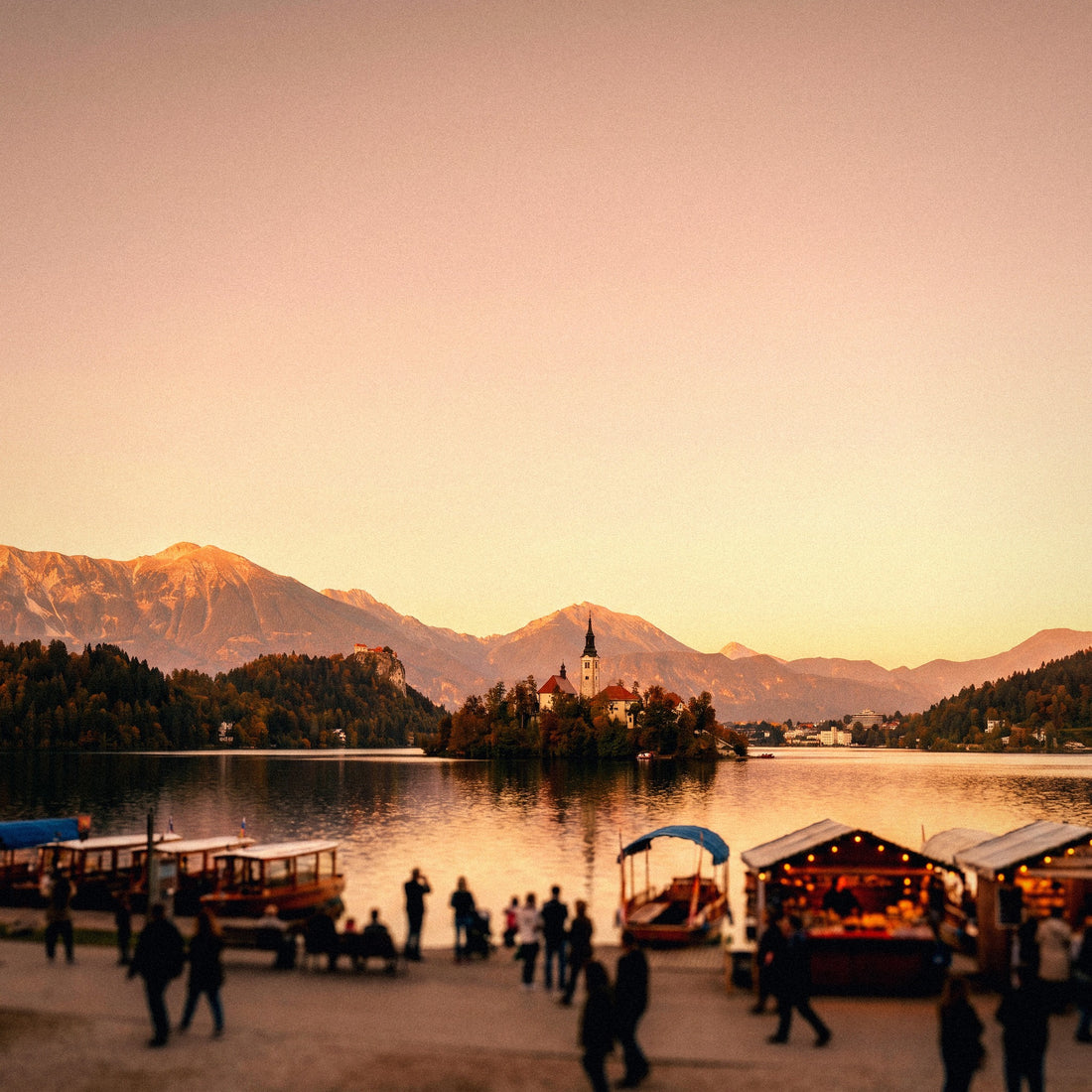
Honest counterpoint: Slovenia is a destination for wild photos. Bled with the church on the island, the turquoise of the Soča, the rooftops of Piran from the walls… you're going to shoot a lot. But taking photos doesn't consume data: uploading them does. And that's something you control, not the country.
A typical day on the classic route, megabyte by megabyte
To avoid being purely theoretical, I've broken down a real day of the most common route: morning in Bled, afternoon in Bohinj, return to accommodation. An active day, with a car, photos, and contact with home.
| Time of day | What you do | Data |
|---|---|---|
| Breakfast | Checking mountain weather, email, news | 15 MB |
| Car journey (45 min) | Navigation + music streaming | 70 MB |
| Morning at the lake | Checking pletna boat schedules, some quick searches | 25 MB |
| Lunch | Finding a restaurant, reading reviews, sending 5 photos via WhatsApp | 60 MB |
| Afternoon in Bohinj | Trail walking with phone in pocket, little to no signal | 5 MB |
| Return journey by car | Navigation + podcast | 60 MB |
| Evening (via hotel Wi-Fi) | Photo backup, series, video call home | 0 MB from your plan |
| Daily Total | Normal usage, no intensive social media | ~235 MB |
There you have it: about 235 MB on a full, busy day. Multiply that by seven, and you get 1.6 GB for a week. Even if you go over by 50%, you're still under 2.5 GB. Now, add an hour of Instagram and TikTok daily outside of Wi-Fi, and that same day will go up to 900 MB or 1 GB: four times as much, without having changed country or itinerary.
The destination sets the floor for consumption; your habits set the ceiling. In Slovenia, the floor is very low, so the question isn't "how much does Slovenia consume?", but "how much do I consume when I don't have Wi-Fi in front of me?".
That's why the same trip allows for two completely different answers. Choose yours from the table below.
The master table: GB by profile and duration
This is the table that really matters. It's calculated with the consumption figures above, assuming you sleep in places with Wi-Fi (which is normal in Slovenia) and do large downloads when connected to it. If you're camping or sleeping in a campervan for several nights, move up one level.
| Traveler Profile | 5 days | 10 days | 15 days | 30 days |
|---|---|---|---|---|
| Map and WhatsApp tourist | 1 GB | 2–3 GB | 4 GB | 8 GB |
| Photos and social media | 3 GB | 5–6 GB | 8–10 GB | 15–20 GB |
| Digital nomad / teleworker | 8–10 GB | 15–20 GB | 25–30 GB | 50 GB or unlimited |
| Family sharing a hotspot | 5 GB | 10 GB | 15 GB | 25–30 GB |
Three nuances for reading it correctly:
- The map and WhatsApp tourist is most people, though almost no one places themselves in that category. If your plan is to drive, hike, eat well, and send photos to your family at night, that's you.
- Sharing data multiplies, but not as much as it seems. Two people in the same car look at the same map on a single phone. In a family, what drives consumption up is children watching videos in the back seat: download their cartoons before leaving, and you'll save several gigabytes.
- Remote work is a different sport. Video calls consume between 300 and 700 MB per hour; two daily meetings are over 1 GB each day. If you're going to work from Ljubljana, calculate by meetings, not by days.
And something not often said: if a 3 GB plan and a 5 GB plan are only two euros apart, take the 5 GB plan and sleep soundly. The figures in this table are to avoid buying 20 GB, not to fine-tune with 500 MB. If you want the details of what can be contracted for the country, you can find it in the eSIM Slovenia guide.
If you combine with Croatia, Austria, Italy… or Bosnia
Almost no one goes only to Slovenia. It's common to combine it with Croatia, go up to Austria through the Alps, or enter Italy via Trieste, which is less than an hour from Piran. Good news: Croatia, Austria, and Italy are also in the European Union, so both your European plan and a regional EU data plan will work in all four countries without any changes.
The exception is Bosnia and Herzegovina, which is not part of the European Union nor included in "roam like at home". If your route goes down to Mostar or Sarajevo, your Spanish plan might charge you very different international roaming rates there, and a plan designed only for the EU probably won't work. The same applies to Serbia, Montenegro, North Macedonia, and Albania. Before crossing, check two things: what your operator charges outside the EU and whether your data plan covers that specific country.
| Travel Country | In the EU? | What to do with data |
|---|---|---|
| Slovenia | Yes | Your EU plan works; optional plan |
| Croatia, Austria, Italy, Hungary | Yes | Same plan, no changes |
| Bosnia and Herzegovina | No | Check plan or a plan that includes it |
| Serbia, Montenegro, North Macedonia | No | Check plan or a plan that includes them |
A practical detail that almost no one mentions: near borders, your phone might connect to a tower on the other side without you realizing it. This is called accidental roaming, and in the Bosnia area, it can be expensive. If you're going to be close to a non-EU border, set network selection to manual or deactivate data for a while. It's thirty seconds of precaution.
How to know your real consumption before leaving home
Everything above is an average. Your exact number is already in your pocket and costs nothing to check. It's the most useful advice in this entire guide.
On Android: Settings → Network & internet → Internet → the gear icon for your SIM → App data usage. You'll see the current billing cycle's usage and can change the date range to see full months.
On iPhone: Settings → Cellular. At the very bottom, you'll find "Reset Statistics"; if you've never done it, the accumulated number won't be useful, so reset it today and check it in a week. You can also consult your monthly usage in your operator's customer area, which is usually more reliable.
With that data, the calculation is simple:
- Take your consumption for a full month and divide it by 30 to get your daily average.
- Multiply it by the number of travel days.
- Subtract 20%: on a trip, you spend more hours away from home, yes, but also more hours on hotel Wi-Fi and many more not looking at your phone.
- Add 300 or 400 MB as a buffer for maps, unexpected situations, and that video call you weren't expecting.
Real example: if you use 6 GB per month, your average is 200 MB per day. For ten days in Slovenia, that's 2 GB; minus 20% is 1.6 GB; plus the buffer, it's a bit over 2 GB. This almost exactly matches the table. When your own calculation and the average coincide, you can buy without fear.
How to stretch your data on a trip to Slovenia
With four adjustments made before leaving home, the same trip will cost you half the gigabytes. These are the ones that really move the needle:
- Download the offline map of the entire country. All of Slovenia fits into a Google Maps or Organic Maps download; do it over Wi-Fi before you leave, and navigation will consume a fraction of your data. This is the most impactful trick for a road trip.
- Turn off automatic backups. Google Photos and iCloud uploading every photo as you take it is the silent killer of any data plan, and in Slovenia, you're going to take hundreds. Set it to "Wi-Fi only" and double-check it, because sometimes it reactivates itself.
- Activate data saver mode on your device and for Instagram, TikTok, and YouTube. Disable auto-play video and set quality to standard.
- Download entertainment for the car. Playlists, podcasts, and if you're traveling with kids, their videos. The journeys are short, but mountain roads can feel long.
- Leverage Wi-Fi for heavy tasks: app updates, series, uploading your Soča video to your profile. Slovenian accommodations usually have good connections.
- Buy the highway vignette in advance or via Wi-Fi. It's a quick online process, but it's better to have it done at your leisure than struggling with the website at a gas station.
With these tips, an average traveler can reduce daily data usage from 400 MB to 200 MB without sacrificing anything. The long list, with specific settings for each application, is in the guide on how to save data while traveling. Half an hour of preparation on the couch is worth more than any extra gigabyte package.
What happens if you run out (and why it's not a big deal)
Many people buy too much out of fear of getting stranded. Let's debunk that, because in Slovenia, that fear makes little sense.
If you run out of data, you simply stop browsing. There are no surprise bills or hidden charges with a prepaid plan: it runs out, and that's it. And you're in a country with Wi-Fi in virtually any cafe, hotel, or restaurant, so in five minutes you'll be connected again to top up or find what you need. Compare that to running out of data in the middle of the desert: it's not the same scenario.
Topping up takes minutes; the money from a large, unused package does not come back. Unused gigabytes expire with the plan, they don't carry over to the next trip. That's why my recommendation is always the same: buy a conservative amount and top up if necessary.
Three things that are worth preparing:
- A usage alert. Set an alert when you reach 80% of your data: on Android, it's in the same data usage menu, and on iPhone, you can check it manually every couple of days.
- Know how to top up without data. Be clear where to top up and do it from your accommodation's Wi-Fi. Ten minutes, and it's resolved.
- The offline map downloaded, which, in addition to saving data, is your safety net: even if you run out completely, you still know how to get back to the hotel.
Running out of data in Slovenia is a five-minute inconvenience. Buying too much is a guaranteed waste of money. Between those two mistakes, I choose the cheap one without hesitation.
Frequently Asked Questions
How many GB do I need for 7 days in Slovenia?
2 GB is more than enough for a normal traveler for seven days. Maps, WhatsApp, searching for restaurants, and a few occasional searches add up to about 235 MB per day, and you spend your nights on the accommodation's Wi-Fi. If you post stories daily, it goes up to 3 or 4 GB.
Do I need to buy data if I have a Spanish plan?
Probably not. Slovenia is in the European Union, and your Spanish plan works there at no extra cost due to EU roaming regulations. Only buy separate data if your plan has a low international data cap, if your operator is not European, or if you plan to cross into Bosnia.
Is there coverage at Lake Bled and in the Julian Alps?
In Bled, Bohinj, and the valley towns, coverage is good. Slovenia has a solid 4G and 5G network even in mountain areas. You will lose signal inside the Postojna and Škocjan caves, in gorges like Vintgar, and on sections of the high mountain trails of Triglav. Have the map downloaded.
Is there free Wi-Fi in Slovenia?
Yes, and it's good. Hotels, apartments, rural houses, Ljubljana cafes, and coastal restaurants usually offer free Wi-Fi. This is the main reason you need fewer gigabytes here than in other destinations: all the heavy lifting is done while connected.
What happens to my data if I cross into Bosnia from Croatia?
Bosnia and Herzegovina is not in the European Union, so free roaming does not apply. Your operator may charge you international rates, and a plan designed for the EU may not work there. Check before crossing and be careful about accidentally connecting to Bosnian antennas near the border.
How many GB do I need to telework from Ljubljana?
Estimate 15 to 20 GB for ten days. Video calls are what drive up data usage: between 300 and 700 MB per hour. If you're going to work from cafes and co-working spaces with decent Wi-Fi, you can reduce it to 8 or 10 GB by using data only as a backup.
Can I top up if I run out of gigabytes halfway through the trip?
Yes, and it takes minutes from any Wi-Fi. That's why it's better to buy a conservative amount instead of over-inflating the package: unused gigabytes expire and are not refunded, while topping up only requires a momentary connection. If you've never used this technology, start with what an eSIM is and how it works.
Do the Postojna Caves consume data?
Zero, because there's no signal underground. The visit lasts about an hour and a half between the train and the walking tour, and during that entire time, your mobile consumes nothing. It's a good example of why the Slovenian itinerary is so forgiving for small plans: a good part of the trip takes place where there's nothing to spend data on.
Conclusion
To summarize bluntly: for a week in Slovenia, 2 GB; for ten days, 3 GB; and only those who telework or travel with family with in-car video go over 10 GB. It's a small country, with short stages, generous Wi-Fi, and half the itinerary underground or in the mountains without coverage. Buying 20 GB for a trip from Ljubljana to Piran is throwing money away.
And I repeat what's important, even if it goes against my interest: if you have a European Union plan and are not going outside Slovenia, Croatia, Austria, or Italy, you most likely don't need to buy anything. Just check your plan's international data cap. If that cap is low, if your operator is not European, or if your route goes into Bosnia, then it's worth having your own plan: our eSIM for Slovenia activates before you leave home and lets you choose the exact size you've calculated here, with no surprises or extra gigabytes you'll never use.