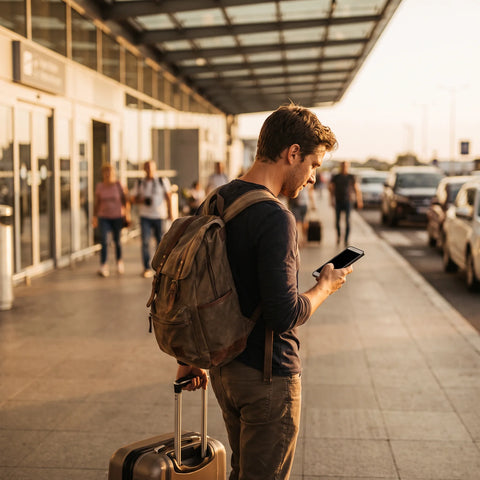
Every week someone asks me how many GB they need for France, and I almost always end up giving them the same awkward answer: you might not need to buy anything. France is in the European Union, so if you have a Spanish plan with data included, EU roaming already covers you from the moment you land. Even so, this article still makes sense in three very specific situations: you want to know how much you'll actually spend so you don't hit your plan's cap, you have a cheap plan without a decent European bonus, or you're traveling from outside the EU and you definitely need data. Let's look at the numbers.
The short answer, no beating around the bush
For 10 days in France, most people will be fine with 5 GB, and with 2 GB if you only use maps and WhatsApp. Honest warning: France is in the EU, so your Spanish plan already covers you via roaming. This is useful for calculating consumption, for plans without an EU bonus, and for travelers from outside the EU.
That's the number I use and the one I give to everyone who asks me. And I give it with a clear conscience because France, in terms of data consumption, is an easy destination: you talk on your phone without a camera translator glued to your face, public transport works with light apps, maps can be downloaded without problems, and hotel, café, and museum Wi-Fi is reasonably good.
What drives the number up isn't the country, it's you. If you go to Paris for five days and upload three stories a day, a couple of reels, and share photos via WhatsApp, you'll be around 2.5-3 GB. If you go on a fifteen-day road trip with Google Maps on for four hours a day and Spotify in the background, it goes up to 6-8 GB. And if you work remotely from an apartment in Lyon, forget all the above: we're talking tens of gigabytes.
Before deciding anything, I recommend you check out my general guide on how much data you need for travel, which is the framework from which all these calculations originate. Here, I apply it to France with the specific factors that truly move the needle: the Paris Metro, road trip kilometers, and family video.
Before buying: check if your plan already covers you
I will insist on this because I think it's the honest thing to do. Since 2017, "Roam Like At Home" has been in effect: your Spanish operator must allow you to use your plan in France as you would at home, without surcharges. If you have 30 GB in Spain, in principle you have 30 GB in Marseille. Period. There's nothing to buy, nothing to activate, and nothing to configure.
The nuance lies in the fair use policy. European regulations allow operators to set a data cap for roaming when the plan is very cheap relative to what it offers. The indicative formula is simple: divide the monthly price of your plan (excluding VAT) by the regulated wholesale price per gigabyte, and that gives you the volume you are obliged to have available abroad. With plans costing €10-15 per month, this cap usually remains at a few gigabytes, well below your national allowance. And if you exceed it, they start charging you a supplement per gigabyte.
Translated: check the fine print of your plan before traveling, not the large allowance on the front page. Look for "EU data limit" or "fair use" in your customer area. If it says 3 GB and you're going on a fifteen-day road trip, you have a small but real problem.
If you prefer to understand all connection options before looking at the numbers, I explain it calmly in internet in France. Here we continue with gigabytes.
How much each activity actually consumes
This is the table you should look at before buying anything. These are real average figures, not brochure promises: they vary depending on video quality, your phone screen, and whether you're on 5G (which, be aware, tends to serve you higher quality and therefore consume more).
| Activity | Approximate Consumption | Note for France |
|---|---|---|
| Google Maps, normal navigation | 3-5 MB/hour | With live traffic, it goes up to 7-10 MB/h |
| Google Maps in satellite view | 15-20 MB/hour | Avoid it; it doesn't add anything in the city |
| Offline downloaded maps | 0 MB | Download them at the hotel, for free |
| WhatsApp (text, audio, single photos) | 3-8 MB/day | Practically irrelevant |
| WhatsApp or FaceTime video call | 300-500 MB/hour | The biggest silent data hog |
| Instagram or TikTok, feed and stories | 100-150 MB/hour | With reels and video, up to 1 GB/hour |
| Uploading photos (20 photos) | 60-100 MB | 3-5 MB per photo from a modern phone |
| Uploading a 1-minute reel or video | 30-60 MB | Upload them via hotel Wi-Fi |
| Spotify, high quality | 60-75 MB/hour | In lossless, it skyrockets to ~600 MB/h |
| YouTube or Netflix in SD | 500 MB-1 GB/hour | In HD, 1.5-3 GB/hour |
| Email, web browsing, finding a restaurant | 10-25 MB/hour | Background noise |
Notice something: navigating with maps is extremely cheap, and video is everything. One hour of reels is equivalent to two hundred hours of Google Maps navigation. If you want the long breakdown, with more apps and scenarios, I have it in the mobile data usage statistics by activity.
How many GB based on your profile and number of days
This is the heart of the article. Find your profile, cross-reference it with the number of days you're staying, and you'll have your number. These figures assume you're sleeping somewhere with Wi-Fi and uploading large photos and backups there, which is normal in France.
| Traveler Profile | 5 days | 10 days | 15 days | 30 days |
|---|---|---|---|---|
| Tourist with maps and WhatsApp | 1 GB | 2 GB | 3 GB | 5 GB |
| Photos and social media (most common) | 3 GB | 5 GB | 8 GB | 15 GB |
| Video, reels, and unlimited streaming | 5 GB | 10 GB | 15 GB | 30 GB |
| Sharing family (2 adults + 2 children) | 8 GB | 15 GB | 20 GB | 40 GB |
| Digital nomad / remote work | 10 GB | 20 GB | 30 GB | 50 GB or unlimited |
Two notes about this table. First: the "sharing family" profile assumes one mobile acts as a router for the others, which is what always ends up happening. If everyone uses their own data, divide and apply each individual's profile.
Second: if you're going to France for work, don't try to save. A one-hour team video call a day is 10 GB over twenty working days just for that, not counting Drive, Slack, or downloads. It pays to have plenty of data, because the cost of being stranded in the middle of a meeting is much greater than that of an extra gigabyte.
Paris is explored with a phone in hand
This is the first French peculiarity that changes the number, and everyone underestimates it. Paris is not walked: it's navigated. Metro, RER, impossible transfers at Châtelet, night buses, Vélib, VTC. Between the RATP app, Citymapper, or Google Maps, you'll have your phone on for a good part of the day.
The good news is that it costs very little: we're talking 5-10 MB a day for transport inquiries, even if you check them forty times. The expensive part isn't looking at the metro map; it's what you do while you wait. And in Paris, you wait a lot: lines at the Louvre, Orsay, Eiffel Tower, Sainte-Chapelle. Twenty minutes in line means twenty minutes of scrolling, and that's where the real megabytes go.
Add to that the fact that almost all Parisian metro lines now have 4G coverage underground, so there's no "forced data break" as in other cities: you can also consume data during your commutes. And add that Paris is one of the destinations where the most photos are taken per day of travel.
My estimate for a typical day in Paris, walking and by metro, with photos and some social media: between 250 and 400 MB daily. Five full days in the capital rarely exceed 2 GB if you don't get hooked on long videos. With 3 GB, you'll be relaxed and have plenty of room for unforeseen events.
Road trip: Provence, Brittany, and the Loire
The second major French pattern is driving. France is a country meant for driving: the Loire castles, the route through the villages of Provence, the Brittany coast, picturesque Alsace, the Landes. And there, consumption patterns change significantly.
Contrary to what many people believe, navigation itself is cheap: four hours of Google Maps is 12-20 MB, nothing. The problem with a road trip is the hours. Four hours in the car means four hours of music streaming (240-300 MB if you're on high quality), four hours of a co-pilot scrolling (easily 400-600 MB), and four hours of kids in the back watching videos if you're traveling with family (that's already gigabytes).
My rule of thumb: on a road trip, budget by travel hours, not by kilometers. Each hour in the car with music and a bored co-pilot costs about 150 MB. Multiply that by your hours behind the wheel and you'll have the real number.
There's one helpful detail: on secondary roads in rural areas, valleys, and mountains, coverage isn't always perfect, especially inland. In practice, this saves you data unintentionally, because your phone simply can't consume it. But it also means you should download your route offline before you leave, or you'll be staring at a gray screen in the middle of the Périgord.
For a 10-day road trip through France, with two people and background music, my figure is 6-8 GB per main mobile device.
Alps, skiing, and Disneyland Paris
Two very specific French scenarios, and curiously opposite. I'll start with skiing. In the Alps, coverage on slopes and in high valleys is patchy: it works well at the resort and in the village, but there are gaps between lifts, forests, and north faces. This limits consumption by necessity. However, a lot of photos and videos are taken, and as soon as you regain signal on the refuge terrace, all of that gets uploaded at once.
Disneyland Paris is the opposite: good coverage, entire families recording all day long, two or three phones sharing, park app maps, live wait times, and kids watching videos in line. It's the scenario that burns the most gigabytes in all of France.
| French Scenario | Consumption per day | Why |
|---|---|---|
| Paris on foot and by metro | 250-400 MB | Cheap maps, lots of scrolling in queues |
| Loire / Provence road trip | 300-500 MB | Music and co-pilot for hours |
| Skiing in the Alps | 400-700 MB | Video and photos uploaded in bursts |
| Disneyland Paris with family | 800 MB-1.5 GB | Multiple phones, continuous video, queues |
| Remote work from Lyon or Bordeaux | 1.5-3 GB | Video calls and cloud all day |
If your trip mixes scenarios (three days in Paris, four in the Alps), add up by segment instead of applying an average. You'll get a much more accurate number than multiplying days by a generic figure.
French Wi-Fi works in your favor
One of the reasons France needs fewer gigabytes than, for example, a van trip in Iceland or a rural trip in Asia, is simple: Wi-Fi is abundant and decent. And every hour you spend connected to Wi-Fi is an hour that doesn't count against your data allowance.
Where you'll find real Wi-Fi in France:
- Hotels and apartments: practically 100% include it, and in the city, it usually works well. This is your time for backups, uploading photos, and updating apps.
- Cafés and brasseries: very widespread, although sometimes they ask you to make a purchase. In Paris, it's almost the norm.
- Museums and major stations: Louvre, Orsay, Gare du Nord, Gare de Lyon, and airports have free public Wi-Fi.
- TGV INOUI trains: there's free on-board Wi-Fi, although quality depends on the section. It works for messaging and email; for video, forget it.
- Town halls and squares: many cities have municipal Wi-Fi in the historic center.
Now, the serious warning: don't do anything sensitive on public Wi-Fi. No banking, no entering card details, no accessing work email without a VPN. And if you use a VPN, expect 5-15% more consumption when it's active on mobile data.
With reasonable use of accommodation Wi-Fi, my experience is that you save between 30% and 40% of your total trip consumption. That's exactly what separates buying 5 GB from buying 10.
How to calculate YOUR consumption before you leave
All of the above are averages. Your actual number is in your pocket, and it takes two minutes to find it. This is the most useful advice in this article, and I'm not making it up: your own phone tells you.
On iPhone: Settings → Mobile Data. Scroll down to see the total for the period. The trick is to reset the statistics at the beginning of a month so the number means something, because by default it accumulates from who knows when.
On Android: Settings → Network & internet → Data usage (or SIM → Data usage). There you'll see the current cycle's consumption, and if you tap the graph, the breakdown app by app.
With that data, do the math:
- Divide your monthly consumption by 30. That's your daily expenditure at home.
- Multiply it by the number of travel days.
- Subtract 30-40% if you're staying somewhere with Wi-Fi every night.
- Add 20-30% if you're someone who records a lot and shares instantly.
Real example: if you use 12 GB a month in Spain, that's 400 MB a day. Ten days in France would be 4 GB gross, minus a third for hotel Wi-Fi, plus a bit for travel photos: 3-4 GB. There's your number, much better than any average.
A note: at home, you consume more than you think, because you have Wi-Fi at work and at home. If your monthly mobile data consumption is very low, it's not that you spend little, it's that you're almost never out of Wi-Fi coverage. When traveling, that proportion is reversed.
Ten ways to make your gigabytes last
If you're still cutting it close, these measures will halve your consumption without you noticing any sacrifice. I apply them every time I travel.
- Download offline maps before leaving the hotel. Google Maps lets you download the Paris area, Provence, or an entire region. On-route consumption: zero.
- Lower video quality to 480p on YouTube and enable "data saver" on Netflix. You go from 1.5 GB/hour to 300 MB/hour.
- Disable autoplay on Instagram, TikTok, X, and Facebook. It's the biggest invisible data thief.
- Wi-Fi only backups: iCloud, Google Photos, and OneDrive. Check this before you leave, because they upload as soon as they detect a network.
- Activate your system's Data Saver Mode (iOS and Android have it) and Chrome's.
- Download music and podcasts for car or train journeys. An offline playlist saves you 300 MB per trip.
- Block app updates over mobile data. A single update can be up to 200 MB.
- Upload photos and reels at night, using your accommodation's Wi-Fi, not on the fly from the street.
- Use audio calls instead of video calls when possible: 15 MB/hour vs. 400 MB/hour.
- Check your data usage every two days in settings to correct in time, not on the last day.
I have an entire article dedicated to this, with more tips and step-by-step screenshots: how to save mobile data while traveling. With half of these measures, you'll already notice the difference; there's no need to become a digital monk.
What happens if you run out
Let me tell you clearly: it's much better to run out than to have too much. And in France, even more so, because you're in the EU and have options everywhere.
If you run out of data, you won't be incommunicado. You'll still have Wi-Fi at the hotel, in cafes, and at the station. You'll still be able to call and send SMS with your Spanish line. And if you have data purchased separately, topping up is a matter of a minute from any Wi-Fi: buy another package and continue. What you can't do is get a refund for the gigabytes you didn't use.
Real-life numbers make it clear. Buying 10 GB when you were only going to use 4 is wasting more than half the cost. Buying 3 GB and topping up 2 more halfway through your trip is almost always cheaper, and you'll know your actual consumption rate when you do it.
That's why my standard advice is: buy for the probable scenario, not the worst-case scenario. Add a 20% buffer and nothing more. If your trip gets complicated, top up. If not, you've paid just the right amount.
And if all this talk of buying separate data sounds like Greek to you because you've never done it, start by understanding the technology in what an eSIM is and then look at the specific options for the country in my guide to eSIM for France. It's ten minutes of reading that will save you the shock of a roaming bill outside the EU.
Frequently Asked Questions
The most common questions I get about data in France, answered without beating around the bush and with the numbers right in front of you.
Do I need to buy data if I travel to France from Spain?
No, unless your plan has a low roaming cap in the EU. France is in the European Union, and your Spanish operator should let you use your data there without extra charges. Check your client area for the fair use policy limit: with cheaper plans, it might be just a few gigabytes, and after that, you'll be charged a supplement per gigabyte.
How many GB do I need for a weekend in Paris?
1 GB is more than enough for three days. A full day in Paris with metro, maps, photos, and a bit of social media averages around 250-400 MB. If you sleep in a hotel with Wi-Fi and upload photos at night, three days will total 700-900 MB. It only skyrockets if you watch long videos while queuing at museums.
How many gigabytes does a week of skiing in the Alps use?
Estimate 3-4 GB for seven days. On the slopes, you use little data because coverage is spotty in valleys and on lifts, but you record a lot of video, and all that uploads as soon as you regain signal. If you stay in an apartment with Wi-Fi and upload your daily material there, you can easily reduce it to 2 GB.
And for Disneyland Paris with kids?
Between 800 MB and 1.5 GB per day for the whole family. This is the most data-intensive scenario in France: several phones at once, the park app checking wait times, continuous video, and kids entertained in queues. For three days at the park, budget 4-5 GB if you share a connection from a single phone.
Does Google Maps use a lot of data on a road trip through France?
Very little: 3-5 MB per hour of navigation. Four hours of driving is barely 20 MB. What uses data on a road trip is everything else: streaming music (60-75 MB/hour), the co-pilot scrolling, and video in the back seats. Download offline maps anyway, because there are rural stretches with weak coverage.
How do I know how much data I actually use?
Check your phone settings and extrapolate. On iPhone, Settings → Mobile Data; on Android, Settings → Network & internet → Data usage. Divide your monthly consumption by 30, multiply by the number of travel days, and subtract 30-40% if you'll be sleeping with Wi-Fi every night. That number is worth more than any average.
Is there good Wi-Fi in France to rely less on data?
Yes, and it saves you 30-40% of your trip's consumption. Hotels and apartments almost always include it, cafes widely offer it, museums and large stations provide public networks, and TGV INOUI trains have onboard Wi-Fi. Use it for backups and uploading photos, but never for banking or sensitive data without a VPN.
What do I do if I run out of data halfway through my trip?
You can top up from any Wi-Fi in a minute. You won't be incommunicado: you'll still have Wi-Fi at your accommodation and calls/SMS with your line. That's why it's best to buy for probable consumption plus a 20% margin, rather than paying upfront for gigabytes you probably won't use.
Conclusion
Here's what I'd tell a friend going to France next week. First: check your plan, because France is in the EU, and you're most likely already covered without spending a dime. Second: if your plan has a low roaming cap, or you're coming from outside the EU, the reference figure is 5 GB for 10 days, 2 GB if you only use maps and WhatsApp, and 15 GB if you're traveling as a family sharing a connection.
Third, and this is what saves you the most money: buy conservatively and top up if needed. With the Wi-Fi available in French hotels and downloaded maps, almost everyone uses less than they feared.
If you need to buy separate data, here's the option for France with activation in two minutes and no physical card: PuraSIM eSIM for France. Choose the size with this guide in mind, not at random, and you'll arrive in Paris paying exactly what you need.