Bhutan is the trickiest destination to organize in all of Asia: you pay a fee for each night, and a good part of the trip includes a licensed guide. Amidst all that, the question about mobile connectivity always comes up: how does internet in Bhutan work, do I need to buy anything, or is it already included? I’ll tell you straight: what options are available, how much they cost, where there's coverage, and what to ask your agency before spending a single euro so you don't pay twice for the same thing.
What the internet in Bhutan is really like
In Bhutan, you have four ways to connect: roaming (very expensive, as the country is outside the European Union), hotel Wi-Fi (free but inconsistent), a local SIM from B-Mobile or TashiCell (very cheap, requires passport), and a travel eSIM (activated before flying). All use the same two networks in the country.
Bhutan is not a digital black hole. There are only two mobile operators: Bhutan Telecom (B-Mobile brand), which is public and holds about 70% of the market, and TashiCell, private, with the remaining 30%. Between them, they provide 4G to all inhabited valleys, with average download speeds of 21.7 and 23.7 Mbps, respectively—more than enough for maps, WhatsApp, and video calls from Thimphu.
The nuance is geographical: the country is a succession of deep valleys separated by passes over 3,000 meters high, and the signal lives at the bottom of the valley. As soon as you go up to a pass, it disappears. So the question isn't "will I have internet?", but "where exactly will I have it?".
| Option | Estimated Cost (1 week) | Advantage | Disadvantage |
|---|---|---|---|
| Roaming with Spanish operator | From €25 with a bundle; €6–12/MB without a bundle | Zero hassle, same number | Highest risk of bill shock |
| Hotel Wi-Fi | €0, included in accommodation | Available in almost every hotel | Inconsistent and nonexistent outside the building |
| Local Bhutanese SIM | BTN 100–500 (approx. €1–5) | By far the cheapest option | Passport, cash, and SIM card change |
| Travel eSIM | Varies by data and days (check the details) | Activated before leaving home | More expensive than local SIM |
The SDF fee and the guide: ask before you buy anything
This section can save you the most money. Bhutan charges a Sustainable Development Fee (SDF) of $100 per adult per night: the reduced rate approved in September 2023—previously $200—valid until August 31, 2027. Children aged 6 to 12 pay $50, and those under 6 are exempt. This is separate from flights, hotels, and guides.
That's the key. Since the trip is usually organized with an authorized operator, and because a licensed Bhutanese guide is required to enter dzongs, monasteries, and museums—including Tiger's Nest—and to travel beyond Paro and Thimphu, many packages already include extras that no one details in writing. Among these, frequently, is connectivity:
- Some operators buy and activate the local SIM for you or accompany you to the counter on the first day.
- Others have Wi-Fi in the vehicle during the tour.
- The guide and driver are connected daily: there's always an emergency channel.
- Hotels on the circuit include Wi-Fi in the rate.
Before buying data on your own, write to your agency: "Does the package include a local SIM, in-vehicle Wi-Fi, or any type of connection?" The answer changes what you should contract.
Don't take anything for granted. If it's included, save your money; if they say no or respond evasively, buy it yourself and arrive with the issue resolved.
Roaming with your Spanish operator: convenient and very expensive
Bhutan is light years away from "roaming like at home": that rule only applies in the European Union. In the tables of Movistar, Vodafone, or Orange, the country falls into Zone 3 or "Rest of the world", where the most aggressive prices reside.
Without a contracted bundle, standard rates hover around €6/MB and reach €12/MB with some operators. Per megabyte, not per gigabyte: uploading three photos of Tiger's Nest could cost you more than that night's hotel. International bundles cushion the blow, but they come with fine print. The good ones offer about 20 GB for €25 for 7 days; the bad ones, things like 150 MB for €60.
- Check the exact zone for Bhutan on your operator's website; some don't even list it.
- Activate your roaming spending limit if allowed.
- Turn off mobile data before landing in Paro if you haven't contracted anything.
- Be careful near the Indian border: close to Phuentsholing, your phone might connect to an Indian network without warning.
That last point happens more often than it seems if you enter overland from Jaigaon: you change countries without changing your rate plan. The breakdown by operator can be found in how much international roaming costs and a head-to-head comparison in eSIM versus roaming. To summarize: leaving your Spanish SIM loose in Bhutan is the most expensive way to look at a map.
Hotel Wi-Fi, public Wi-Fi, and pocket Wi-Fi
Almost all hotels on the tourist circuit have Wi-Fi and do not charge extra for it. How well it works is another matter. In high-end accommodations in Thimphu and Paro, browsing is generally good, with 5–20 Mbps, sufficient for video calls. In three-star properties, speeds fluctuate depending on the time, and in homestays in rural valleys, you might get below 2 Mbps, which is only good for text messages and little else.
Public Wi-Fi, on the other hand, is almost non-existent: there's some in cafes in Thimphu and at Paro airport, and that's about it. The times when you would really need to be connected are precisely when there isn't even an antenna nearby:
- The road trip between Paro, Thimphu, and Punakha, with the Dochula Pass in between.
- The climb to Taktsang, the Tiger's Nest, when you want to announce you're running late.
- The weekend markets, if you need to translate or check the exchange rate.
- Any health or flight emergency away from the hotel.
And what about rented pocket Wi-Fi? In Bhutan, almost no one offers it to tourists, and when it appears, it's via a tour operator: you pay for an extra device with a deposit to do what your phone already does, and it still relies on the same two networks. I compare it in eSIM vs. pocket Wi-Fi. My conclusion: hotel Wi-Fi is a good nightly complement, never the main plan.
Local Bhutanese SIM: B-Mobile and TashiCell, with passport
If you only look at the price, there's no debate here. A B-Mobile card starts at about 100 ngultrum (around €1) and a TashiCell card at about 200 BTN. Data packages are around 99 BTN for 1 GB or 299 BTN for 5 GB, roughly €3. Choosing an operator is simple: B-Mobile, the state network, is the most widespread in remote valleys and in the east; TashiCell is slightly faster on average and was the first to switch on 5G in December 2021, starting with Thimphu, Paro, and Phuentsholing.
What's not on the label are the costs not paid in money. Bhutan requires each line to be registered with an identification document, so you must submit your original passport and sometimes a passport photo. There is no anonymous card: any card offered activated on the street is in someone else's name and can be cut off. The natural point of purchase is Paro airport, with counters for both operators in arrivals.
- Bring cash in ngultrum; card payment is not always an option.
- Activation takes between 5 and 30 minutes, and your guide will be waiting outside.
- If you enter overland via Phuentsholing, you'll need to find an official store in the city.
- Ask them to confirm GB and days on screen before you leave.
The long analysis is in eSIM vs. local SIM. For long, leisurely trips, the Bhutanese card is unbeatable in terms of data-to-price ratio.
The eSIM: my recommendation for most people
An eSIM is a digital card that is downloaded to your mobile. There's no plastic, no tray, no clip, no counter: you buy the plan, scan a QR code, a profile is installed, and upon landing in Paro, your phone automatically connects to the Bhutanese network. Your Spanish number remains active on the physical card, so you receive bank SMS messages while browsing with local data. I explain it without jargon in what an eSIM is.
An honest note: not all countries support it well for visitors, so check the website to ensure the destination is listed as available before paying. Bhutan does support it, and it relies on the same B-Mobile and TashiCell antennas. What changes is not the network, but everything else:
- No queues at arrivals or guides waiting on the first day.
- No handing over your passport or having photocopies circulating.
- No cash: you pay from home, in euros and by card.
- No touching your Spanish SIM or risking losing it.
The downside also needs to be mentioned: in such a small country with such low volume, digital plans cost significantly more than the three euros of a local card. Here you're not buying cheap data, you're buying time and peace of mind. Details on plans and days are in the eSIM guide for Bhutan, and for me, the decisive advantage is landing with your phone already working.
Coverage by areas: Paro, Thimphu, Punakha and the treks
Whatever you choose, everything relies on the same two networks. This is what you'll find, valley by valley.
Thimphu: the best coverage in the country. Solid 4G throughout the capital and 5G in a good part of the city; video calls and photo uploads without a problem. Paro: very good, both in the town and at the airport and on the valley road. Punakha: good at the bottom of the valley, at the dzong and in the accommodations by the river, a bit weaker on the hillsides.
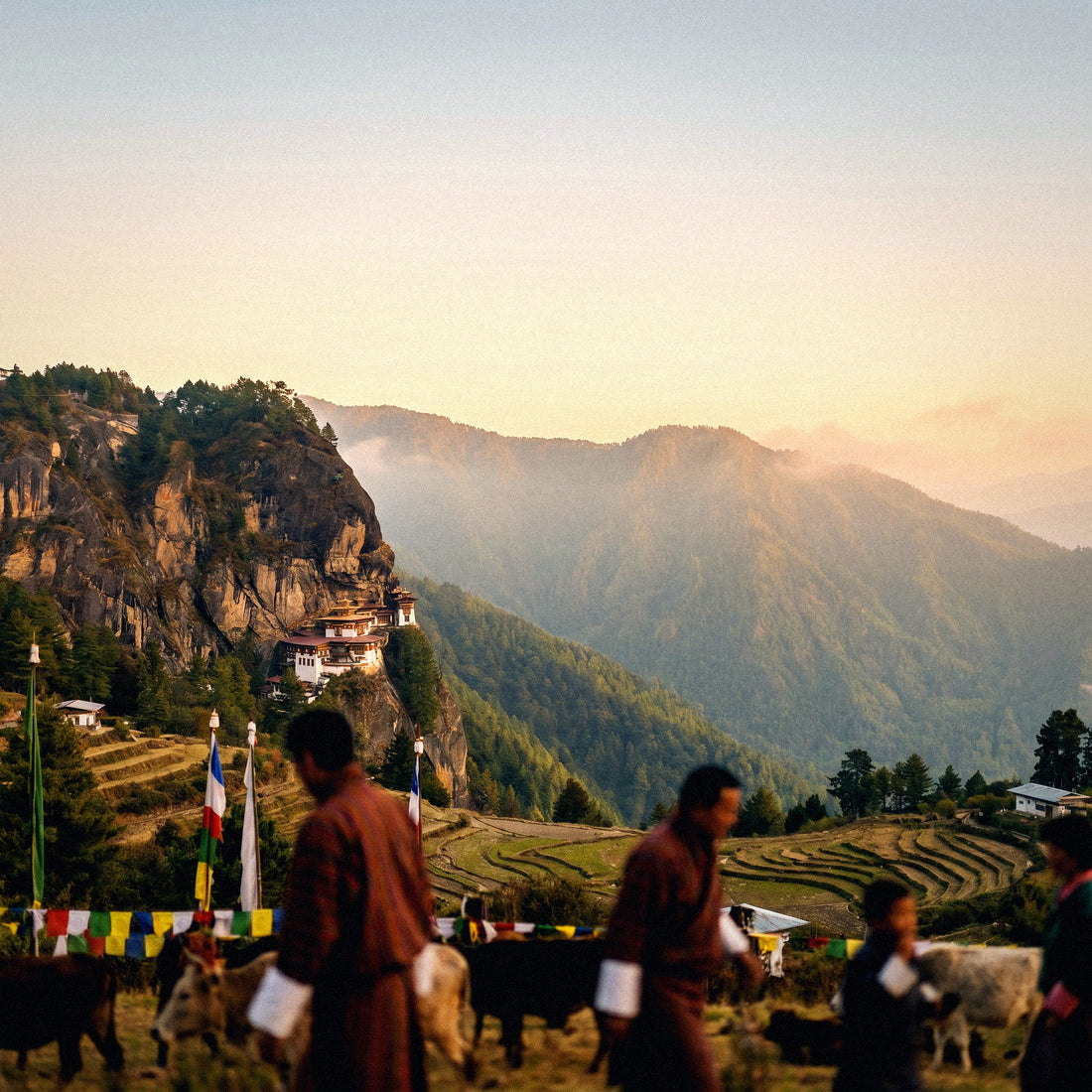
Tiger's Nest (Taktsang): there is signal in the car park and at the start of the trail, and it usually appears in bursts during the ascent, but don't count on it continuously among the trees or right by the cliff. Bumthang and the east: 4G in the main towns and 3G in isolated valleys, with dead spots in the passes that separate them.
Himalayan Treks: here you have to accept reality. On the Druk Path, reception is minimal or non-existent, and on the Jomolhari or Snowman Trek, there's simply no signal: entire days without reception above 4,000 meters. No SIM card will change that. What you can do is prepare your mobile before you go up: downloaded maps, itinerary saved locally, and let your loved ones know when you'll be back in touch.
How much data you really need
This is the most frequently asked question, and it's almost always over-answered. A typical trip to Bhutan is 5 to 10 nights, with hotels offering Wi-Fi and long days out. Actual mobile data consumption is around 200–500 MB per day. With 3 to 5 GB, you'll comfortably cover a week if you take advantage of your accommodation's Wi-Fi at night.
| Activity | Approximate Consumption | On a typical day |
|---|---|---|
| Maps and navigation | 5 MB/hour | ~30 MB |
| WhatsApp (text and audio) | 1–3 MB per active chat | ~40 MB |
| Searching for dzong information | 2–5 MB per query | ~25 MB |
| Uploading photos of Tiger's Nest | 3–5 MB per photo | ~150 MB |
| Instagram or TikTok | 150–250 MB for 15 min | ~200 MB |
| Video call home | 250–400 MB/hour | ~200 MB |
Three habits that are doubly valuable in Bhutan. Download the offline map of each valley the night before, because there won't be a signal in the passes to load it. Set photo backups to "Wi-Fi only", which is how gigabytes disappear without you noticing. And download music and podcasts before long, winding road trips. With that, a modest plan will be more than enough.
Final comparison: local SIM vs eSIM
Both run on the same Bhutanese antennas, so the network quality you'll experience is virtually identical. The difference lies in the raw price of data on one hand, and time, paperwork, and peace of mind on the other.
| Criterion | Local Bhutanese SIM | Travel eSIM |
|---|---|---|
| Data price | Unbeatable (~€3 for 5 GB) | Significantly higher, but fixed in advance |
| Activation time | Upon arrival, at the counter in Paro | Before flying, from home |
| Passport and registration | Mandatory and in-person | Not submitted at any counter |
| Payment method | Cash in ngultrum | Card, in euros |
| Your Spanish number | Goes offline when changing cards | Remains active in parallel |
| Recharge or extension | In a physical store or local app | Online, in two taps |
My take: if you're traveling on a very tight budget, plan to stay for several weeks, and don't mind dedicating half an hour on the first day to the process, the Bhutanese card wins hands down. If you're on a classic one-week trip with an operator and guide, where every hour is scheduled, it pays to arrive with everything sorted. And don't forget the preliminary step: if the agency already includes connectivity, the best purchase is to buy nothing at all.
Frequently asked questions
Does my tour package include a SIM or Wi-Fi?
It depends on the operator, so ask in writing before purchasing. Many Bhutanese agencies manage local SIMs for clients or have Wi-Fi in the vehicle, and circuit hotels almost always include Wi-Fi. If they confirm it, you save yourself the purchase.
Do I need a passport to have internet in Bhutan?
For a local SIM, yes: you need to register the line with your original passport and sometimes a photo. With a digital card, you buy online from home and don't hand over your passport at any counter in Paro.
How much does a tourist SIM cost in Bhutan?
Very little: the card costs between 100 and 200 ngultrum (1–2 €) and data packages are around 99 BTN for 1 GB or 299 BTN for 5 GB. However, you pay in cash.
Is there coverage at Tiger's Nest?
Yes, though patchy. There is signal in the car park and at the start of the Taktsang trail, and it usually appears in bursts during the climb. Don't count on continuous connection at the top of the cliff.
What about in the Himalayan treks?
Practically none. On the Druk Path, reception is minimal, and on long routes like the Jomolhari or the Snowman Trek, it's non-existent. Download offline maps and let your family know how many days you'll be out of signal.
Is there 5G in Bhutan?
Yes, limited to urban areas. TashiCell turned it on in December 2021 in Thimphu, Paro, and Phuentsholing, and it has been expanding. Outside the cities, 4G at about 20 Mbps is normal, which is more than enough for a tourist.
How many GB do I need for a week in Bhutan?
Between 3 and 5 GB will cover a seven-night trip if you sleep in hotels with Wi-Fi. Typical consumption outside the accommodation is 200–500 MB per day, and on many trek days, you won't even be able to use that.
Does my phone support a digital card?
Almost certainly if it's recent: iPhone XS or later, Pixel 3 onwards, and most Samsung Galaxy S20+ and modern Xiaomi. Check by dialing *#06#: if an EID code appears, it is compatible.
Conclusion
In summary, internet in Bhutan: the network is much better than the image of an isolated kingdom suggests, with solid 4G in Paro, Thimphu, and Punakha, and 5G emerging in cities, but it disappears in mountain passes and on long treks. Spanish roaming is the fast track to an absurd bill, hotel Wi-Fi is an uneven supplement, and a local card is very cheap in exchange for a passport, cash, and a bit of hassle upon arrival.
And above all, the step almost no one takes: asking your agency. In a destination where you already pay a $100 per night fee and travel with an authorized guide, it's likely that connectivity is included in some form.
Be practical: confirm what your package includes, and if it doesn't cover data, check out the PuraSIM eSIM for Bhutan, choose your days and data with the consumption table above, and arrive in the Himalayas with your phone ready from the first valley.