Luxembourg is one of those destinations where I'm hesitant to sell you data. It's tiny, you can visit it in two or three days, the Wi-Fi is excellent, and it's also part of the European Union. Even so, the question comes in every week: how many GB do I need for Luxembourg if I'm going for a long weekend, or if I'm passing through it as part of a route across half of Europe? Here I'll give you a reasoned figure and the why, not an inflated number to make you buy the large package.
How many GB for Luxembourg: the quick answer
For 3 days in Luxembourg, most people will find 1 GB is enough if they sleep with hotel Wi-Fi; if you're into social media and video, count on 2 GB. A whole week is covered with 3 GB. And note: if your line is from the EU, you're already covered without buying anything.
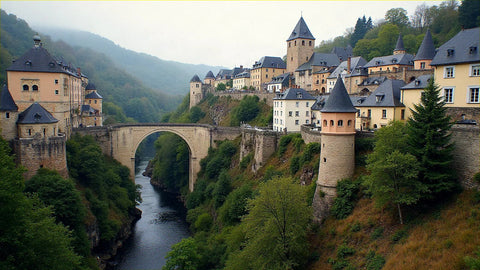
That number is low for a very specific reason: Luxembourg is a country of about 2,586 km², smaller than the province of Gipuzkoa. The capital can be explored on foot, the historic center fits into a morning stroll, and distances between cities are counted in minutes, not hours. There are no eternal journeys where you kill time with videos, which is precisely what drives up data bills in large destinations.
Before deciding, keep in mind three things that apply to any destination and which I explain in depth in the general guide on how much data you need for travel:
- Your at-home consumption doesn't translate directly. When traveling, you use your phone less than you think, because you're looking at the city.
- Wi-Fi does half the work. Hotels, cafes, museums, and central squares cover a good part of the day.
- It's better to run short and recharge than to buy too much and waste half of it.
If you leave this section with only one idea, let it be this: for a short trip to Luxembourg, the minimum package is usually enough.
Honest warning: Luxembourg is in the EU, and your plan already works there
I have to tell you this, even if it's not to my advantage. Luxembourg is a founding member of the European Union, so if your line is Spanish (or from any EU country), the Roam Like At Home principle applies to you: you use your data in Luxembourg at the same price as at home, without surcharges. Regulation (EU) 2022/612 extended this system until 2032, with a fair use policy designed to prevent anyone from living permanently outside their country with a plan from another.
In other words: if you come from Spain with a normal plan, you probably don't need to buy anything at all. Check it before you spend a single euro.
I'd rather you not buy a package from me and come back in two years for a trip to Japan, than sell you 5 GB for a weekend in a country where your plan already works.
However, there are real cases where it does make sense to have separate data:
- Your line is not from the EU: United Kingdom after Brexit, Switzerland, Latin America, United States, Asia. In these cases, the surcharge for connecting outside your country can be brutal.
- Your plan limits gigabytes outside your home country. Many cheap plans offer 40 GB in Spain but only a few GB when abroad. Check the fine print.
- You are traveling for work and don't want to use up your personal line's allowance on video calls.
- You want a secondary security line in case you run out of credit or there's an issue with your operator.
If you want a complete comparison of options for connecting there, you can find it in internet in Luxembourg. Here I focus on gigabytes.
Why you spend less than you think in Luxembourg
There are destinations that inflate consumption for very tangible reasons: four-hour bus rides, camera translators to read every menu, essential taxi apps, maps that freeze. Luxembourg is the opposite case, and that's why the final number is lower.
First, Wi-Fi density. It is one of the countries with the highest per capita income in the world, and that is noticeable: hotels, cafes, museums, and stations have decent connections. In addition, the capital's city council and Esch-sur-Alzette offer free public network (the historic HOTCITY), with access points in central squares like Place d'Armes and Place Guillaume II, and an expansion of 44 points in Kirchberg and 21 in Belval. You connect by selecting CITYLUXFREE networks in the capital or CITYESCHFREE in Esch.
Second, you don't need paid apps to get around. In many countries, you download the metro app, create an account, enter your card details, generate a QR code for each journey... all that consumes data and time. Not here: public transport is free, and you just hop on.
Third, the distances are ridiculous. From the old town to the Kirchberg district takes minutes. From the capital to Vianden or Echternach, less than an hour. There are no long travel gaps to fill with video, which is what truly devours gigabytes.
Adding the three things, the actual daily expense is well below the European average for a normal tourist.
How much each activity truly consumes
Let's get to the numbers, which is what you came here for. These figures are contrasted orders of magnitude and vary depending on video quality, network, and app settings, but they serve perfectly for calculation:
| Activity | Approximate consumption | On a short trip |
|---|---|---|
| Maps and navigation (Google Maps) | 5-10 MB per hour | Almost irrelevant |
| WhatsApp text messages and audios | Less than 5 MB per hour | Almost irrelevant |
| WhatsApp voice call | ~1 MB per minute (60 MB/hour) | Low |
| WhatsApp video call | 5-12 MB per minute | High |
| Work video call (Meet, Teams, Zoom) | 200-600 MB per hour | Very high |
| Social media with video (Instagram, TikTok) | ~700 MB per hour | Very high |
| Uploading photos from phone | 3-5 MB per photo | Medium |
| Music streaming (Spotify) | ~150 MB per hour | Medium |
| Video on demand (Netflix, YouTube) | 500 MB - 1 GB per hour | Very high |
| Searching for restaurants, reading news, email | 10-30 MB per hour | Low |
Notice the pattern: what consumes data is not traveling, it's video. Maps, which everyone fears, are among the cheapest things on the list. A whole week navigating two hours a day will only use about 100 MB.
If you want the full breakdown by application, I have it detailed in the mobile data usage statistics by activity. And the practical conclusion is always the same: if you control video, you control the bill.
A typical day in Luxembourg, broken down
Let me put together a realistic day for a tourist in the capital, not counting what you do connected to the hotel Wi-Fi at night. This is the consumption that truly comes from your data plan:
| Time of day | What you do | Consumption |
|---|---|---|
| Morning | Maps to get to the old town, 1 hour | 10 MB |
| Morning | 20 bus and train schedule queries | 5 MB |
| All day | WhatsApp: messages, audios and 15 photos to the group | 70 MB |
| Lunch | Search for a place, read reviews, email | 25 MB |
| Afternoon | Social media with video, 20 minutes | 235 MB |
| Commutes | Music streaming, 30 minutes | 75 MB |
| Total for the day | — | ~420 MB |
And now the important part: that day includes 20 minutes of scrolling with video, which is more than half of the total. If you're someone who doesn't open Instagram during the trip, that same day would only use about 150 MB. Three times less.
That's why I give two figures instead of one: 1 GB for three days if your phone is mostly for maps and messages, and 2 GB if you're into video. The difference between these two profiles isn't the destination, it's what you do with your thumb while waiting for the bus.
Transport is free: the app you will use
This is the most interesting fact about Luxembourg to me, and it also changes your data consumption: since March 1, 2020, it was the first country in the world to make all public transport free nationwide. Buses, trams, and trains, no ticket required, and not just for residents: also for cross-border commuters and tourists. The only exceptions are first-class train travel and associated passes, which remain chargeable.
What does that mean for your gigabytes? Two opposing effects that almost cancel each other out:
- You save all the consumption of ticket sales apps, registrations, payment gateways, and QR codes. There's nothing to buy.
- You spend a little more checking schedules, because since it's free, you move around a lot more: you hop on a bus for three stops, change your plans on the fly, head to a village just because.
The official reference app is the Luxembourg public planner (mobiliteit.lu), which combines bus, tram, train, and walking routes into a single plan, with real-time information on incidents, works, and diversions. Consulting it costs next to nothing: we're talking about a few MB a day even if you open it twenty times.
My advice: download the map of the area in Google Maps before leaving the hotel and save the schedule app for real-time queries. This way, you'll move like a local without noticing the expense.
Old town, Bock casemates and Wi-Fi: where you won't spend
There's a very specific detail about Luxembourg that works in your favor: a good part of what you'll visit is underground or inside buildings with their own connection. The Bock casemates are a labyrinth of galleries carved into the rock; the old town and fortifications have been a UNESCO World Heritage site since 1994. And underground, quite simply, there's no data to spend.
| Place | Wi-Fi available | Mobile coverage | What to do |
|---|---|---|---|
| Hotel or apartment | Yes, almost always good | Good | Downloads, backups, and long video calls here |
| Place d'Armes, Place Guillaume II | Yes, free public network | Good | Connect and don't touch your data plan |
| Bock casemates | Wi-Fi at the attraction | patchy in the galleries | Have the map downloaded; don't count on signal |
| Kirchberg and Belval | Yes, extended public network | Good | Ideal for working without spending |
| Museums and Philharmonie | Yes in several of them | Good | Take the opportunity to upload the day's photos |
| Routes through Mullerthal or the Sûre valley | No | Variable in wooded areas | Route and map downloaded before leaving |
The takeaway is clear: for 80% of your trip, Wi-Fi is just a step away, and for the other 20% (underground, trails), there's either no signal or you don't need it because you're not looking at your phone. This means your data package will go unused more often than you think, and that's precisely why I recommend going for the lower end here.
Business trip, European institutions and video calls
Luxembourg doesn't live off tourism: it lives off banking, investment funds, and European institutions. The European Court of Justice, the Court of Auditors, the European Investment Bank, and part of the Parliament are in Kirchberg. If your trip is for business, your consumption profile is nothing like that of a tourist.
Here, video calls are king. With 200 to 600 MB per hour, two one-hour daily meetings will consume between 0.4 and 1.2 GB per day, more than what a tourist spends in three days. Add screen sharing, uploading a couple of heavy documents, and using your phone as a hotspot for your laptop, and you easily reach 1.5 GB daily.
What I would do on such a trip:
- Long meetings, over Wi-Fi. Business hotels in Kirchberg and the city center have ample connection.
- Lower the camera to standard definition when using mobile data. You save half without anyone noticing.
- Join meetings with audio only if you're not presenting. A voice call costs a tenth of the same with video.
- Count 5 GB for three days if you're going to truly work from your phone, not 1 GB.
With that discipline, a one-week business trip can easily be managed with 8 GB, with plenty of margin for a last-minute surprise on Thursday afternoon.
Luxembourg as a stop on a route through Belgium, Germany and France
Here's the most common scenario: almost no one flies only to Luxembourg. You arrive by car or train from Brussels, Trier, Metz, or Strasbourg, spend two nights, and then continue your journey. That is, your trip isn't "Luxembourg": it's "Benelux and surroundings."
That completely changes the purchase. It makes no sense to have a single-country package for two days and then a different one when crossing the border, especially when borders here are crossed without you even realizing, and your phone can connect to a German or Belgian antenna from Luxembourg itself.
Three rules for multi-country routes:
- A regional European package always beats three national packages, in price and headaches.
- Add up the days of the entire route, not just each country. Ten days between Brussels, Luxembourg, and Trier means ten days of data, not three separate segments.
- Distribute your consumption wisely: in Luxembourg, you'll spend little, so the bulk of your gigabytes will go to long journeys and large cities.
For a 10-day route through that area, with normal use of maps, messaging, and some social media, 5 GB is the figure that works for almost everyone. If you're into video, go up to 10 GB. If you only need to cover the Luxembourgish leg because the rest is already sorted, check out the specific country page and stick with the smallest package you can find.
How many GB per profile and duration: the important table
This is the table from the article. Find your profile, cross-reference it with the number of travel days, and you'll have your number. I've included the 2-3 days column because that's how long a visit to Luxembourg truly lasts, although I also give longer durations in case you combine it with a European route or settle for a period.
| Profile | 2-3 days | 5 days | 10 days | 15 days | 30 days |
|---|---|---|---|---|---|
| Maps and WhatsApp tourist | 1 GB | 1 GB | 2 GB | 3 GB | 5 GB |
| Photos and social media | 2 GB | 3 GB | 5 GB | 8 GB | 15 GB |
| Digital nomad or remote worker | 5 GB | 8 GB | 15 GB | 20 GB | 40 GB |
| Family sharing a phone | 3 GB | 5 GB | 10 GB | 15 GB | 25 GB |
A couple of important nuances to read it correctly:
- The table assumes you sleep with Wi-Fi. If your accommodation doesn't have it, go up one step.
- "Family sharing" means one mobile acting as a hotspot for children's tablets. If each person has their own line, apply the individual profile to each.
- For stays of 30 days, we are no longer talking about tourism: if you are going to live or work there, consider a local line instead of a travel package.
And the rule that summarizes everything: in Luxembourg, always round down. It's one of the very few destinations where I tell you this without fear, because the country's connection infrastructure has your back.
Calculate your actual consumption, stretch it, and what to do if you run short
All the above are averages. Your actual number is on your own phone, and it takes a minute to see it. On Android, go to Settings, Connections or Network, and Data Usage; on iPhone, go to Settings and Mobile Data, with details per app. Look at the consumption for the last full month, divide it by 30, and you have your daily average.
My rule for Luxembourg: take your daily average at home, multiply it by the number of travel days, and subtract a third. You'll spend more time outside looking at fortifications and less time looking at the screen, and you'll almost always have Wi-Fi handy.
To stretch what you buy, four gestures that really work:
- Download offline maps of the capital and the area you're going to explore before you leave. GPS works without data.
- Photo backups, Wi-Fi only. This is the number one invisible expense: uploading 200 photos at once can easily take 1 GB.
- Disable automatic video playback on Instagram, TikTok, X, and Facebook, and lower streaming quality.
- Activate system Data Saver and limit background usage for apps you don't need.
You have more tips in the guide on how to save mobile data while traveling. And if you run short, don't worry: nothing dramatic is cut off, you simply top up in two minutes from any Wi-Fi. That's why I insist that running short is cheaper than overspending: what you don't use doesn't come back.
Frequently asked questions
Do I need to buy data if I'm going to Luxembourg from Spain?
Most likely, no. Luxembourg is an EU country, and your Spanish tariff works there at national prices thanks to EU regulations extended until 2032. Just check two things in your contract: how many gigabytes you can use outside Spain and if you have any fair use limitations.
How many GB do I need for a weekend in Luxembourg?
1 GB is more than enough for two or three days. A day as a tourist with maps, messages, and some searching is around 150 MB; if you also scroll with video, it goes up to about 420 MB daily, and then 2 GB is advisable. Both are small packages.
Do maps consume data while I walk through the old town?
Very little: between 5 and 10 MB per hour of navigation. It's one of the cheapest things there is. Even so, download the city map before you go, because in the underground galleries of the casemates, coverage is irregular, and you'll appreciate having the route saved on your phone there.
Is public transport really free for tourists?
Yes, since March 1, 2020, throughout the country. Luxembourg was the first in the world to do so on a national scale, and it applies to residents, cross-border workers, and visitors. Only first-class train travel is still paid. For you, this means zero ticket apps and zero data spent buying them.
What if I also go to Belgium, Germany, or France?
Buy a regional European package, not one per country. Add up all the days of your trip and choose based on the total: about 5 GB covers ten days of travel with normal use. Changing packages at each border is not worth it in terms of price or convenience, and borders are crossed constantly here.
How does this digital card thing work if I've never used it?
It's a card that installs on your phone without changing anything physical. You activate it by scanning a code, and your usual number continues to work in parallel. If it's your first time, I explain it step-by-step in what an eSIM is, including phone compatibility requirements.
What happens if I run out of data halfway through my trip?
Nothing serious: you top up from any Wi-Fi in a couple of minutes. And in Luxembourg, you have free public Wi-Fi in the central squares of the capital and in Esch-sur-Alzette, in addition to hotels and museums. That's why I always prefer to buy short and extend rather than paying for gigabytes you won't use.
Conclusion
To sum up without embellishment: 1 GB for three days, 2 GB if you watch videos, and 3 GB for a week. If you travel for work with daily video calls, 5 GB for a long weekend and 8 GB for the week. And if your line is from the European Union, the most honest thing I can tell you is to check your contract first, because you might not need to buy anything.
If you still want a separate data line (because you're coming from outside the EU, because your tariff caps your gigabytes when you leave, or because you don't want to depend on anyone), PuraSIM's eSIM for Luxembourg gets you activated in five minutes from your couch. Choose the smallest package that suits you, save the top-up link, and dedicate your trip to looking at the Alzette valley instead of the screen. That is, ultimately, the best possible data plan.