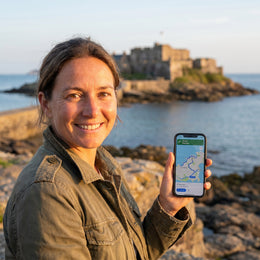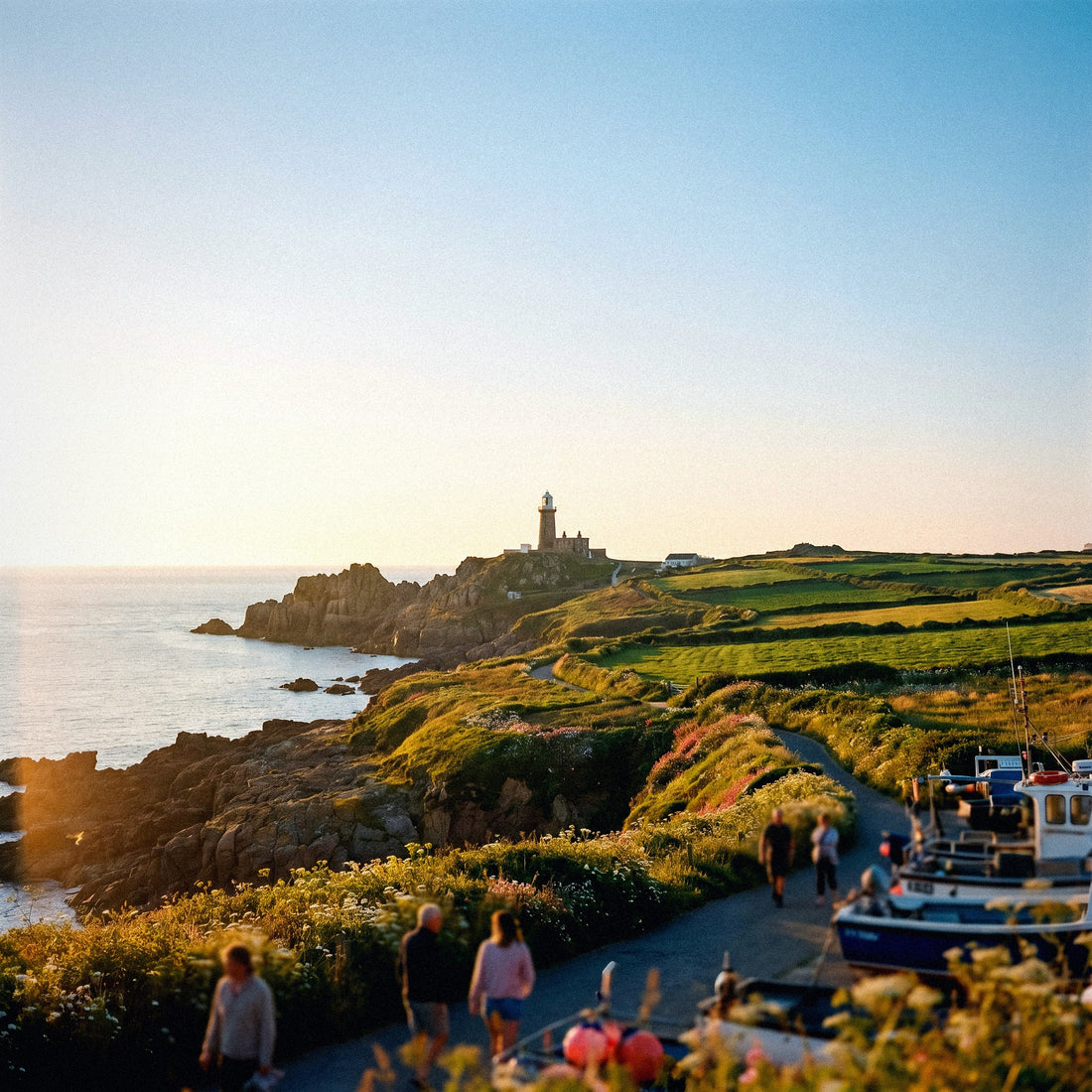
If you're wondering how many GB you need for Guernsey, I'll tell you right now: probably far less than you imagine. Guernsey is an island of just over 60 km², English is spoken, almost everything is within fifteen minutes, and a good part of your trip will be spent walking along cliffs or on a ferry heading to Herm or Sark. You won't use data there. Here's the specific figure, why, and how to fine-tune it for your trip.
The short answer: how many GB for Guernsey
For a 3 or 4-day trip to Guernsey, 1 GB is more than enough for most people. If you live on Instagram, upload videos, and make video calls daily, 3 GB. Only if you work from the island or share data with your family does it make sense to go over 5 GB.
I know this contradicts what half the internet sells you, where the recommended package always seems to be 20 GB. But Guernsey is a destination for little mobile use and a lot of walking boots: the entire island can be crossed in half an hour by car, Saint Peter Port can be explored on foot, and the main attractions (Victor Hugo's house, German occupation bunkers, the southern cliff paths, a day trip to Herm) are things you do with your phone in your pocket.
The figure only goes up for three reasons: if you record and upload a lot of video, if you telework from your accommodation without using Wi-Fi, or if you're sharing the connection with more people. If that's not your case, buying 10 GB for four days is a waste of money: you'll return home with 80% unused.
If you're combining Guernsey with Jersey, the UK, or France, then this calculation no longer applies: check the general hub on how much data you need for travel and add up the days for each segment before deciding.
Why you use less data than usual in Guernsey
Each destination has its own "data consumption coefficient," and Guernsey's is low. There are four specific reasons, all of which work in your favor:
- English is spoken. No need for a camera translator pointing at every restaurant menu, or photos of signs to decipher. That habit, in Japan or Greece, eats up hundreds of MBs a day. Here, zero.
- Distances are tiny. No internal journey takes more than about twenty minutes. GPS navigation itself uses very little data (about 3-5 MB per hour), but you'll only use it in short bursts, not for hours on the road.
- Abundant Wi-Fi where it matters. Hotels, guesthouses, cafes, and restaurants in Saint Peter Port usually have Wi-Fi, so heavy downloads (maps, series, backups) can be done for free.
- The plan is to be outdoors. A day of cliffs, beaches, or markets is not a day spent on a screen.
Where it's wise not to be overconfident is in preparation: ferry schedules to Herm and Sark, tides, and the bus website. These are light, but constant, queries. Even so, adding everything up, a normal tourist in Guernsey will use between 150 and 250 MB per day. Four days of that is less than 1 GB.
Important notice: Guernsey is not the UK or EU
This is what causes the most trouble, so I'll state it clearly: Guernsey is a British Crown Dependency, not part of the United Kingdom or the European Union. It has its own government and its own telecommunications regulator. Practical consequences:
- European "roaming like home" does not apply. Your Spanish tariff's gigabytes don't travel here via the EU, because the EU has no jurisdiction in Guernsey.
- It also doesn't count as the UK in many tariffs. And this is the expensive mistake: you assume your UK bundle covers you, but it turns out your operator classifies Guernsey in another zone.
According to what the operators themselves publish, Movistar places Guernsey in its Zone 2 (along with Jersey and the Isle of Man) and Vodafone puts it in its Zone 7 with temporary promotional conditions. These classifications change every season and with every tariff, so don't trust what you read in any blog, not even this one: log into your customer area and search literally for "Guernsey" before leaving home.
The clean way to avoid this problem is to pre-contract local data, with a fixed price and no surprises on the bill. I break down how each option works in the internet in Guernsey guide; here we continue with what matters to you, which is getting the right size.
How much data each activity consumes, in figures
Before choosing a package, it's worth knowing where your megabytes really go. These are approximate figures for typical mobile consumption; they vary with connection quality and app settings, but they serve as a guide for calculation.
| Activity | Approximate Consumption | Translated to your trip |
|---|---|---|
| GPS Navigation (Google Maps, Waze) | 3-5 MB/hour | A whole week of maps: less than 50 MB |
| Searching for places, ferry schedules, tides | 10-25 MB/hour | About 20 MB per day |
| WhatsApp text only | 1-3 MB/hour | Practically free |
| WhatsApp with audio and photos | 20-30 MB/day | A day's family group chat |
| Video call (WhatsApp, FaceTime) | 200-400 MB/hour | 10 min/day ≈ 50 MB |
| Scrolling social media with video (TikTok, Reels) | 700-900 MB/hour | 10 min ≈ 130 MB. The big data hog |
| Uploading a photo to stories or a group | 3-5 MB per photo | 10 photos ≈ 40 MB |
| Uploading a short video (30 s) | 30-60 MB | Three videos ≈ 150 MB |
| Music streaming | 40-150 MB/hour | Download at the hotel and save everything |
| HD video (Netflix, YouTube) | 1-3 GB/hour | One movie eats your entire package |
| Email and web browsing | 10-25 MB/hour | Irrelevant unless you're working |
The takeaway is always the same: video dominates, and everything else is loose change. Maps, messages, and searches combined rarely reach 60 MB per day. If you want a detailed breakdown, you can find it in the data usage statistics by activity.
A typical day in Guernsey, megabyte by megabyte
Let's plan a realistic day: you arrive at your accommodation, have breakfast in Saint Peter Port, visit Hauteville House (Victor Hugo's home), eat by the harbor, in the afternoon you visit the German occupation bunkers and batteries or a section of the cliff paths, and in the evening you have dinner and talk to family back home.
| Time of Day | What you do with your phone | Data |
|---|---|---|
| Morning | Map to the parking lot, check bus schedules | 10 MB |
| All day | WhatsApp: messages, a couple of audios, photos to the group | 25 MB |
| Midday | Search for restaurant, tides, tickets, some web browsing | 20 MB |
| Downtime | 10 minutes of social media scrolling | 90 MB |
| Evening | Upload 10 photos to stories | 40 MB |
| Daily Total | — | ≈ 185 MB |
Multiply that: 4 days is about 740 MB. That's why 1 GB is the honest figure for the classic short break, with room for an odd day. And notice the most repeated detail: ten minutes of vertical video weighs more than everything else combined. If you're someone who spends half an hour in bed before sleeping, add 250-300 MB daily, and you're already looking at 3 GB.
Also, be mindful of what happens without you seeing it: automatic photo backup. A day on the cliffs with 120 photos and three videos can try to upload 1.5 GB all at once. Always do that over Wi-Fi at night.
Herm, Sark, and the ferries: hours when you don't use data
Here's the most beautiful peculiarity of Guernsey and, incidentally, the one that most reduces your data bill. The neighboring islands are visited by ferry from Saint Peter Port, and their coverage depends on the signal they receive from Guernsey.
| Location | Expected Coverage | What to do |
|---|---|---|
| Guernsey (Saint Peter Port and center) | Good; 5G rollout underway since 2026 | Normal usage |
| Southern cliffs and coves | patchy, with dead spots | Download map before leaving |
| Herm | Basic, sufficient for messages | Don't count on video |
| Sark | Very limited | Notify home before boarding |
| Ferry crossing | Comes and goes; risk of jumping to French network | Airplane mode or manual network selection |
Sark deserves a separate paragraph: there are no cars (you get around by bike, on foot, or by horse-drawn carriage) and in 2011 it was declared the world's first Dark Sky Island, precisely because it has no public lighting. In other words: a place designed so your mobile is useless.
In Sark, the best screen is the sky. I would go with the trail map downloaded, the camera charged, and data turned off: you won't be able to use it anyway, and it's one of the few places in Europe where that's appreciated.
Count, at a minimum, on a full day trip to the neighboring islands consuming almost nothing. That, on a four-day trip, is 25% less data.
How many GB according to your profile and number of days
This is the important table. Find your profile, cross-reference with the days, and there's your number. I include the 3-4 day column because that's the actual duration of almost all visits to Guernsey.
| Profile | 3-4 days | 5 days | 10 days | 15 days | 30 days |
|---|---|---|---|---|---|
| Tourist using maps and WhatsApp | 1 GB | 1 GB | 2 GB | 3 GB | 5 GB |
| Photos and social media | 3 GB | 3 GB | 5 GB | 8 GB | 15 GB |
| Digital nomad / remote work | 5 GB | 8 GB | 15 GB | 20 GB | 40 GB |
| Family sharing one mobile | 3 GB | 5 GB | 8 GB | 12 GB | 20 GB |
A couple of notes on these figures. The remote work profile assumes actual video calls and screen sharing; if your accommodation has decent Wi-Fi (normal in Saint Peter Port), you can drop a whole tier and use data only as a backup. And the family profile assumes one person acts as a hotspot for children's tablets and mobiles, which is where gigabytes evaporate without anyone knowing how: a couple of streaming cartoons on the ferry and goodbye to the package.
If you're still unsure which plan to buy or how to activate it, first check out the eSIM for Guernsey guide, which covers the technical aspects and island coverage.
How to calculate your own consumption before leaving
Tables are great, but you have the real data in your pocket. Your mobile has been measuring exactly how much data you spend for months, and you just need to read it:
- iPhone: Settings > Mobile Data. Scroll down to "Current Period" and see the total and breakdown by app. If you've never reset the statistics, the number will be cumulative from years ago: tap "Reset Statistics" and check again in a week.
- Android: Settings > Network & internet > SIMs > App data usage. You can set the monthly cycle and see which app is consuming the most.
With a normal month's consumption, divide by 30 to get your daily average. Now apply the Guernsey adjustment: subtract between 30% and 50%, because at home you consume data on your way to work, on the subway, and on the sofa, while there you'll be walking along cliffs with no coverage for half the day. Multiply by the number of travel days and round up to the next package.
Real example: if at home you spend 6 GB a month, your average is 200 MB a day; in Guernsey it will be about 120-140 MB, and four days is half a gig. With 1 GB you'll be more than covered. This calculation is worth more than any generic recommendation, including mine, because it's based on your habits and not those of the average tourist.
How to make your data last on the island
If you still want to go with the smallest possible package, these adjustments are the most effective. They can be done in five minutes the night before, connected to your home or hotel Wi-Fi.
| Adjustment | Where to change it | How much it saves |
|---|---|---|
| Download offline map of Guernsey | Google Maps > profile > Offline maps | Almost all map usage, and works in Sark |
| Photo backups only on Wi-Fi | Google Photos / iCloud > Settings | 0.5-2 GB per trip |
| Disable video autoplay | Instagram, X, Facebook > Data usage | 200-500 MB per day |
| Video quality in data saver mode | YouTube, Netflix > Settings | From 3 GB/hour to about 300 MB/hour |
| System data saver mode | Mobile settings | 20-30% of total |
| Download music, podcasts, and series beforehand | Spotify, Netflix, on Wi-Fi | Up to 1 GB per journey |
| Manually fix network on the ferry | Settings > Mobile data > Network selection | Avoid jumping to French networks |
That last point is specific to here: the Normandy coast is only a few dozen kilometers away, and on open sea, your mobile might connect to a French network without warning. If your plan only covers the islands, you'll run out of data without understanding why; if you have active roaming from your Spanish operator, it could be expensive. Disable automatic network selection while crossing and you're good to go. You can find more tips in the guide on how to save data while traveling.
What happens if you run out
No big drama, and this is exactly why I recommend buying a small package. When a prepaid plan runs out of data, you simply stop browsing: no bill is triggered, and you're not charged extra. You still have the hotel's Wi-Fi, the cafe's, and almost any restaurant's in Saint Peter Port, and from there you can top up in a couple of minutes.
Compare the two scenarios. If you buy 1 GB and run out on the last day, you top up and lose a few extra euros. If you buy 10 GB "just in case" and use 700 MB, you've wasted 90% of your money and you won't get it back: data doesn't travel with you to your next trip. It's simple math, even if your gut tells you otherwise.
My work order for Guernsey, in three steps:
- Start with 1 GB if you're going for 3-4 days with normal use.
- Monitor your consumption on the second day. If you've used less than half by mid-trip, you know you'll make it.
- Only top up if necessary, from your accommodation's Wi-Fi.
And a basic precaution before leaving: check that your phone is compatible and install the line from home, using your own connection's Wi-Fi. If this is your first time with this format, the full explanation is in what an eSIM is. Arriving at the airport with everything done is half the battle.
Frequently Asked Questions
The most common questions I get about data in Guernsey, answered in two lines each.
How many GB do I need for 3 days in Guernsey?
1 GB is more than enough. A normal tourist uses about 185 MB per day for maps, WhatsApp, searches, and a bit of social media; three days is just over half a gigabyte. Only go up to 3 GB if you upload videos daily or make long video calls.
Do the gigabytes from my Spanish plan work in Guernsey?
It depends on your operator, and don't assume it does. Guernsey is not in the EU, so European roaming doesn't apply, and many plans don't include it within their UK zone either. Literally search "Guernsey" in your plan's terms and conditions before traveling.
Is there coverage in Sark and Herm?
Basic in Herm, very limited in Sark. Both depend on the signal they receive from Guernsey. Expect messages and little else; don't even try for video or live maps. Download the map before getting on the ferry.
Why does my phone connect to a French network?
Because Normandy is only a few tens of kilometers away. At sea and on the island's east coast, your phone might connect to a French network. Disable automatic network selection and manually choose the local network to avoid surprises.
Do I need data during the crossing to Herm or Sark?
No, and it's better not to use it. Coverage comes and goes, and that's precisely the stretch with a risk of network hopping. Airplane mode during the crossing, and enjoy the sea. It's better to check and screenshot return schedules before boarding.
Is there good connectivity in Guernsey?
Yes, and it's improving. The island has a solid mobile network in Saint Peter Port and in the center, and 5G rollout began in 2026, with Sark and Alderney planned afterward. In the southern cliffs and some coves, the signal is irregular.
Which package should I choose if I continue to Jersey or the UK?
One that covers all three locations, not three separate packages. Guernsey, Jersey, and the UK are distinct territories for coverage purposes. Check the plan's details for which areas it includes and calculate the GB by adding up the days for each segment.
What if I run out of data mid-trip?
You can top up from any Wi-Fi in two minutes. When a prepaid plan runs out, you simply stop browsing, with no surprise charges. That's why it's better to start small and extend than to buy too much: unused gigabytes are not refunded.
Conclusion
Guernsey is one of those destinations where the honest answer is small: 1 GB for a 3-4 day getaway is enough for 80% of people, 3 GB if you're into social media and uploading videos, and 5 GB or more only if you work remotely or share your connection with family. The island is small, English is spoken, there's Wi-Fi where you sleep, and a good part of your trip will be spent on a cliff or in Sark, where your phone simply won't work.
What I do ask is that you don't arrive without checking the fine print of your plan: as it's neither the UK nor the EU, it's the perfect place to get a bill shock. Local data contracted before leaving, fixed price, and then you can focus on what matters.
If you want to sort it out in five minutes, choose your size and leave home with the line already installed: check out the eSIM plans for Guernsey and start with the small package. If you run short, you top up; if you overbuy, you don't get it back.